
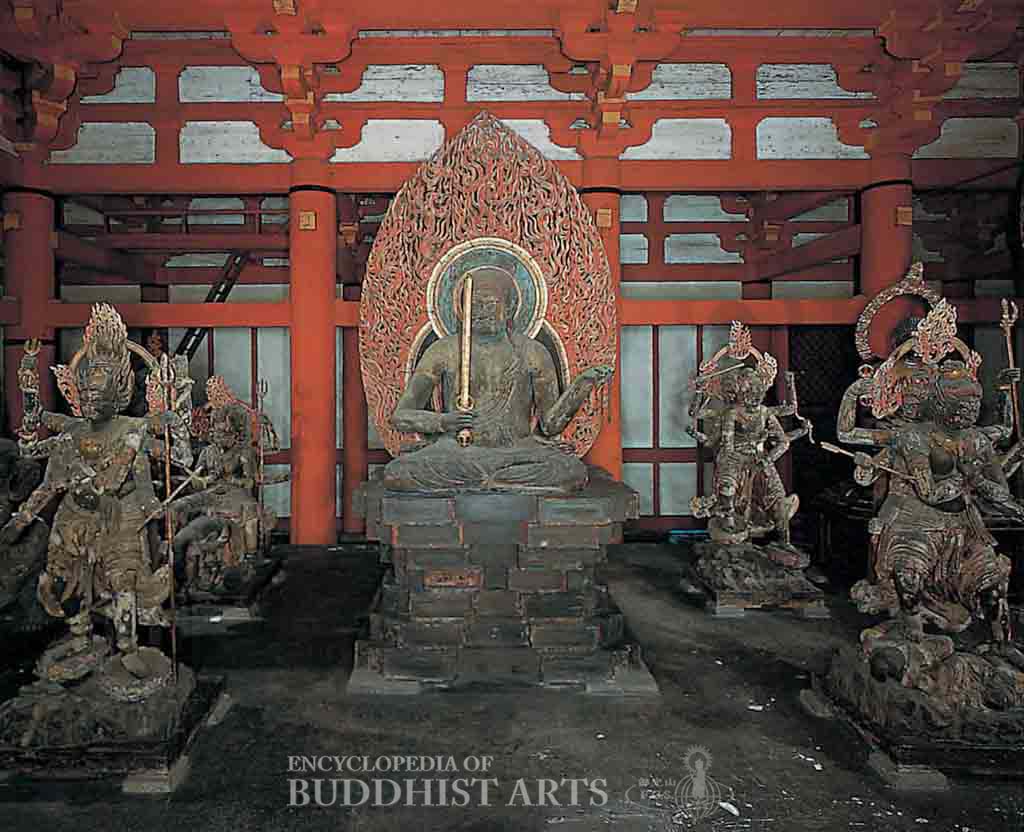
Toji Temple Lecture Hall: Five Wisdom Kings
Wood
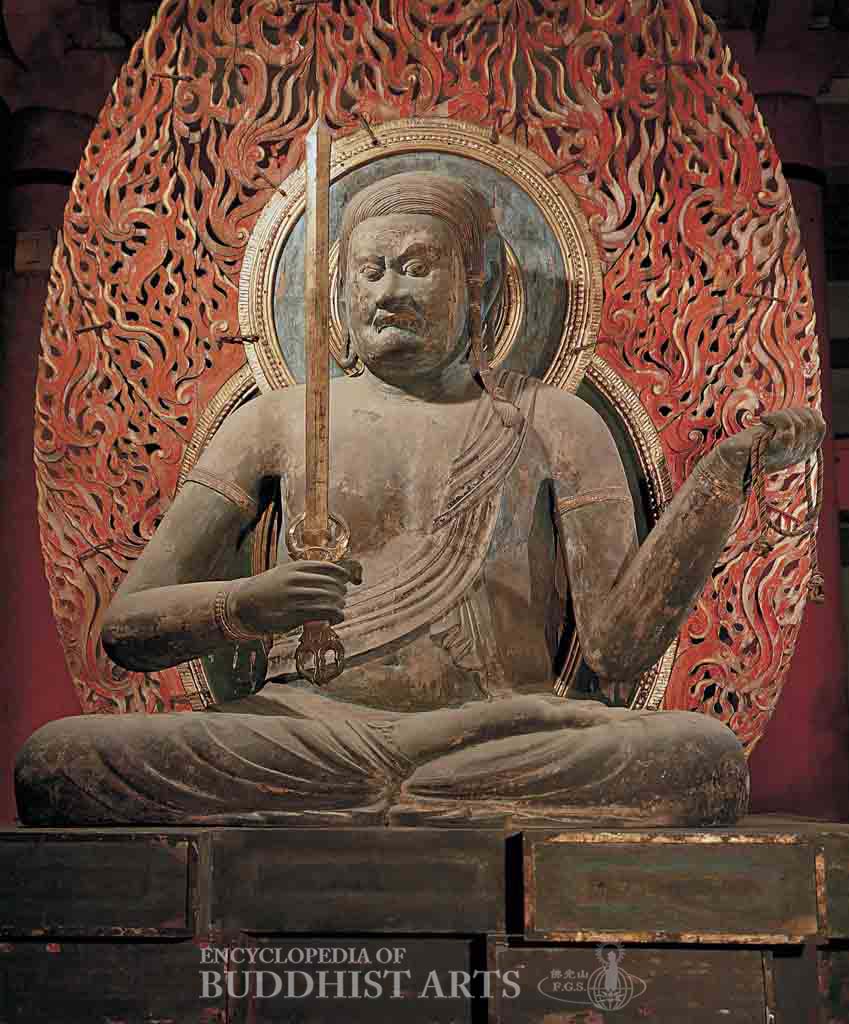
Toji Temple Lecture Hall: Five Wisdom Kings - Acala
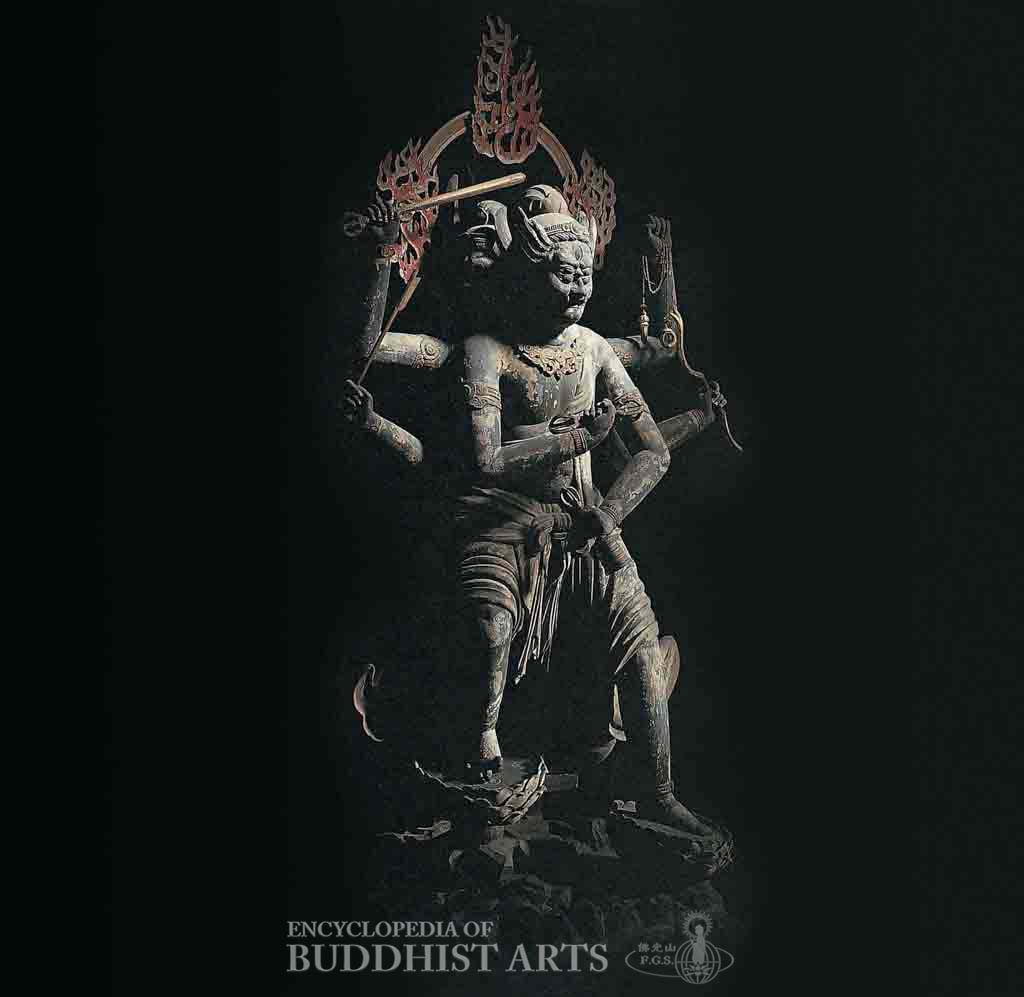
Toji Temple Lecture Hall: Five Wisdom Kings - Vajrayaksa
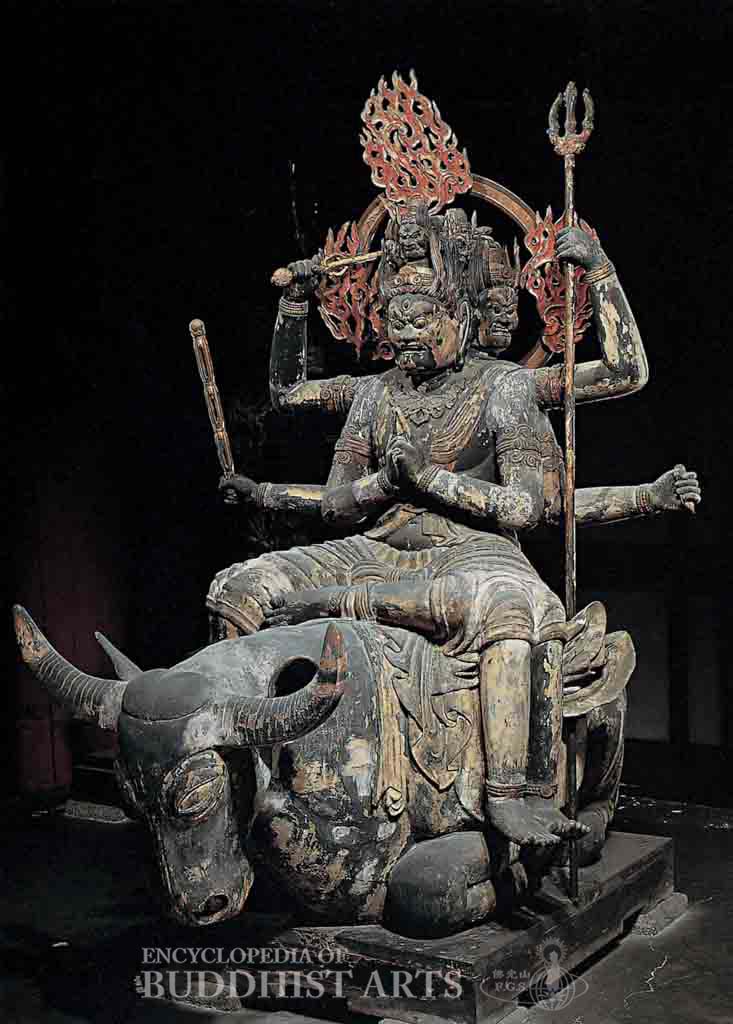
Toji Temple Lecture Hall: Five Wisdom Kings - Yamantaka
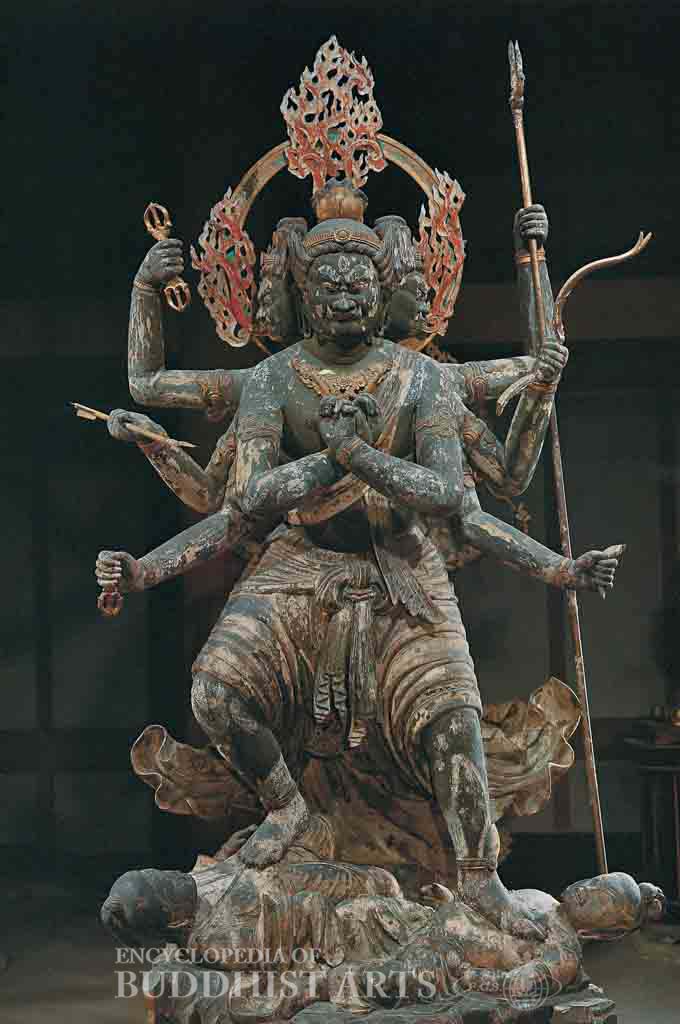
Toji Temple Lecture Hall: Five Wisdom Kings - Trailokyavijaya
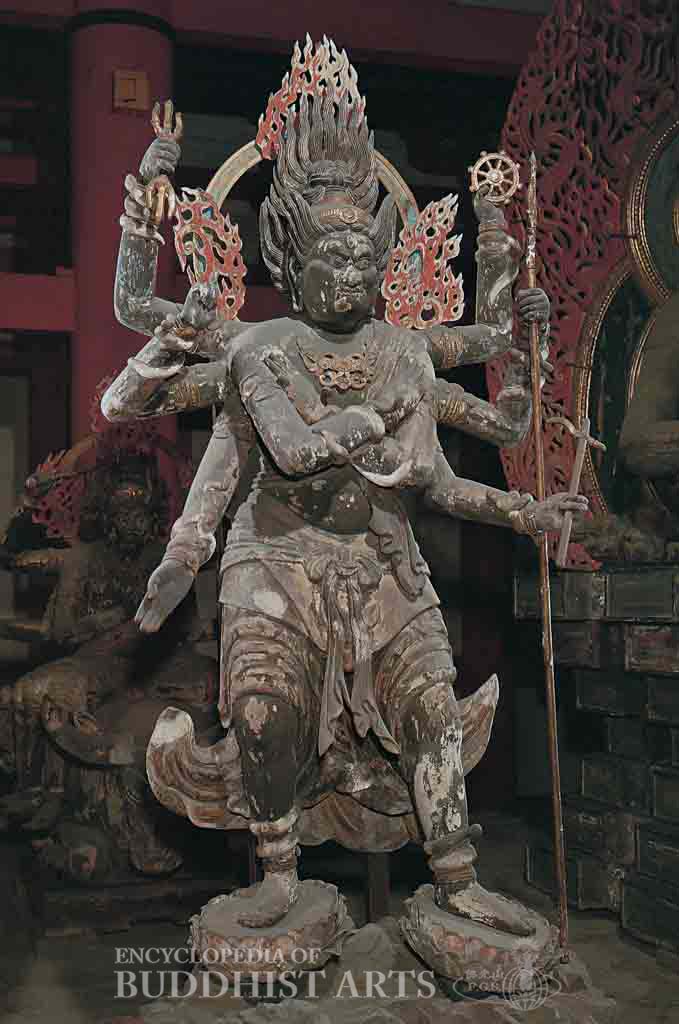
Toji Temple Lecture Hall: Five Wisdom Kings - Kundali
Toji Temple Lecture Hall: Five Wisdom Kings
JAPAN, Kyoto; Heian period
The Five Dhyani Buddhas manifest in wrathful forms as the Five Wisdom Kings according to Vajrayana teachings. These statues were commissioned by Emperor Ninmyo (reigned 833–850) and completed in 839. They are the earliest sculptures of these figures in Japan and were made according to the instructions of Shingon Master Kukai who based their images on the descriptions in the Vajrasekhara Sutra. The main bodies are carved from solid pieces of wood, with the hair and parts of the accessories produced in lacquer-work, which was then painted. The group was listed as a National Treasure in 1952.
The sturdy Acala is positioned in the center of the group. A braid of hair falls over his left shoulder. The right hand grasps a sharp sword with a three-pronged vajra hilt and in the left hand is a noose. The eyes glare angrily and the top fangs gnaw the lower lip. Behind him is a mandorla that encloses a radiating aureole and nimbus.
The remaining four kings form a square about Acala. Vajrayaksa has three heads, with two pairs of eyes and a vertical wisdom eye. His six hands brandish various weapons: a sword, weighted noose, bow and arrow, thunderbolt and vajra. He stands with one leg raised on lotuses of different heights. Yamantaka has six arms, six legs, and six heads, each with an eye in the middle of the frowning forehead, fang-like teeth, and bristling hair. Yamantaka rides on a kneeling buffalo and is backed by a fiery hollow nimbus. Trailokyavijaya and Kundali are also multi-headed and many-armed. They pose with their weapons in forceful attitudes, one tramples a corpse and the other is astride boulders.
For more details, go to the Encyclopedia of Buddhist Arts: Sculpture St-Z, page 1236.
Cite this article:
author = Hsingyun and Youheng and Lovelock, Yann and Chou, Yuan and Huntington, Susan and Edson, Gary and Neather, Robert,
booktitle = {Encyclopedia of Buddhist Arts: Sculpture St-Z},
pages = 1236,
title = {{Toji Temple Lecture Hall: Five Wisdom Kings}},
volume = 13,
year = {2016}}