
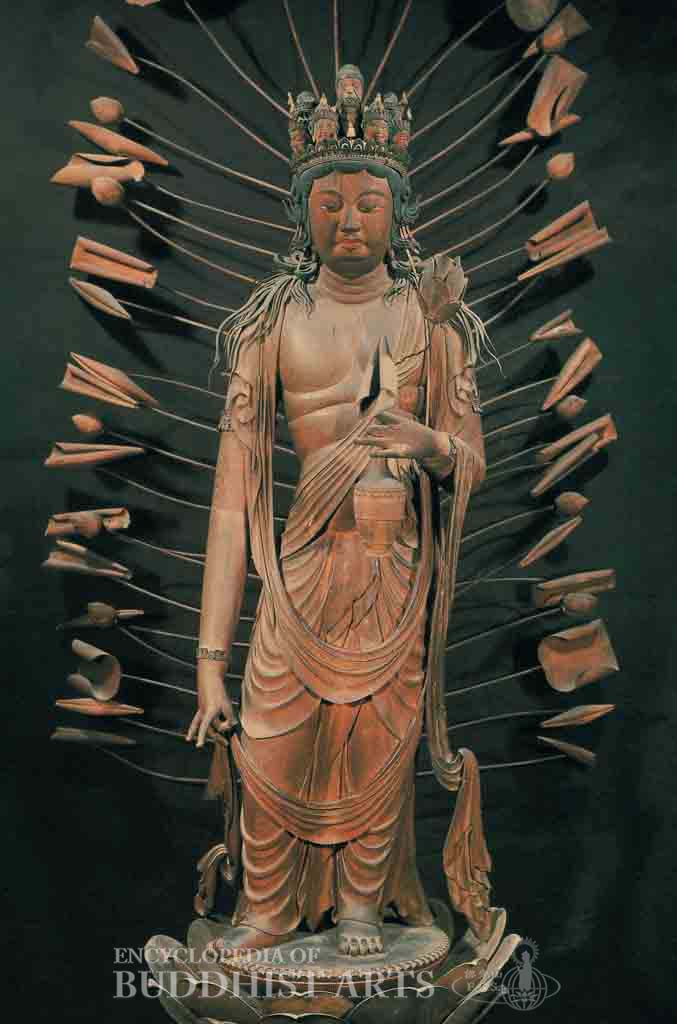
Hokkeji Temple Main Hall: Eleven-Headed Avalokitesvara
Nutmeg wood
Hokkeji Temple Main Hall: Eleven-Headed Avalokitesvara
JAPAN, Nara; Heian period
Sculpted in the late 9th century, the statue is recorded in the Origins of Kofukuji Temple as based on the image of Empress Komyo while she was taking a walk by a lotus pond. The statue was created by a sculptor from India. The statue is put on display for public viewing for only 15 days each year. It was listed as a National Treasure in 1951.
The upper body, apart from the eleven faces, the arms, and part of the stole, is carved from a single block of nutmeg wood. The carving has not been hollowed out, except for the back of the head which is fitted with a cover. The waist is slightly twisted to one side and the long right hand reaches to the knees, the fingers curled to grasp the stole. The weight of the figure rests mainly on the left foot, while the right foot advances beyond the edge of the lotus pedestal, where the lifted right toe gives the impression of walking. The lower robe and stole is adeptly carved to emphasize movement. The mandorla is unusual in that it is made of radiating lotus buds and curled lotus leaves.
The Bodhisattiva’s pupils are inlaid with copper, as was common in the Heian period (794–1185). The crown where the other heads cluster, the armlets, bracelets and strands of hair scattered on the shoulders are also made of copper. With the exception of all the heads, which are painted, the entire statue is made of plain wood.
For more details, go to the Encyclopedia of Buddhist Arts: Sculpture G-M, page 435.
Cite this article:
author = Hsingyun and Youheng and Lovelock, Yann and Chou, Yuan and Huntington, Susan and Edson, Gary and Neather, Robert,
booktitle = {Encyclopedia of Buddhist Arts: Sculpture G-M},
pages = 435,
title = {{Hokkeji Temple Main Hall: Eleven-Headed Avalokitesvara}},
volume = 11,
year = {2016}}