
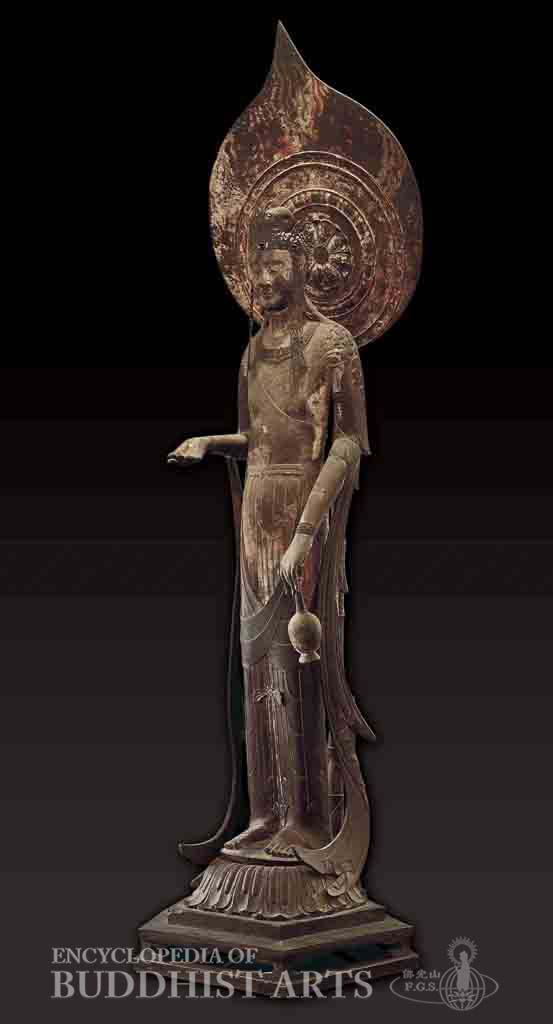
Horyuji Temple Baekje Avalokitesvara Hall: Avalokitesvara Bodhisattva
Camphor wood
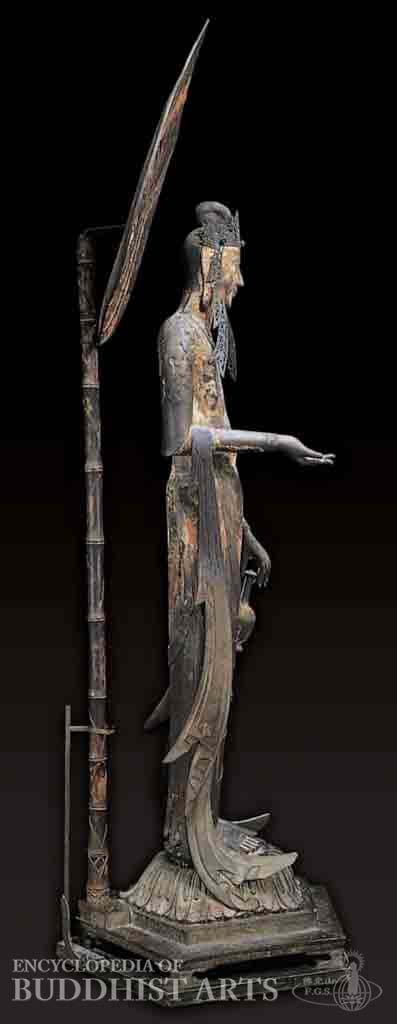
Horyuji Temple Baekje Avalokitesvara Hall: Avalokitesvara Bodhisattva (side)
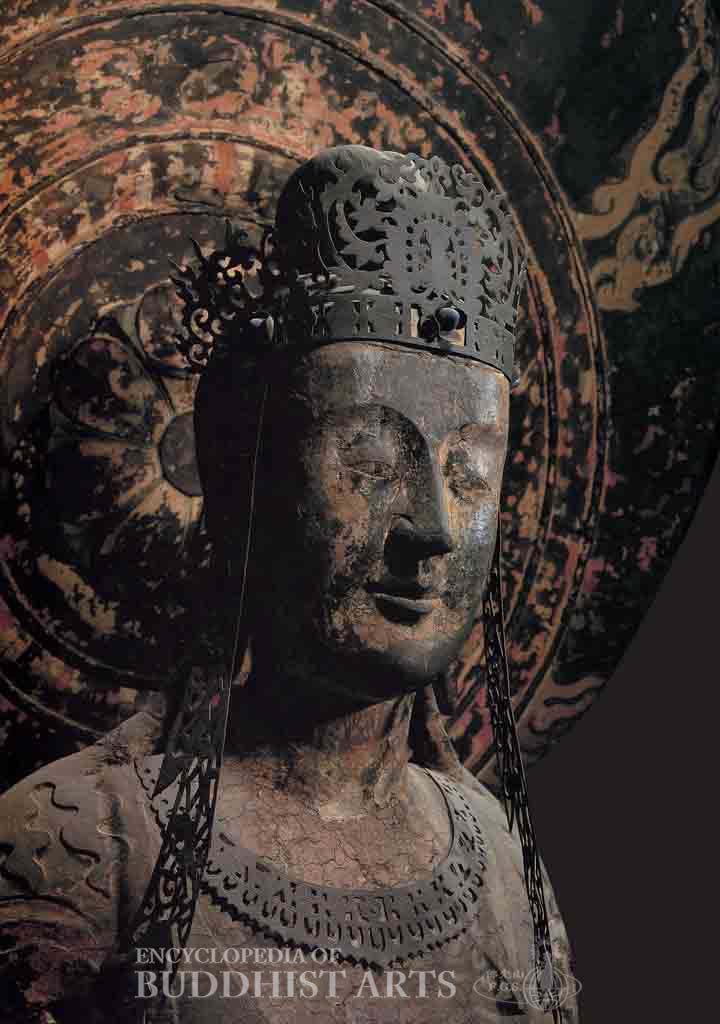
Horyuji Temple Baekje Avalokitesvara Hall: Avalokitesvara Bodhisattva (detail)
Horyuji Temple Baekje Avalokitesvara Hall: Avalokitesvara Bodhisattva
JAPAN, Nara, Ikoma; Asuka period
Also known as the Baekje Avalokitesvara, the statue is displayed in the hall named after it. However, the temple has few records relating to the figure. During the early Edo period (1615–1868), it was, for a time, believed to be Akasagarbha Bodhisattva. During the Meiji period (1868–1912), experts were finally able to see the presence of a Buddha on the headdress, thus identifying the figure as Avalokitesvara. Records dating to 1698 indicate that the statue originated from the Korean kingdom of Baekje (18 BCE–663 CE), but the wood used was local. So far, the statue’s origins remain a mystery. It was listed as a National Treasure in 1951.
Though the figure is mainly constructed from one piece of wood, the forearms are made from other wood. The interior is hollowed out from the back and the exterior is painted. The figure is slender and long, with the head and torso structured in a 1:7 ratio. The Bodhisattva’s hair is gathered in a topknot, and the crown has ribbons that fall to the shoulders. A lotus nimbus radiates outwards from behind the figure to a blazing flame shape. The face is full with small features and lips pressed lightly together. The Bodhisattva carries a vase in the left hand, while the right hand is held out with the palm up. The figure wears openwork ornaments and a stole. This design is indicative of artistic influences from the Southern Dynasties (420–589) of China.
For more details, go to the Encyclopedia of Buddhist Arts: Sculpture G-M, page 449.
Cite this article:
author = Hsingyun and Youheng and Lovelock, Yann and Chou, Yuan and Huntington, Susan and Edson, Gary and Neather, Robert,
booktitle = {Encyclopedia of Buddhist Arts: Sculpture G-M},
pages = 449,
title = {{Horyuji Temple Baekje Avalokitesvara Hall: Avalokitesvara Bodhisattva}},
volume = 11,
year = {2016}}