
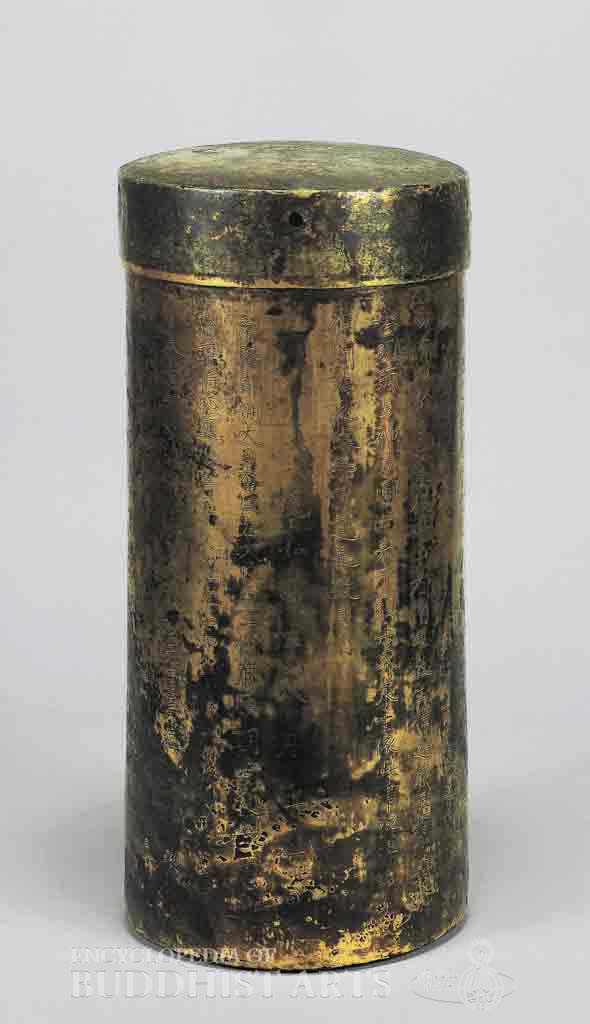
Kimpusen Sutra Mounds: Sutra Containers - Cylindrical Sutra Container
Gilt copper alloy
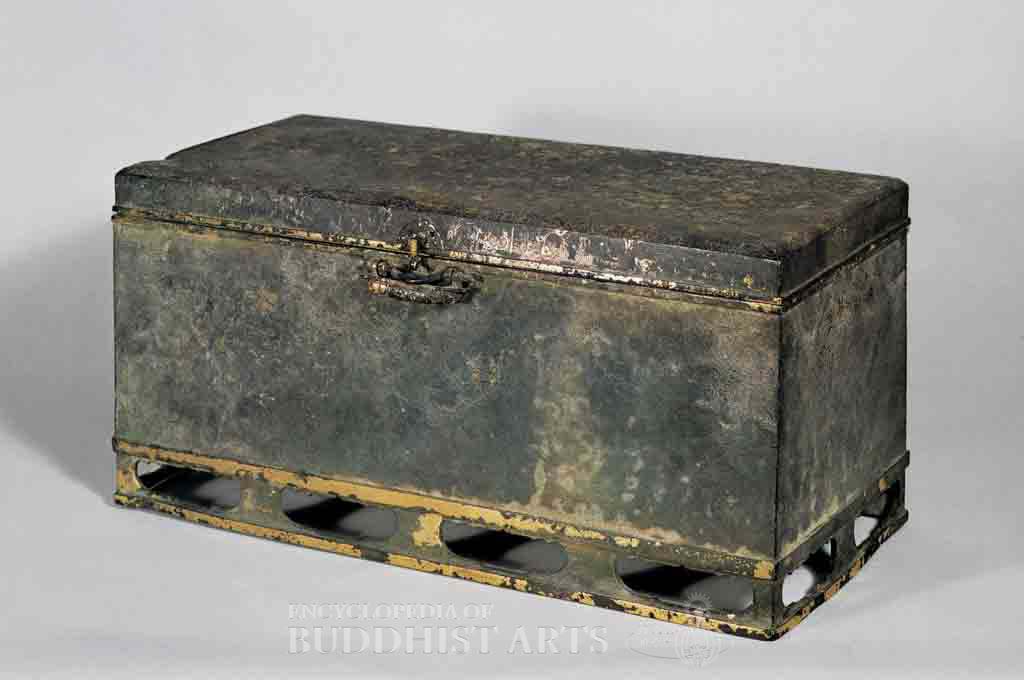
Kimpusen Sutra Mounds: Sutra Containers - Rectangular Sutra Box
Gold and silver plated copper alloy
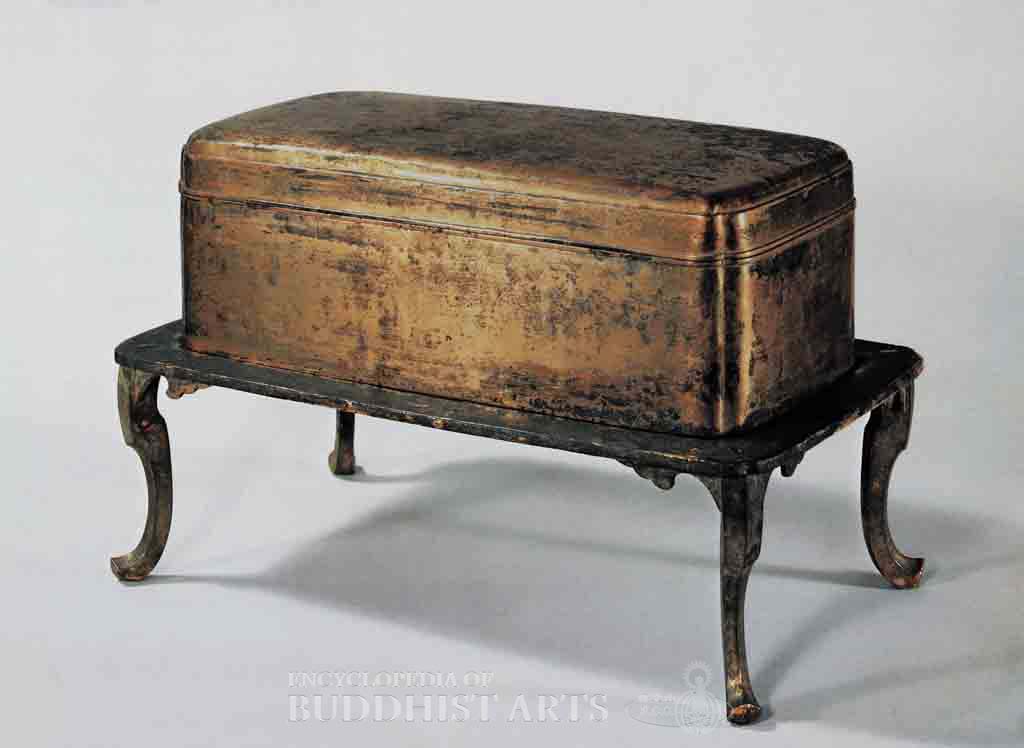
Kimpusen Sutra Mounds: Sutra Containers - Rectangular Gilt Sutra Box and Table
Gilt copper alloy
Kimpusen Sutra Mounds: Sutra Containers
JAPAN, Nara, Yoshino; Heian period
After the middle of the Heian period (794–1185), it was felt that Buddhism was in decline in Japan. For this reason, a large number of copies of the Lotus Sutra were transcribed, placed in sutra containers, and buried in mounds, so that they would be preserved for the arrival of Maitreya, the future Buddha. The sutra mounds at Kimpusen, which were created by Tomo no Nobuske, are famous for their large number of unearthed sutra containers and votive objects.
Most of the artifacts recovered date to the 11th to 13th centuries, including sutra cases, sutra boxes, bronze mirrors, bronze pagodas, coins, and knives. There are five sutra boxes and about 50 sutra cases. A gilt copper alloy cylindrical container is the oldest of the artifacts, with an inscription dating to 1007. Along with a gilt silver sutra box, they were listed as a National Treasure in 1952.
Found in 1693, the cylindrical sutra container measures 36.4 cm high and 15.8 cm in diameter. The Sanskrit words “homage to the Lotus Sutra” were found on the cylindrical body with the name of the artisan at the bottom. It was inscribed with 510 characters in five rows, recording the origin and building of the sutra mound. The last part of the inscription stated that some relics were buried there.
The rectangular sutra box is decorated with a floral pattern and twin birds and measures 16.1 cm high. It stands on an openwork base, and the entire box is plated with gold and silver. Anoter rectangular gilt sutra box is made of copper alloy and measures 13.6 cm high. Its body and lid are plain. The rectangular table, on which the box is placed, is 12.4 cm high and has legs that gently curve and feet that point outward.
For more details, go to the Encyclopedia of Buddhist Arts: Artifacts, page 160.
Cite this article:
author = Hsingyun and Youheng and Youji and Pokorski, Stefanie and Mankuang and Fan, Wen,
booktitle = {Encyclopedia of Buddhist Arts: Artifacts },
pages = 160,
title = {{Kimpusen Sutra Mounds: Sutra Containers}},
volume = 18,
year = {2016}}