
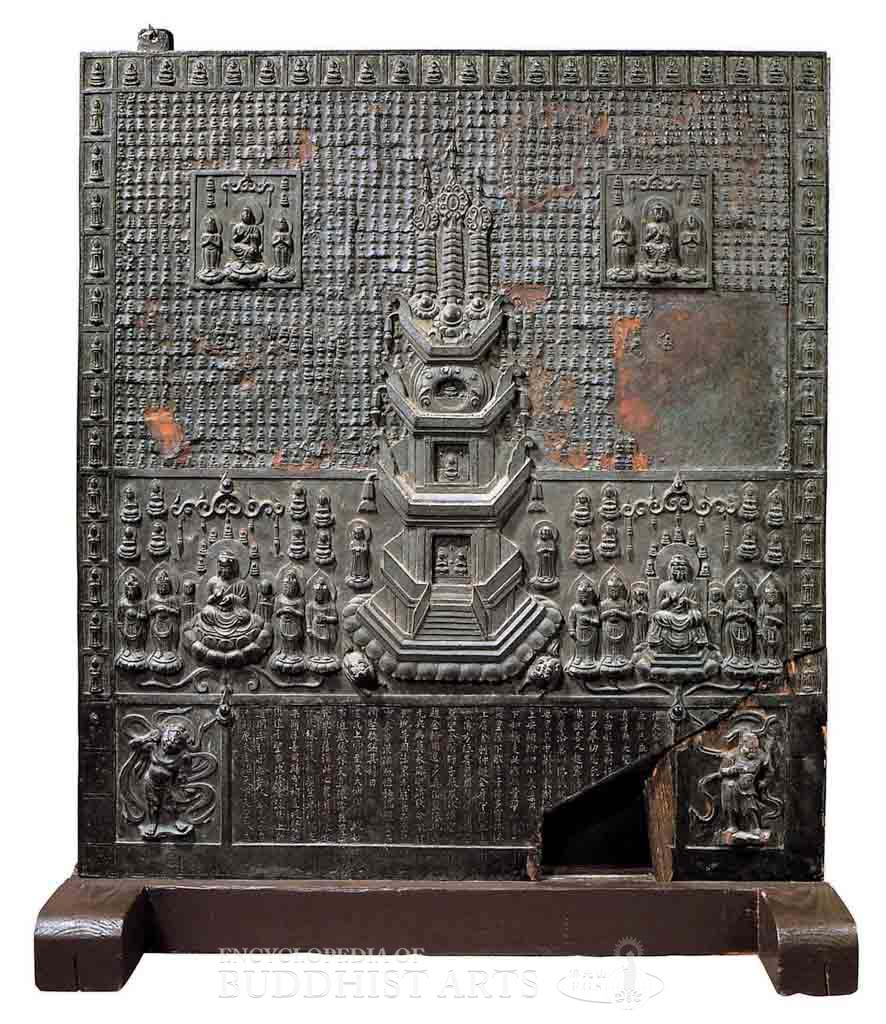
Hasedera Temple: Plaque with Illustration of the Lotus Sutra
Bronze
Hasedera Temple: Plaque with Illustration of the Lotus Sutra
JAPAN, Nara, Sakurai; Nara period
From the inscription, it is known that the plaque was cast by more than 80 people, including monk Domyo, to pray for Emperor Temmu (reigned 673–686). It was salvaged from a fire at Hasedera Temple in 1876, and was listed as a National Treasure in 1963.
The artwork depicts the “Chapter on the Emergence of the Prabhutaratna Pagoda” from the Lotus Sutra. In the center, there is a hexagonal three-tier pagoda with a lotus base, either side of which has a crouching lion. Steps lead from the base up to the first of the three stories, all of which contains a Buddha niche. On the lowest story are the seated Sakyamuni and Prabhutaratna Buddhas, while middle story is occupied by another Prabhutaratna Buddha, and the upper story holds reliquaries. The top of the pagoda has a spire consisting of three columns of stacked rings, representing the Buddha, the Dharma, and the Sangha. Near the base of the pagoda is a group of images on either side, each with a central Buddha that is flanked by four Bodhisattvas and two disciples.
A square panel appears on either side of the pagoda in the upper register of the plaque, each enshrined with a Buddha and two attendant Bodhisattvas. The remainder of the register features images of the Thousand Buddhas. In the lower register, guarded by a Dharma protector on each side, there is an inscription comprised of 319 characters. A border of seated Buddha images runs along the top of the plaque, while standing Bodhisattvas adorn the sides. The plaque reveals the practice and belief in the Lotus Sutra during the Nara period (710–794).
For more details, go to the Encyclopedia of Buddhist Arts: Artifacts, page 119.
Cite this article:
author = Hsingyun and Youheng and Youji and Pokorski, Stefanie and Mankuang and Fan, Wen,
booktitle = {Encyclopedia of Buddhist Arts: Artifacts },
pages = 119,
title = {{Hasedera Temple: Plaque with Illustration of the Lotus Sutra}},
volume = 18,
year = {2016}}