
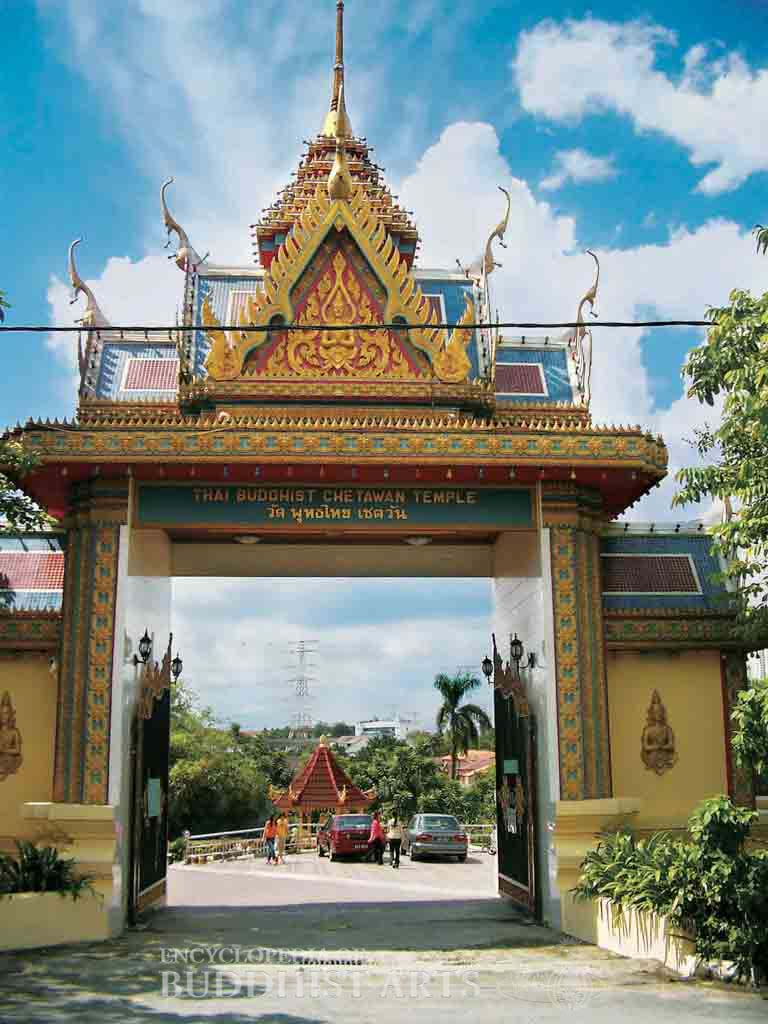
Thai Buddhist Chetawan Temple: Main Temple Gate
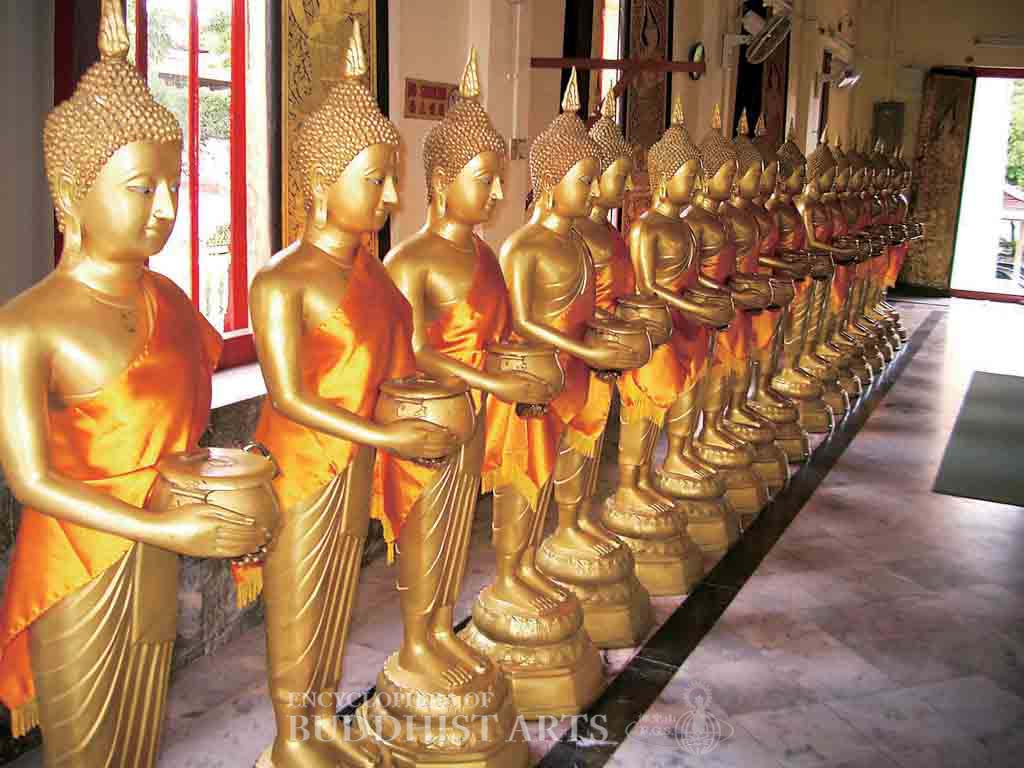
Thai Buddhist Chetawan Temple: Main Hall - Standing Buddhas
Thai Buddhist Chetawan Temple
MALAYSIA, Selangor, Petaling Jaya
The temple was conceived by a Thai monk Phra Kru Palat Vieng in 1956. The following year, the Selangor State Government allocated approximately 1 ha for the temple. The Government of Malaysia and King Rama IX of Thailand supported some of the funding. The temple was designed by the Fine Arts Department of the Ministry of Culture in Bangkok. It is the largest Thai temple in the State of Selangor and symbolizes the long-standing close relationship between Thailand and Malaysia.
The temple occupies 1.98 ha and the main buildings are the main hall, ordination hall, Avalokitesvara Pavilion, bell tower, meditation hall, and the Patriarch Memorial Hall. The main hall has a roof consisting of three-tier eaves and five overlapping sections. The gable with its decorated pediment faces to the front above the main entrance. A copper statue named Phra Buddha Thammeen is enshrined within the main hall. On the left side of the hall, there are 18 copper standing statues of Sakyamuni Buddha. They are each 152 cm high and are holding alms bowls to receive offerings from devotees. Enshrined within the Patriarch Memorial Hall there is a golden statue of Sakyamuni Buddha, together with a copper statue of the founder monk. There are also four 152 cm high statues of eminent Thai monks. Construction of the three-story meditation hall began in June 2004.
For more details, go to the Encyclopedia of Buddhist Arts: Architecture T-Z, page 1105.
Cite this article:
author = Hsingyun and Youheng and Johnson, Peter and Mankuang and Lancaster, Lewis,
booktitle = {Encyclopedia of Buddhist Arts: Architecture T-Z},
pages = 1105,
title = {{Thai Buddhist Chetawan Temple}},
volume = 4,
year = {2016}}