
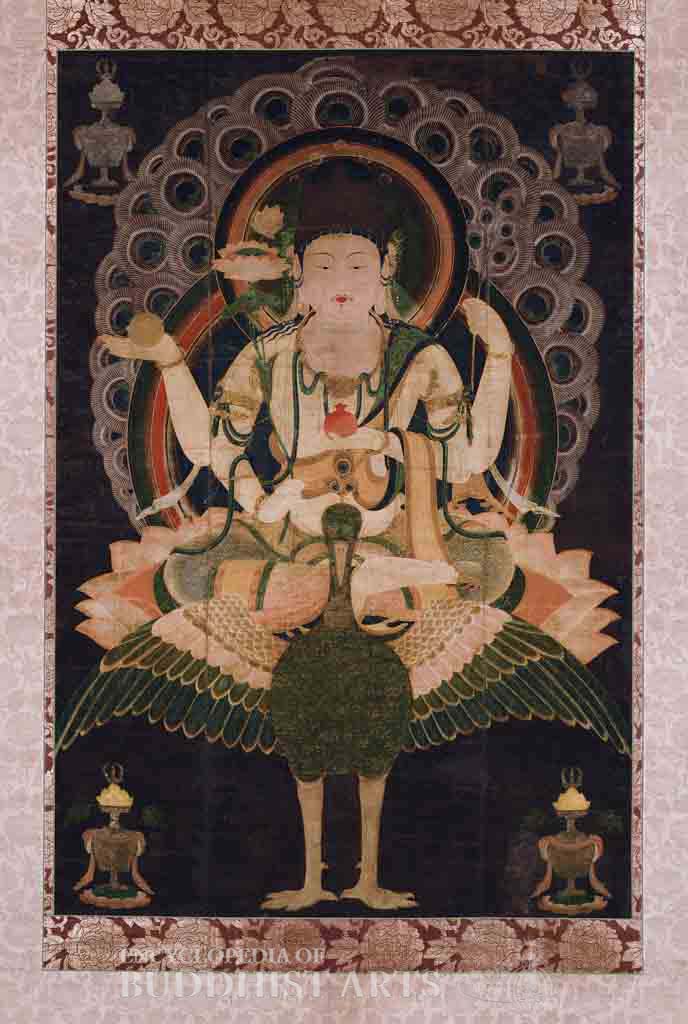
Mahamayuri
Ink and color on silk
Mahamayuri
JAPAN; Heian period
In the Mahamayuri Vidyarajni Sutra, Mahamayuri is described as being able to protect devotees from poisons and disasters. This 12th century picture corresponds with descriptions in the Liturgy for the Mandala of Mahamayuri. It was listed as a National Treasure in 1951.
Sitting in full lotus position on the back of a peacock, Four-armed Mahamayuri wears a purple hat and is adorned with jewelry. Ribbons and a stole are draped around the body. The right hands hold a lotus and a matulunga fruit; the left hands hold a pomegranate and peacock feathers. The peacock faces the viewer with its wings and tail feathers spread. In the four corners of the painting, decorative vases rest on lotus flowers.
Mahamayuri’s skin is painted with white pigment washed with pale red. The clothes, the objects in the hands, the throne, and the peacock are colored in darker tones. The jewelry worn by Mahamayuri and the tail feathers of the peacock are lined with gold.
For more details, go to the Encyclopedia of Buddhist Arts: Painting I-O, page 498.
Cite this article:
author = Hsingyun and Youheng and Youlu and Wilson, Graham and Manho and Mankuang and Huntington, Susan,
booktitle = {Encyclopedia of Buddhist Arts: Painting I-O},
pages = 498,
title = {{Mahamayuri}},
volume = 15,
year = {2016}}