
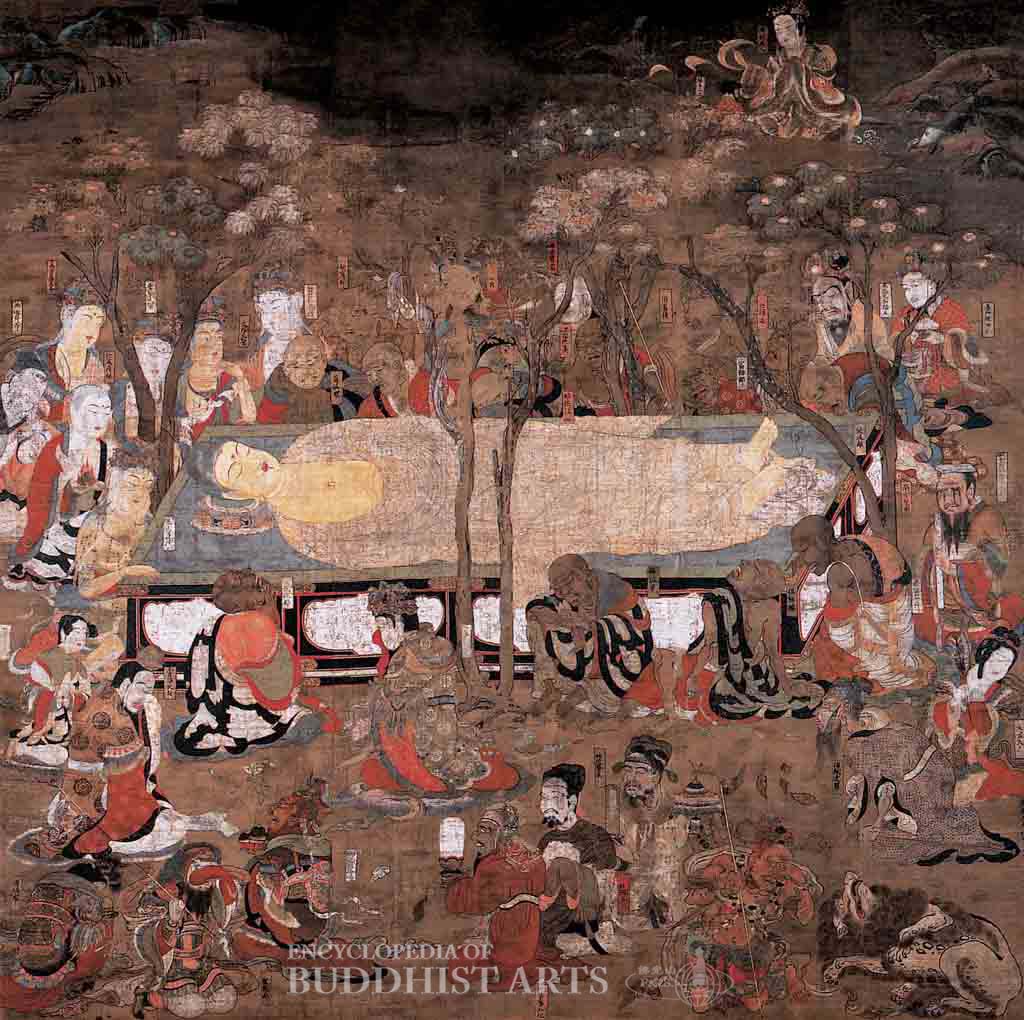
Kongobuji Temple: Life of the Buddha - Parinirvana
Ink and color on silk
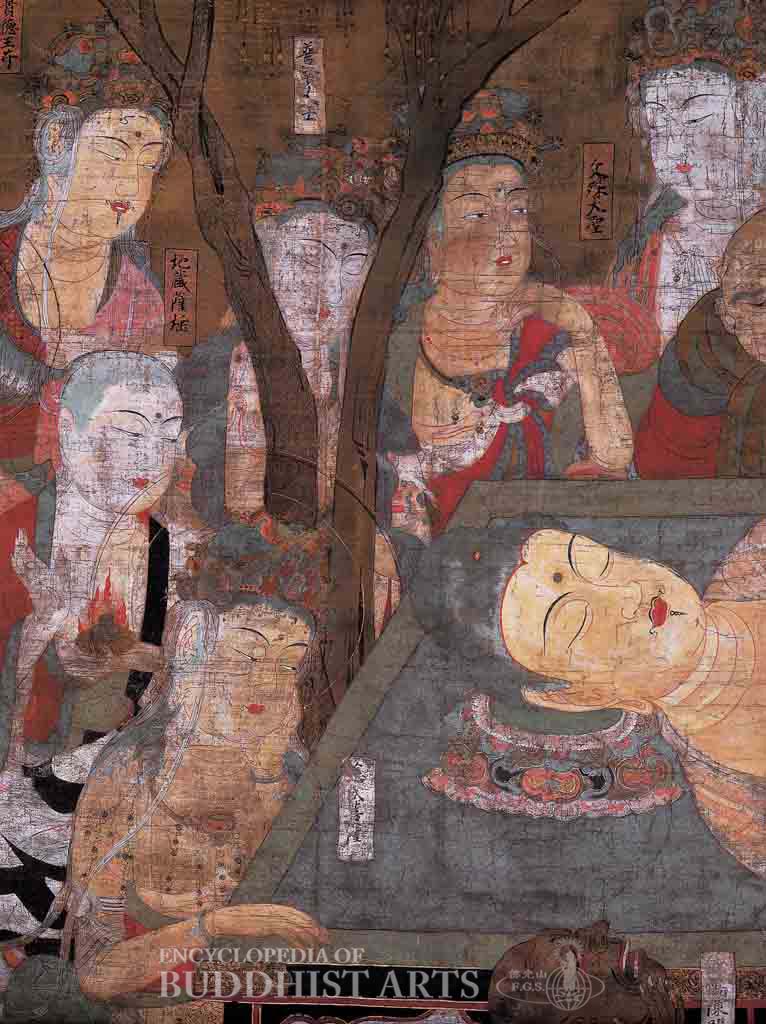
Kongobuji Temple: Life of the Buddha - Parinirvana (detail)
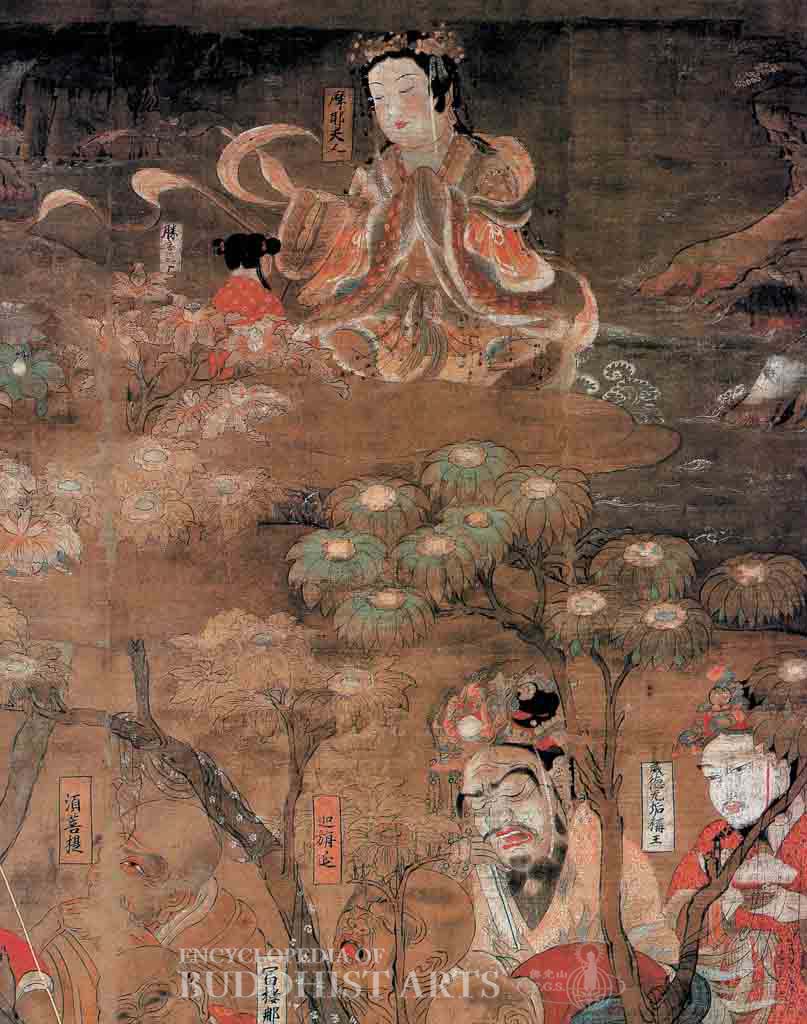
Kongobuji Temple: Life of the Buddha - Parinirvana (detail)
Kongobuji Temple: Life of the Buddha - Parinirvana
JAPAN, Wakayama, Ito; Heian period
This painting of the Buddha’s parinirvana is based on descriptions in the Mahaparinirvana Sutra. An inscription in the bottom right corner dates the image to 1086, making it the oldest among similar artworks in Japan. In 1951, it was listed as a National Treasure.
The Buddha lies on a bed between two sala trees and enters parinirvana peacefully, surrounded by Bodhisattvas, disciples, Sakra, Brahma, warriors, and devotees in mourning. Each figure is accompanied by an identifying cartouche. In the top right corner, the Buddha’s mother, Queen Maya, has descended from heaven to bid her son farewell. In the bottom corners, warriors cover their faces with their hands and weep, and a lion rolls on its back in despair. The blossoms of the sala trees are shown above the heads of the figures.
The white robe and pale yellow skin of the Buddha stand out against the brown background. The figures wear colorful clothes, and each expresses their grief differently. Some of the figures appear inconsolable, while the Bodhisattvas and Queen Maya are more reflective. The painting emphasizes traditional tones, appearing bright yet reserved. It is regarded as one of the finest Buddhist paintings of the late Heian period (794–1185).
For more details, go to the Encyclopedia of Buddhist Arts: Painting I-O, page 448.
Cite this article:
author = Hsingyun and Youheng and Youlu and Wilson, Graham and Manho and Mankuang and Huntington, Susan,
booktitle = {Encyclopedia of Buddhist Arts: Painting I-O},
pages = 448,
title = {{Kongobuji Temple: Life of the Buddha - Parinirvana}},
volume = 15,
year = {2016}}