
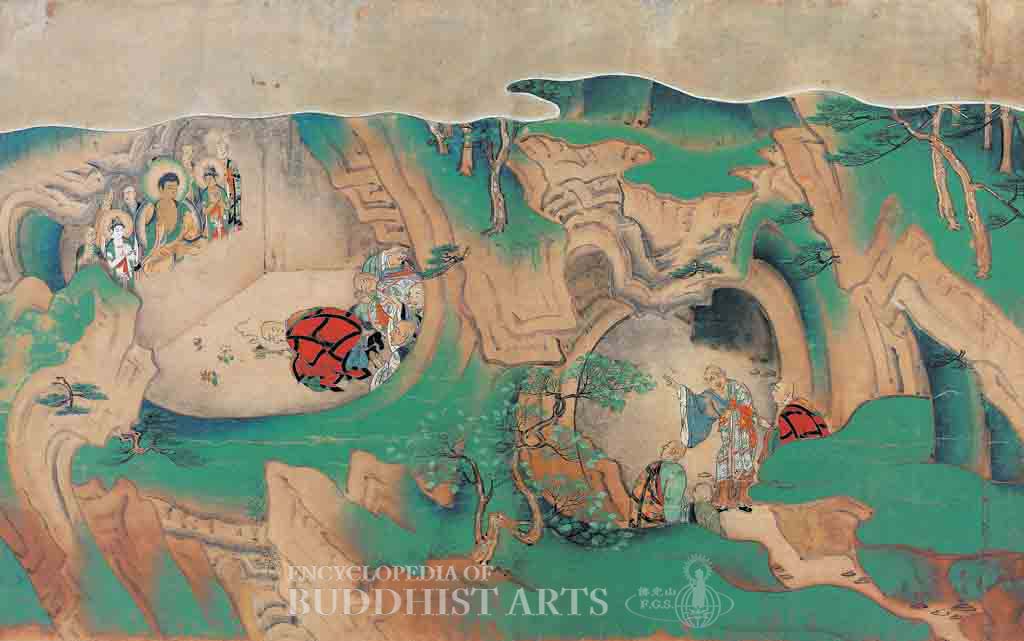
Biography of Master Xuanzang - Scroll 4 (detail)
Ink and color on paper
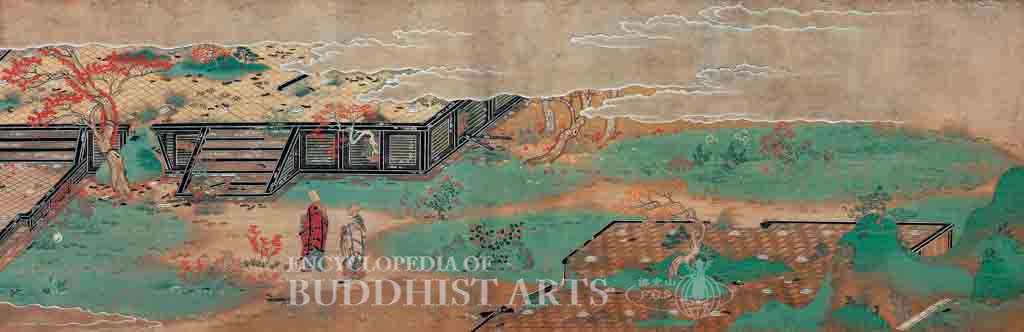
Biography of Master Xuanzang - Scroll 5 (detail)
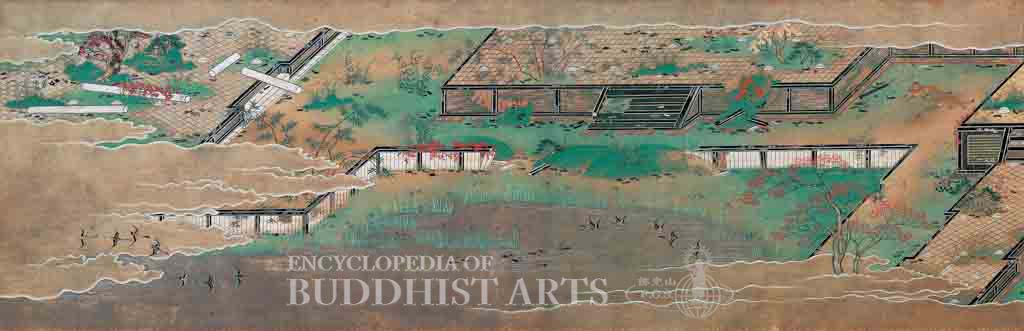
Biography of Master Xuanzang - Scroll 5 (detail)
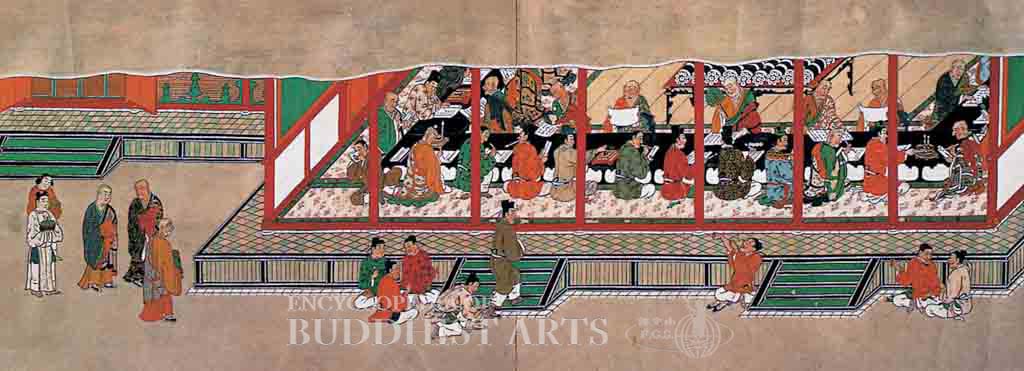
Biography of Master Xuanzang - Scroll 10 (detail)
Biography of Master Xuanzang
JAPAN; Kamakura period
According to the diary of the courtier and calligrapher, Sanetaka, these scrolls were made by the court painter Takashina Ryuken for Kofukuji Temple in Nara during the 14th century. There are a total of 12 scrolls painted with 76 scenes. The text and images on the scrolls are based on the Biography of Master Xuanzang of the Tang Dynasty written by his disciple Huili. The first section of the Scroll 1 depicts the childhood, renunciation, and ordination of Master Xuanzang. The rest of the images on Scrolls 1 to 9 illustrate his pilgrimage to India. The last three scrolls depict his translation work after his return to China, the founding of the Mind-Only school, of which he is considered the first patriarch, and his death. Thus, these painted scrolls are also known as the History of the Faxiang school. The set was listed as a National Treasure in 1969.
The first section of the Scroll 4 depicts Master Xuanzang paying homage to the Buddha inside the Dragon Cave at Pragbodhi. Wearing a monastic robe and holding an incense burner, Xuanzang bows reverently before the Buddha image in the cave. An image on the Scroll 5 depicts Xuanzang and his attendant circumambulating the Jetavana Monastery in India. The buildings are in ruins, with only the foundation and the stairs of the pavilions remaining. The ground is covered with withered leaves and weeds. A skull is painted on the grass on the left, emphasizing the desolation of the ruins. Although the painter did not visit the holy sites in India, and depicted the landscape and architecture in Chinese style, he manages to capture the sense of melancholy that Xuanzang must have felt at seeing the legendary Buddhist sites in ruins. The third section of the Scroll 10 illustrates Xuanzang’s translation work at Hongfu Temple in Chang’an (present day Xi’an) after his return from India. Seated in the center of a hall, Xuanzang holds a round fan in his hand and writes on a scroll, surrounded by attendants who aid him in his work. The images are bordered by clouds outlined with fine, curving lines. The strong colors, precise brushwork, and the detailed depiction of the figures are typical features of the yamato style paintings of the late Kamakura period (1185–1333).
For more details, go to the Encyclopedia of Buddhist Arts: Painting A-H, page 108.
Cite this article:
author = Hsingyun and Youheng and Youlu and Wilson, Graham and Manho and Mankuang and Huntington, Susan,
booktitle = {Encyclopedia of Buddhist Arts: Painting A-H},
pages = 108,
title = {{Biography of Master Xuanzang}},
volume = 14,
year = {2016}}