
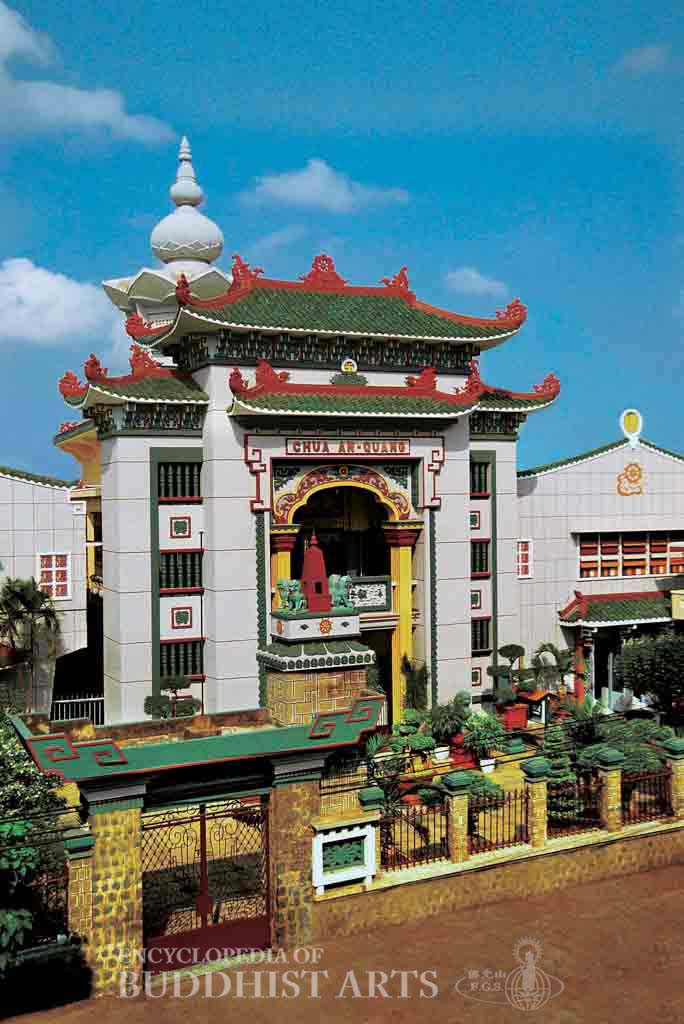
An Quang Temple
An Quang Temple
VIETNAM, Ho Chi Minh City
The temple was established as a bamboo and thatch structure in 1948 by monk Thich Tri Huu and was rebuilt in 1950 by monk Thich Thien Hoa. The layout of Tu Dam Temple in Hue was used as a blueprint. The temple underwent numerous structural changes in the following 20 years. It is listed as a municipal Cultural Heritage Site.
The two-story temple is a fusion of oriental and western architectural styles. Its hip roof is covered with green glazed tiles with the ridge and hips highlighted in orange. The ridge and hips are adorned with auspicious symbols, such as a Dharma wheel and dragons. The intricately carved Buddha niche in the main hall contains a seated statue of Sakyamuni Buddha, with reliefs of Avalokitesvara and Ksitigarbha Bodhisattvas in the upper corners. It is also decorated with pumice lacquered paintings of Bodhisattvas, such as Avalokitesvara, Manjusri, and Samantabhadra.
For more details, go to the Encyclopedia of Buddhist Arts: Architecture A-F, page 12.
Cite this article:
author = Hsingyun and Youheng and Johnson, Peter and Mankuang and Lancaster, Lewis,
booktitle = {Encyclopedia of Buddhist Arts: Architecture A-F},
pages = 12,
title = {{An Quang Temple}},
volume = 1,
year = {2016}}