
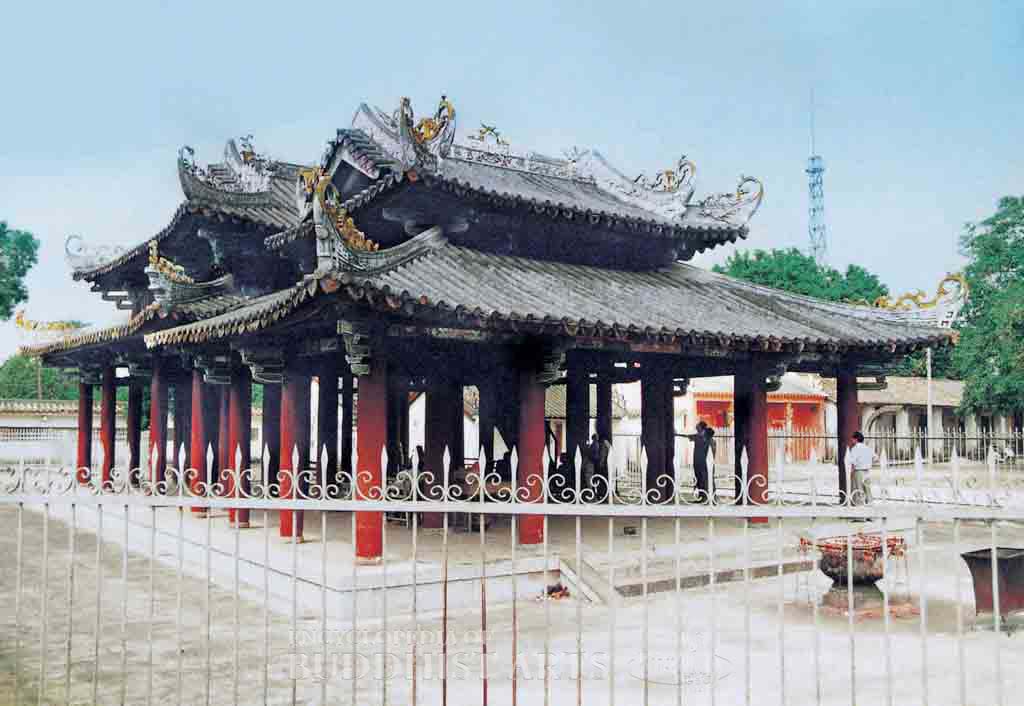
Dashige Pavilion
Dashige Pavilion
CHINA, Guangxi, Beihai
The pavilion was built in 1576 during the Ming dynasty and has been repaired a number of times throughout its history. A statue of Avalokitesvara Bodhisattva, also known as Guanyin Dashi, is enshrined inside the structure, thus it is known as Dashige Pavilion. It was listed as a National Cultural Heritage Site in 1988.
Facing south, the three-by-six bay pavilion is composed of two double-eave hip-and-gable roofs which have delicate ridge decorations. The building is completely open without walls. There are 36 ironwood columns supporting the structure, with complex lotus designs carved on the column bases. One of the columns is suspended, and is considered the most unique aspect of the whole building.
The pavilion is different from the usual Buddhist structure. Its layout and appearance emanate strong distinctive features of the south. Although it was built in the Ming dynasty (1368–1644), the building displays architectural elements from the Song (960–1279) and Yuan (1271–1368) dynasties, making it a valuable reference for researchers studying the coastal facilities in the past.
For more details, go to the Encyclopedia of Buddhist Arts: Architecture A-F, page 214.
Cite this article:
author = Hsingyun and Youheng and Johnson, Peter and Mankuang and Lancaster, Lewis,
booktitle = {Encyclopedia of Buddhist Arts: Architecture A-F},
pages = 214,
title = {{Dashige Pavilion}},
volume = 1,
year = {2016}}