
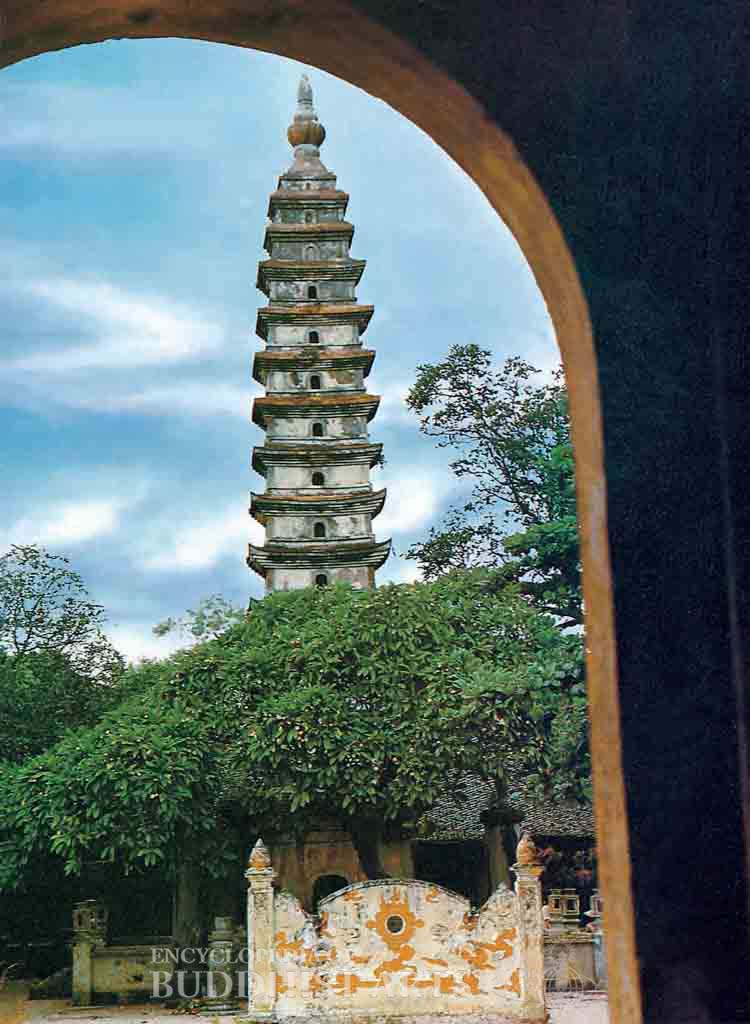
Pho Minh Temple Pagoda
Pho Minh Temple Pagoda
VIETNAM, Nam Dinh
Pho Minh means Universal Clarity. According to inscriptions found on a stone stele and a bell, the temple was built during the Ly dynasty (1009–1225) and it underwent a large-scale restoration in 1262. The pagoda was built in 1305 and was repaired in 1987.
The square 14-tier pagoda is 21 m high. It houses the relics of King Tran Nhan Tong (reigned 1278–1293). The 4.4 m high base platform, together with the lotus base and the first two tiers, are the only remaining original parts of the brick structure. The upper parts were added at the end of the 18th century, following the style of the original. The body of the pagoda is simple and unadorned, with an arched opening on every tier. The eaves of the first six tiers are curved sharply upwards but the subsequent eaves are less flamboyant. The pagoda is surmounted by a simple gourd-shaped spire.
For more details, go to the Encyclopedia of Buddhist Arts: Architecture M-S, page 817.
Cite this article:
author = Hsingyun and Youheng and Johnson, Peter and Mankuang and Lancaster, Lewis,
booktitle = {Encyclopedia of Buddhist Arts: Architecture M-S},
pages = 817,
title = {{Pho Minh Temple Pagoda}},
volume = 3,
year = {2016}}