
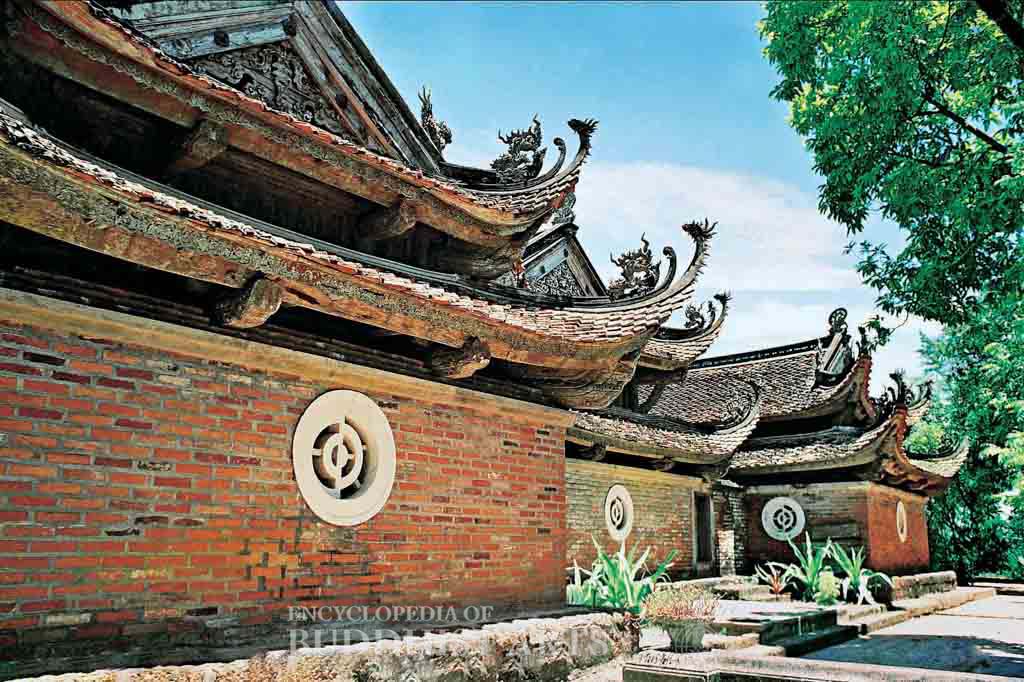
Tay Phuong Temple
Tay Phuong Temple
VIETNAM, Hanoi
Tay Phuong means Western Direction and it is also known as Sung Phuoc Temple. It is located in Sontay county within Hanoi city, and is one of Vietnam’s most famous architectural landmarks. There are different sayings regarding its founding date: some claim that the temple was established during the 3rd century, while others say that it was founded in the 8th or even the 9th century. A stele inscription indicates that the temple was rebuilt in 1632. The temple was completely reconstructed in 1794.
The temple has three parallel buildings, all of which have double-eave hip-and-gable roofs. The distinctive features are the upward sweeping eaves at the corners and the circular windows whose pattern symbolizes form and formlessness. The temple contains numerous openwork carvings, reliefs, sculptures, and other works of art, including a bronze bell which was added to the temple in 1636. The most significant works are a statue of Rahula and one of Sakyamuni as an Ascetic, which is known locally as Tuong Tuyet Son.
For more details, go to the Encyclopedia of Buddhist Arts: Architecture T-Z, page 1102.
Cite this article:
author = Hsingyun and Youheng and Johnson, Peter and Mankuang and Lancaster, Lewis,
booktitle = {Encyclopedia of Buddhist Arts: Architecture T-Z},
pages = 1102,
title = {{Tay Phuong Temple}},
volume = 4,
year = {2016}}