
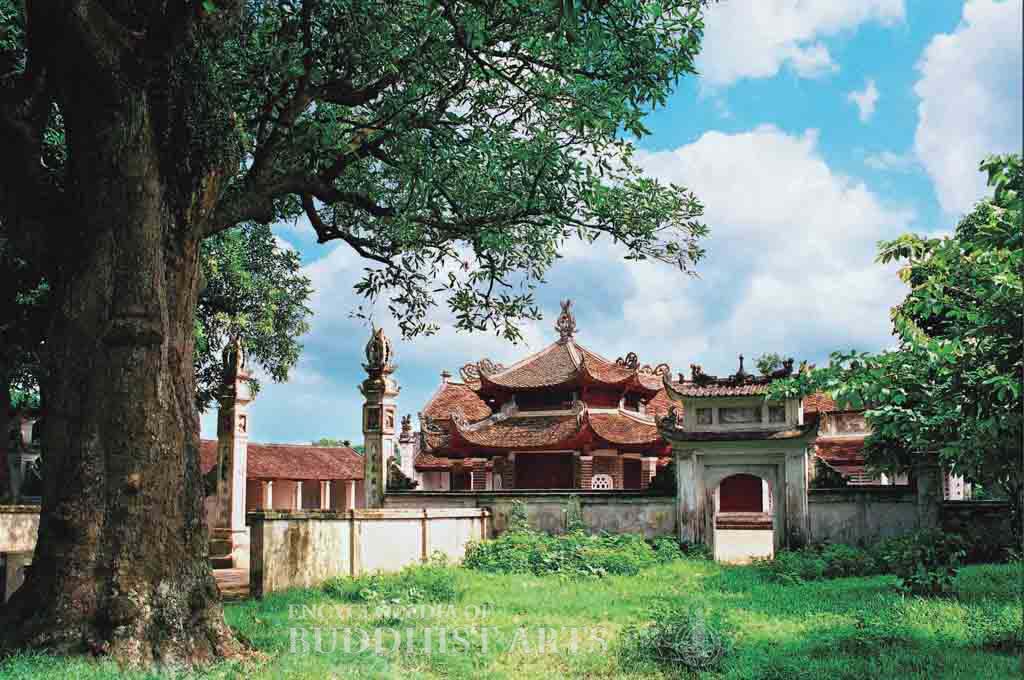
Chieu Thien Temple: Octagonal Pavilion
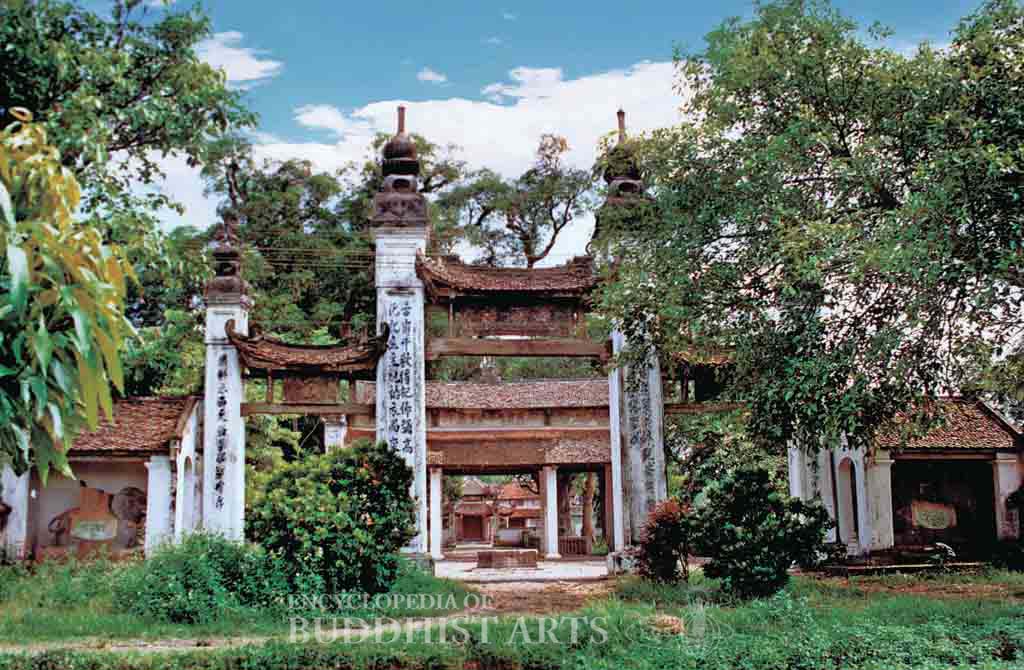
Chieu Thien Temple: Temple Gate
Chieu Thien Temple
VIETNAM, Hanoi, Dong Da
The temple was built during the rule of King Ly Anh Tong (reigned 1138–1175) of the Ly dynasty and was renovated a number of times. Its current appearance is the result of a renovation performed in the 19th century. It is listed as a National Cultural Heritage Site.
The main buildings include the temple gate, main hall, and octagonal pavilion. The temple gate has a hip-and-gable roof and has four columns, which are inscribed with couplets and surmounted by capitals in the form of auspicious symbols and creatures. The main hall contains statues of the Buddha, as well as a statue of the monk Tu Dao Hanh. The brick octagonal pavilion is the most exquisite building at the temple. It has a double-eave pyramidal roof whose corners curve elegantly upwards. On the first story doors alternate with latticed octagonal windows. The pavilion hosts offering ceremonies during festivals. The temple also houses a 17th century altar, an 18th century sedan chair used for processions, as well as a stele dated 1656 relating to the monk Tu Dao Hanh.
For more details, go to the Encyclopedia of Buddhist Arts: Architecture A-F, page 147.
Cite this article:
author = Hsingyun and Youheng and Johnson, Peter and Mankuang and Lancaster, Lewis,
booktitle = {Encyclopedia of Buddhist Arts: Architecture A-F},
pages = 147,
title = {{Chieu Thien Temple}},
volume = 1,
year = {2016}}