
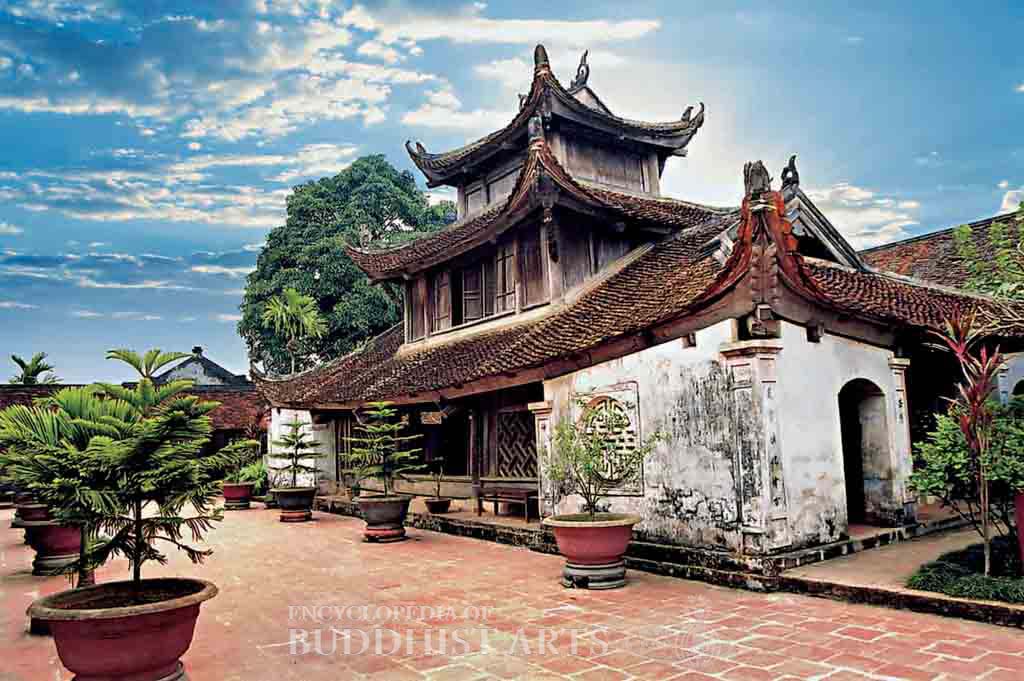
Ninh Phuc Temple
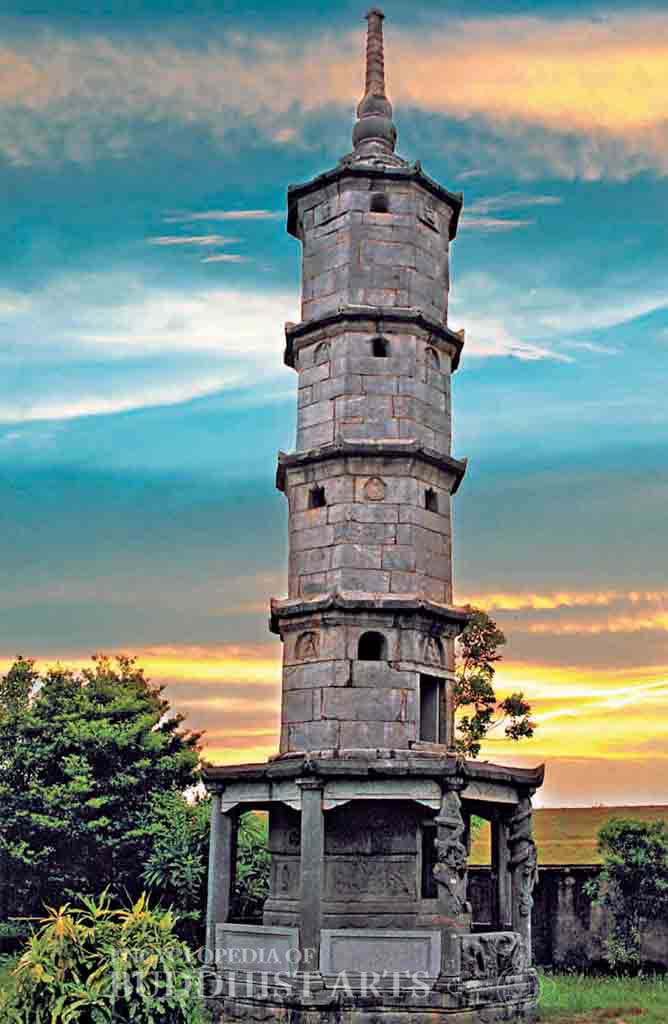
Ninh Phuc Temple: Bao Nghiem Pagoda
Ninh Phuc Temple
VIETNAM, Bac Ninh, Thuan Thanh
Ninh Phuc means Serene Blessing. It is the most complete and best preserved temple from the Tran dynasty (circa 1225–1399). The temple’s first abbot was Huyen Quang, the Third Patriarch of the Truc Lam school. It was rebuilt in 1633 and received imperial protection. The Chinese monk Zhuogong came to practice at this temple and was given an imperial title. It underwent large-scale expansion on one occasion and has been repaired a number of times. The temple was listed as a National Cultural Heritage Site in 1992.
The temple occupies 5.8 ha and consists of ten halls. Its layout is like a letter H inside a square. The main buildings include the temple gate, bell and drum towers, main hall, Hermitage of Accumulating Merit, rear hall, and stone pagodas. Most of the buildings are built with hip-and-gable roofs.
The three-story main hall stands on a 1 m high platform. It houses statues of the Three Buddhas, as well as Dharma protectors carved from wood. On the sides there are several statues carved in the 17th century, including Manjusri Bodhisattva, Samantabhadra Bodhisattva, and Eleven-Headed, Thousand-Armed Avalokitesvara.
The three-story Hermitage of Accumulating Merit has a pyramidal roof, middle eaves on the second story, and a single-eave hip-and-gable roof on the first story. Inside the building there is a multi-tier Pagoda of the Nine Grades of Rebirth, an octagonal wooden pagoda supported by only one pillar at its center. Many images of Buddhas and Bodhisattvas adorn the pagoda. The rear hall is used for veneration of past patriarchs. The stone pagodas include the Bao Nghiem and Ton Duc pagodas, commemorating monks Zhuogong and Minh Hanh respectively. The five-tier octagonal stone Bao Nghiem pagoda is 13.5 m high and stands on a square base platform that is 3 m wide. It has an unusual shape with very short eaves. There is a circular Buddha niche within the pagoda that houses a statue of monk Zhuogong, as well as his relics.
The temple houses several valuable artifacts, including a statue of Ascetic Sakyamuni Buddha, a wooden censer carved with images of dragons, phoenixes, and elephants, as well as other carvings from the 17th century.
For more details, go to the Encyclopedia of Buddhist Arts: Architecture M-S, page 795.
Cite this article:
author = Hsingyun and Youheng and Johnson, Peter and Mankuang and Lancaster, Lewis,
booktitle = {Encyclopedia of Buddhist Arts: Architecture M-S},
pages = 795,
title = {{Ninh Phuc Temple}},
volume = 3,
year = {2016}}