
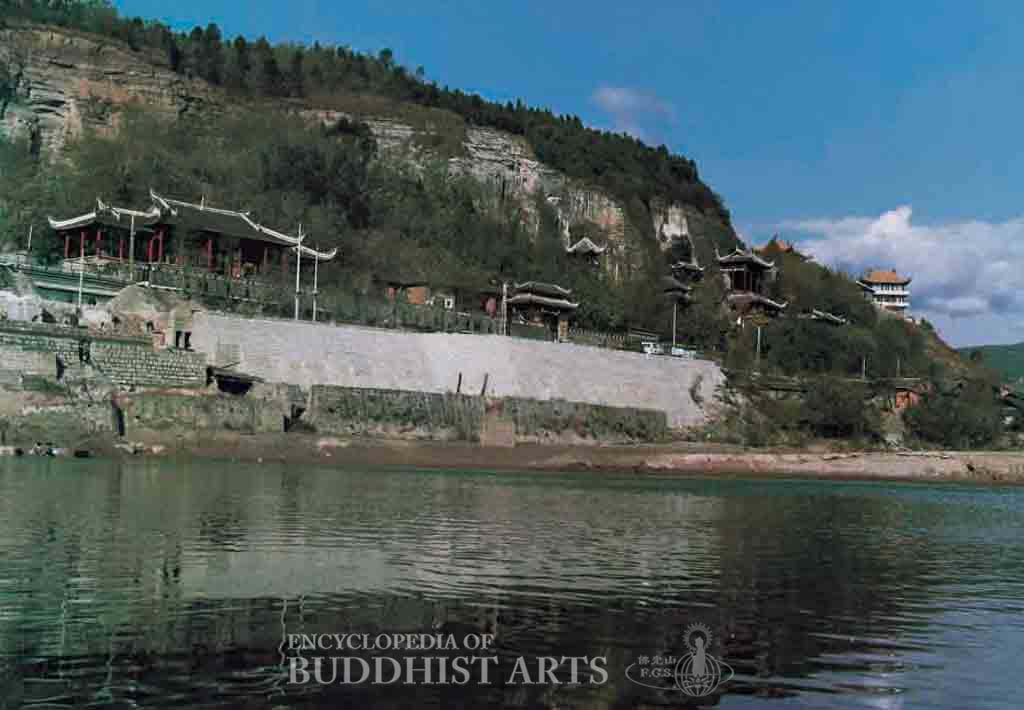
Guangyuan Huangze Temple Caves
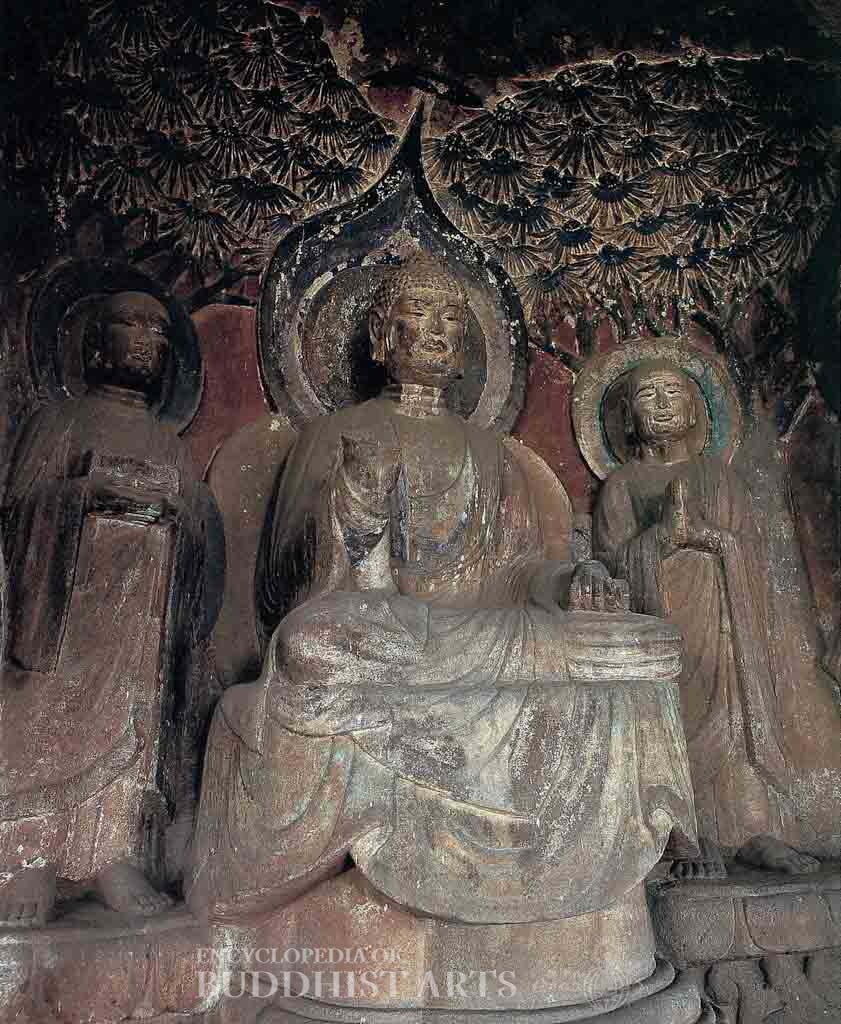
Guangyuan Huangze Temple Caves: Niche 37 - Buddha and Disciples
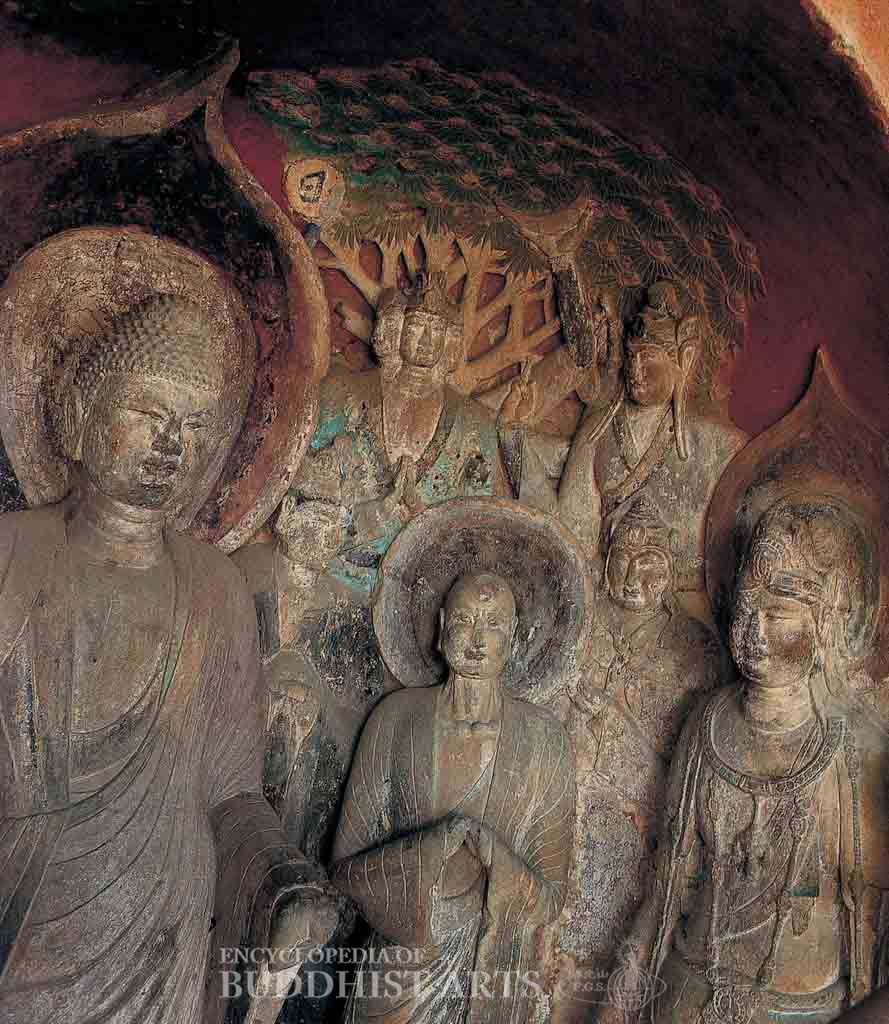
Guangyuan Huangze Temple Caves: Niche 51 - Sculptures (back wall, right side)
Guangyuan Huangze Temple Caves
CHINA, Sichuan, Guangyuan
The Huangze (Imperial Grace) Temple Caves are located on a cliff on the west bank of Jialing River, 1 km west of Guangyuan city. Excavation of the site began during the late Northern Wei dynasty (386–534), although the majority of the caves were constructed in the Tang dynasty (618–907). Huangze Temple, which was constructed after the caves, was originally named Wunu Temple; however, its name was changed due to the generous contributions of Empress Wu Zetian (reigned 684–705) for its restoration. The lower section of the cliff is engraved with an inscription providing a brief history of the temple. The caves were listed as a National Cultural Heritage Site in 1961.
There are currently 6 caves and 50 niches on the cliff face inside Huangze Temple, 6 of which are large niches containing more than 1,000 statues. The main caves are concentrated around the Central Pillar Cave, Great Buddha Building, Zetian Hall, and Five Buddha Pavilion. Of particular note at this site are Caves 28, 38, and 45, as well as Niches 37 and 51.
Cave 28, situated in the Great Buddha Building, was constructed during the Early Tang period (618–712). It is a great Buddha cave that contains statues of a Buddha, two disciples, and two standing Bodhisattvas. A donor is visible beside Ananda’s feet, while the Eight Classes of Dharma Protectors are found on the back wall. Two weathered warriors are carved at the cave entrance. Niche 37, made during the Sui dynasty (581–618), features carvings of Sakyamuni Buddha, the disciples Mahakasyapa and Ananda, two Bodhisattvas, and two warriors. Ananda stands on the left holding a sutra case, while Mahakasyapa stands on the right with joined palms. The back wall is sculpted with a relief of two Bodhi trees.
Cave 38, located in Zetian Hall, is the largest cave at the site. It was constructed during the Northern Zhou dynasty (557–581), with some subsequent restoration in later years. There is a niche in each of the three walls, and each niche contains a Buddha, two disciples, and two Bodhisattvas. Cave 45, a central pillar cave constructed during the Western Wei (535–556) and Northern Zhou (557–581) dynasties, is one of the oldest caves at the site. The pillar is divided into 2 tiers, and contains niches on all four sides. Niche 51, located at Five Buddha Pavilion, was constructed during the Sui dynasty. It has a rectangular opening with an inner circular arch. A Buddha, two disciples, and two Bodhisattva statues, in addition to reliefs of two Bodhi trees and the Eight Classes of Dharma Protectors, are found on a low platform within the cave.
For more details, go to the Encyclopedia of Buddhist Arts: Caves R-L, page 397.
Cite this article:
author = Hsingyun and Youheng and Johnson, Peter and Mankuang and Huntington, Susan and Edson, Gary and Neather, Robert,
booktitle = {Encyclopedia of Buddhist Arts: Caves R-L},
pages = 397,
title = {{Guangyuan Huangze Temple Caves}},
volume = 6,
year = {2016}}