
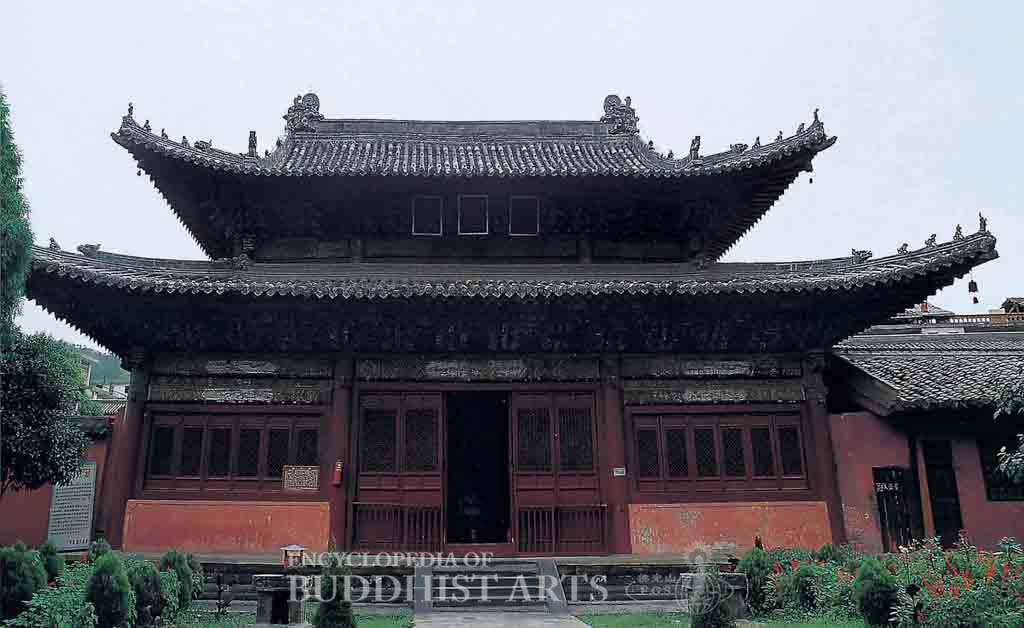
Bao’en Temple: Avatamsaka Hall

Bao’en Temple: Avatamsaka Hall - Revolving Sutra Case
Bao’en Temple
CHINA, Sichuan, Mianyang
Bao’en means Repaying Kindness. The compound is special in that it incorporates both imperial and temple architectural styles from the Ming dynasty (1368–1644). In 1440 Wang Xi, an official, was secretly building his residence to resemble the imperial palace. When the emperor found out he ordered the residence to be converted to a temple and named it Bao’en Temple, which was completed in 1460. It has survived the large earthquakes of 1610, 1630, and 1976. It was listed as a National Cultural Heritage Site in 1996.
Most of the main buildings in the temple face east and the compound occupies 2.5 ha. Along the central axis there are the main temple gate, Heavenly King Hall, Great Hero Hall, and the Ten Thousand Buddha Pavilion. To the north of the main temple gate there is the bell tower, but there is no drum tower to the south, which is unusual for Ming dynasty temples. To the north of the Great Hero Hall there is the Great Compassion Hall and to the south there is the Avatamsaka Hall. A pair of stele pavilions is erected in front of the Ten Thousand Buddha Pavilion. Each building adheres strictly to imperial standards but the decorations are of local design.
Apart from the main temple gate, which has a single-eave overhanging gable roof, all the other buildings have double-eave hip-and-gable roofs. The five-by-four bay Great Hero Hall stands on top of a 1.6 m high Sumeru platform. The structure is located in the center of a corridor, with covered walkways located on either side. These walkways were common during the Ming dynasty but not many have survived. Statues of the Three Buddhas are found within the Great Hero Hall, while an 8 m Thousand-Armed Avalokitesvara statue is enshrined within the Great Compassion Hall. The Bodhisattva is depicted with 104 arms which are carved from phoebe wood. The three-by-three bay Avatamsaka Hall houses an octagonal revolving sutra case made from phoebe wood.
For more details, go to the Encyclopedia of Buddhist Arts: Architecture A-F, page 47.
Cite this article:
author = Hsingyun and Youheng and Johnson, Peter and Mankuang and Lancaster, Lewis,
booktitle = {Encyclopedia of Buddhist Arts: Architecture A-F},
pages = 47,
title = {{Bao’en Temple}},
volume = 1,
year = {2016}}