
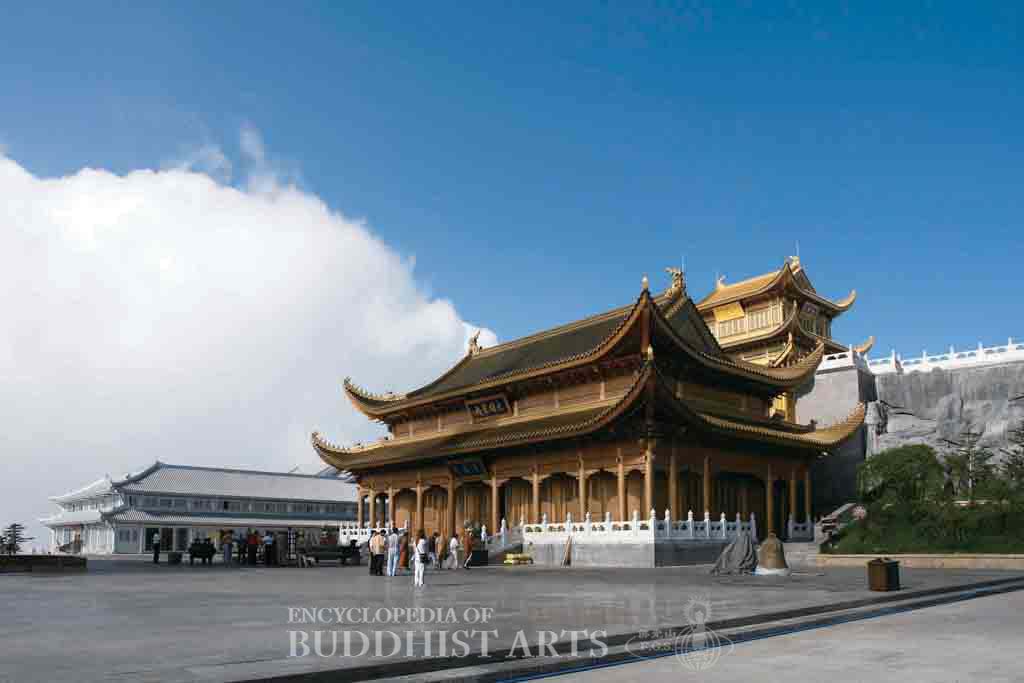
Emeishan Jinding Huazang Temple: Great Hero Hall (Copper Hall)
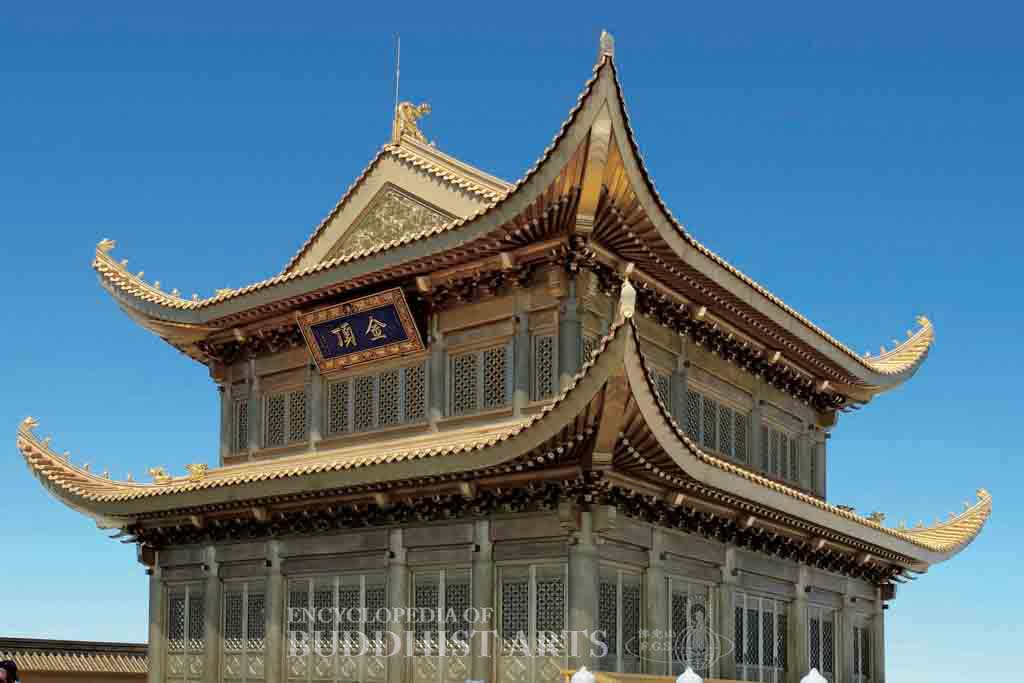
Emeishan Jinding Huazang Temple: Samantabhadra Hall (Golden Hall)

Emeishan Jinding Huazang Temple: Woyun Nunnery (Silver Hall)
Emeishan Jinding Huazang Temple
CHINA, Sichuan, Leshan
Jinding means Golden Summit, while Huazang refers to Avatamsaka. The temple is located on the summit of Emeishan (Delicate Eyebrow Mountain). It is believed that the temple was built during the rule of Emperor Ming (reigned 58–75) of the Eastern Han dynasty. Due to its location, it was frequently damaged from lightning strikes. In 1602 during the Ming dynasty, the Master Miaofeng built Copper Hall on the highest point at the back of the temple. Since every architectural element, including the tiles, pillars, windows, and doors, was created from copper mixed with gold, it is known as the Golden Hall. Between 1664 and 1972, the temple was regularly damaged by fire. A full restoration of the temple was carried out between 1986 and 1989, with further expansions between 2004 and 2006. It was listed as a key Buddhist temple in the Han region of China in 1983, and as part of Emeishan, it was listed as a UNESCO World Heritage Site in 1996.
The temple was built according to the contours of the mountain and the main buildings along the central axis include the Maitreya Hall, Great Hero Hall or Copper Hall, and the Samantabhadra Hall or Golden Hall. There is a 48 m statue of Samantabhadra Bodhisattva of the Ten Directions. The Great Hero Hall has a double-eave hip-and-gable roof. The Samantabhadra Hall is the highest building on Emeishan and occupies 1,800 sq m. The roof tiles are made from gilt copper. A Qing dynasty gilt bronze statue of Samantabhadra Bodhisattva is enshrined within the hall.
The Silver Hall, also known as Woyun (Reclining Cloud) Nunnery, was reconstructed at the same time as the other buildings and occupies 1,600 sq m. It has a timber structure, while the roof is made entirely of silver tiles. From afar, the building appears silvery-gray.
For more details, go to the Encyclopedia of Buddhist Arts: Architecture A-F, page 269.
Cite this article:
author = Hsingyun and Youheng and Johnson, Peter and Mankuang and Lancaster, Lewis,
booktitle = {Encyclopedia of Buddhist Arts: Architecture A-F},
pages = 269,
title = {{Emeishan Jinding Huazang Temple}},
volume = 1,
year = {2016}}