
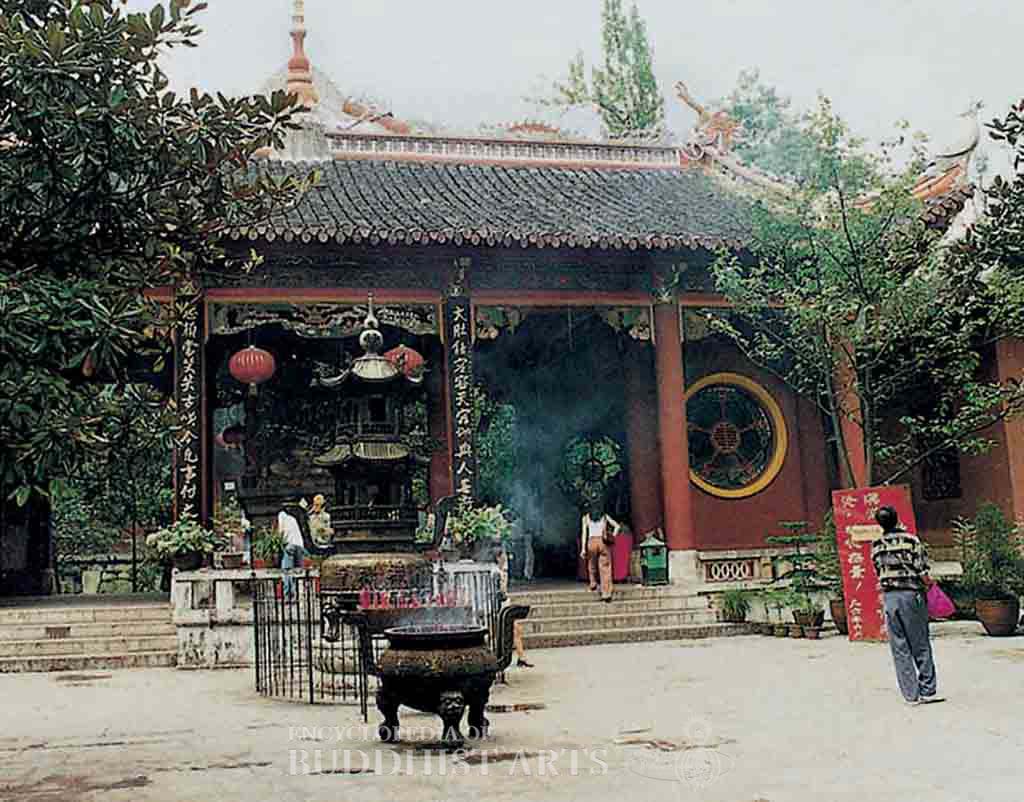
Hongfu Temple: Heavenly King Hall
Hongfu Temple
CHINA, Guizhou, Guiyang
The temple was built by monk Chisong in 1672 during the Qing dynasty. It underwent a number of repairs and expansions after the rule of Emperor Qianlong (reigned 1736–1795) to become the largest temple in the province. It was badly damaged during the Cultural Revolution (1966–1976) but was completely restored after 1978. It was listed as a key Buddhist temple in the Han region of China in 1983.
Facing east, the layout of the temple is in three sections: north, central and south. Each section has three courtyards with halls, pavilions, covered walkways, gardens and ponds. Only the main temple gate stands away from the rest of the buildings. The principal buildings include the main temple gate, Heavenly King Hall, Avalokitesvara Hall, Great Hero Hall, Fahua Pagoda, Vairocana Pavilion, the bell and drum towers, and the sutra repository. The main temple gate consists of three gateways linked together. Within the Heavenly King Hall there are statues of Maitreya and the Four Heavenly Kings, as well as a stele inscribed with the Ksitigarbha Sutra. A Thirty-Two-Armed Avalokitesvara Bodhisattva and Skanda Bodhisattva are enshrined in the Avalokitesvara Hall. The Great Hero Hall has a double-eave hip-and-gable roof with two dragons playing with a pearl along the main ridge. It houses statues of Sakyamuni Buddha, Ananda, Mahakasyapa, Manjusri Bodhisattva, Samantabhadra Bodhisattva, and the Eighteen Arhats. There are also murals depicting the Life of the Buddha.
For more details, go to the Encyclopedia of Buddhist Arts: Architecture G-L, page 448.
Cite this article:
author = Hsingyun and Youheng and Johnson, Peter and Mankuang and Lancaster, Lewis,
booktitle = {Encyclopedia of Buddhist Arts: Architecture G-L},
pages = 448,
title = {{Hongfu Temple}},
volume = 2,
year = {2016}}