
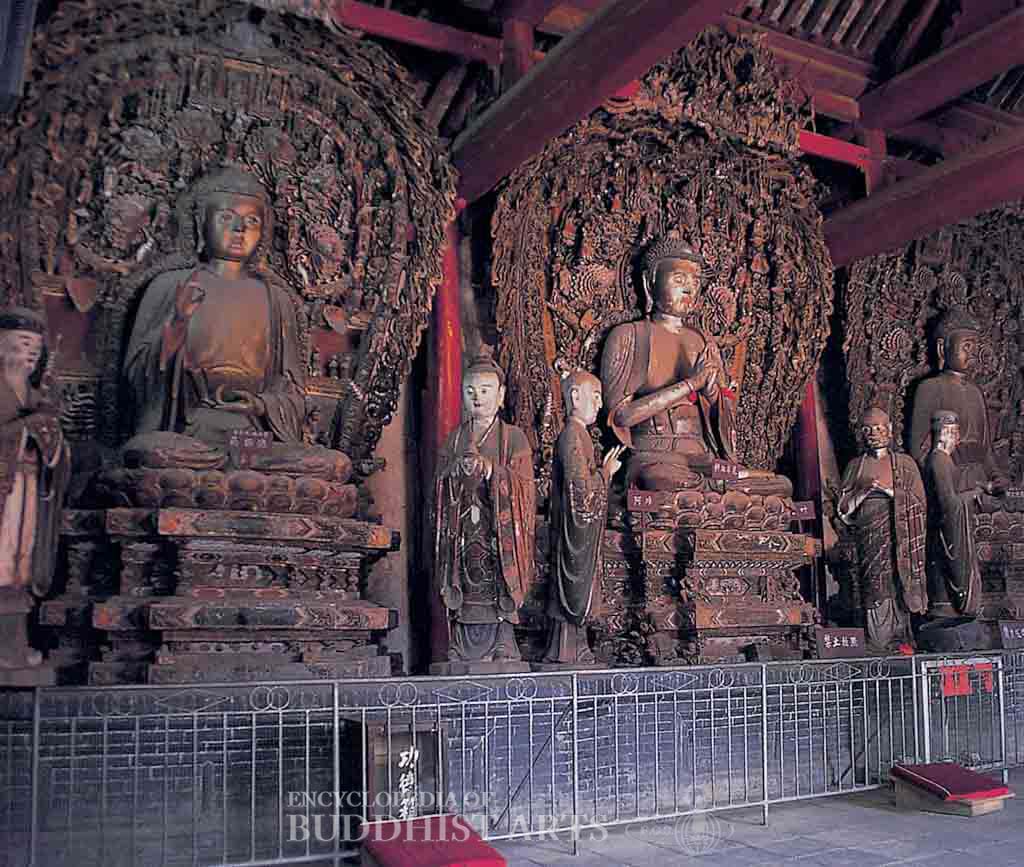
Shuilu Temple Water and Land Hall Sculptures
Clay
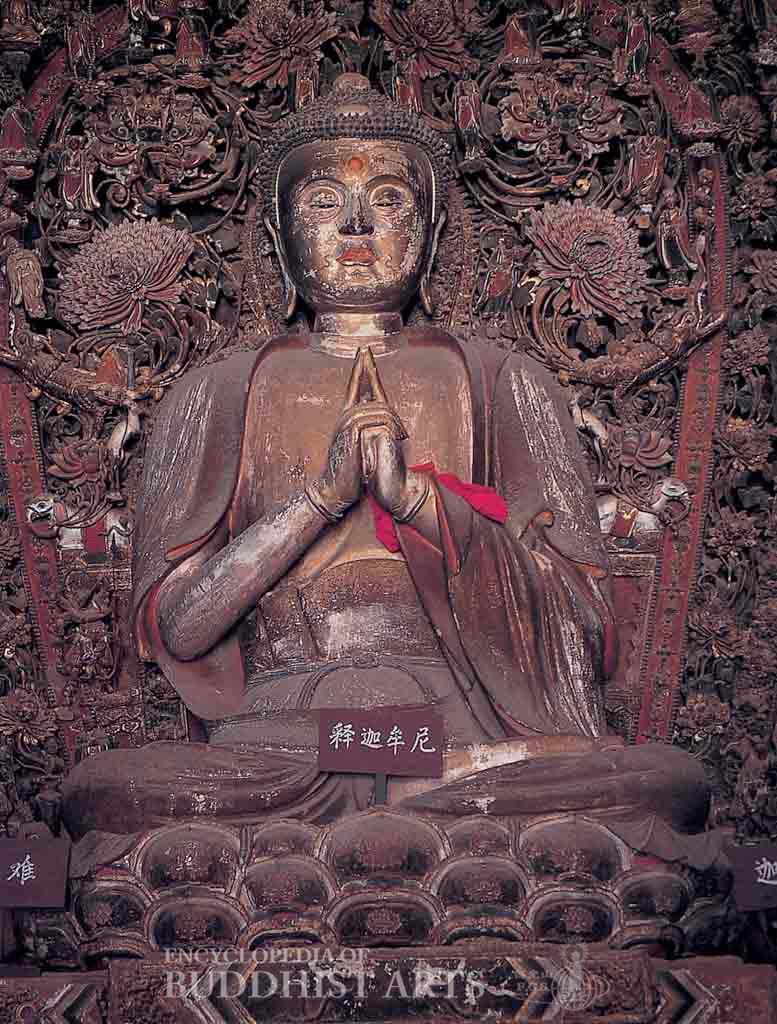
Shuilu Temple Water and Land Hall Sculptures: Sakyamuni Buddha
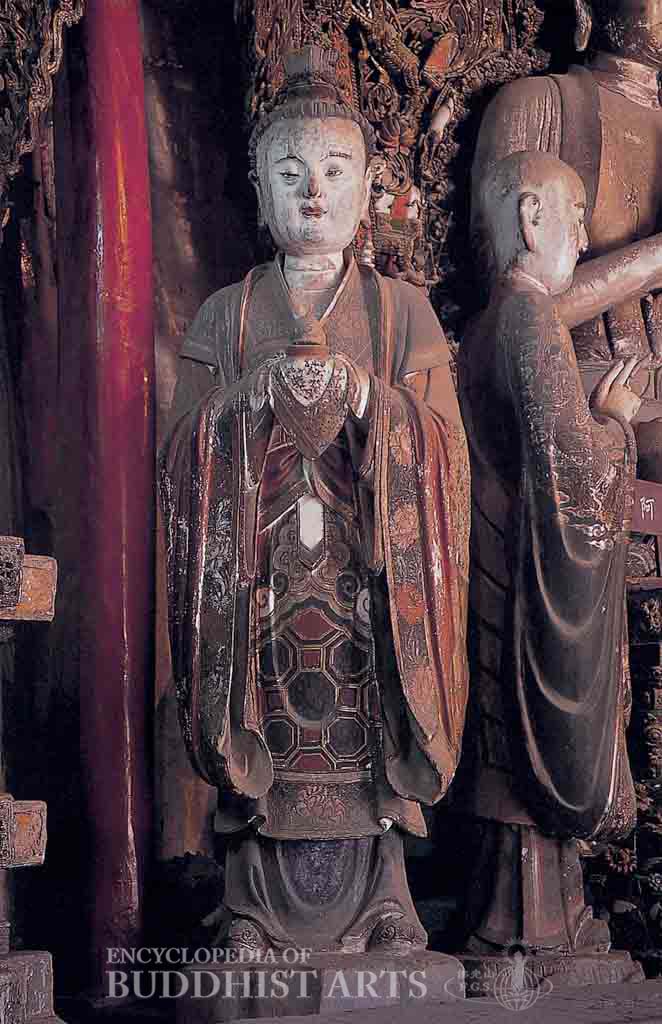
Shuilu Temple Water and Land Hall Sculptures: Attendant
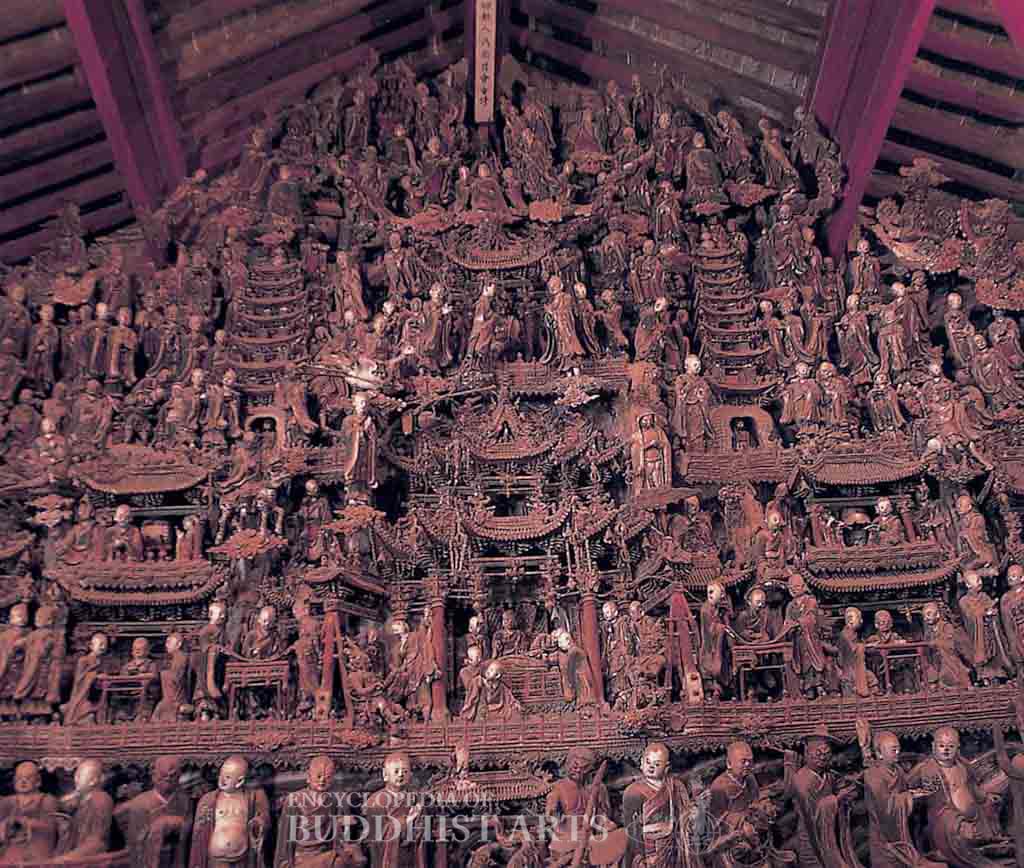
Shuilu Temple Water and Land Hall Sculptures
Shuilu Temple Water and Land Hall Sculptures
CHINA, Shaanxi, Xi’an; Ming dynasty
There are more than 3,700 individual sculptures located within the various parts of this hall. While most statues are stylistically the same, they demonstrate a wide variety of sculptural techniques.
Amitabha and the Medicine Buddha flank an altar along the central dividing wall on which three large Buddha statues are enshrined with Sakyamuni in the middle, each attended by two Bodhisattvas. The Buddhas are seated on lotus thrones and backed by magnificent mandorlas. An interesting conjunction involving Sakyamuni Buddha flanked by Confucius on the left and Laozi on the right can be found on the front wall. This configuration may refer to the convergence of the three religious systems that was being suggested at the time.
The sculpted north and south walls in the front hall include scenes from the Buddha’s life and previous births, the Five Hundred Arhats, and the Twenty-Four Heavenly Beings. An altar enshrining Avalokitesvara on a dragon throne is behind the central wall. Manjusri and Samantabhadra riding their mounts flank the Bodhisattva. The side-walls each feature a seated Bodhisattva. One wears a Buddha crown and a monastic robe. The figure holds a gourd and is flanked by ten laypersons. Experts believe the scene depicts Bhaisajyaraja Bodhisattva and the ten famous doctors of Chinese medicine. The wall behind him features Mahamayuri Bodhisattva riding a peacock.
The Bodhisattva on the north wall is presumed to be Ksitigarbha. The statue on the other side of this wall has sixteen pairs of arms, with one pair in the anjali (reverence) mudra, and is believed to be the Thousand-Armed Avalokitesvara.
For more details, go to the Encyclopedia of Buddhist Arts: Sculpture N-Sr, page 1087.
Cite this article:
author = Hsingyun and Youheng and Lovelock, Yann and Chou, Yuan and Huntington, Susan and Edson, Gary and Neather, Robert,
booktitle = {Encyclopedia of Buddhist Arts: Sculpture N-Sr},
pages = 1087,
title = {{Shuilu Temple Water and Land Hall Sculptures}},
volume = 12,
year = {2016}}