
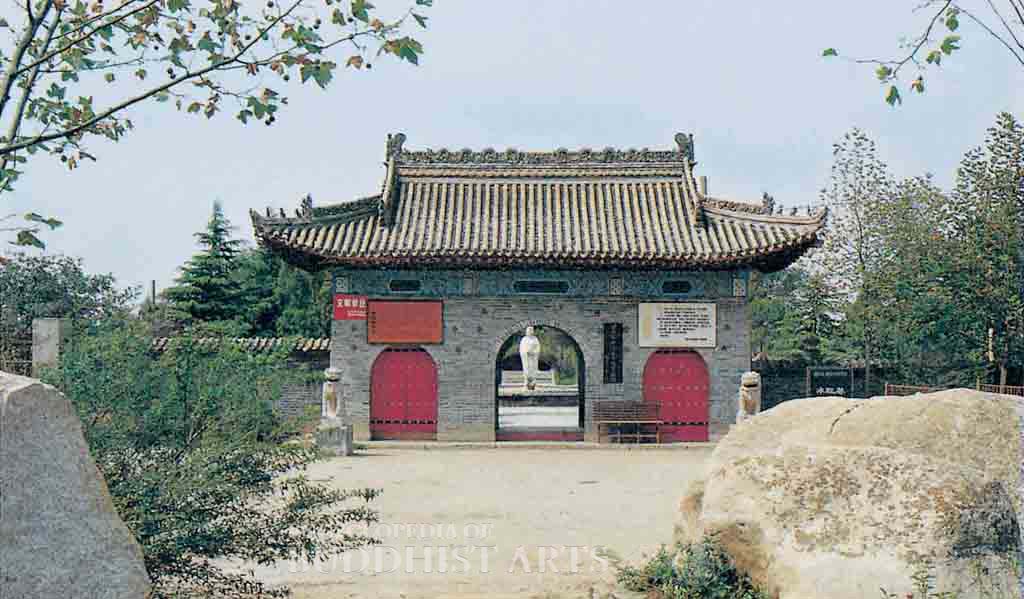
Shuilu Temple: Main Temple Gate
Shuilu Temple
CHINA, Shaanxi, Xi’an
Shuilu means Water and Land. The temple was originally part of the lower temple of Wuzhen (Realizing Truth) Temple. According to the local gazetteer and stele inscriptions, Wuzhen Temple was built around the Six Dynasties period (220–589) and by the Tang dynasty (618–907) it was already a well-known temple. However, the temple was neglected and fell into disrepair, with only the Shuilu Hall still standing. It was reconstructed during the Ming dynasty (1368–1644) and renamed Shuilu Temple. It was repaired a number of times during the 20th century. In 1989, a stele dated to the Tang dynasty was relocated here from the ruins of Kongji Temple and a pavilion was built to protect it. The temple was listed as a National Cultural Heritage Site in 1996.
Facing west, the complex occupies more than 2,000 sq m. The principal buildings include the main temple gate, front hall, middle hall, the Zhusheng Shuilu Hall, and subsidiary buildings. The main temple gate has three archways and a hip-and-gable roof. The five-bay wide Zhusheng Shuilu Hall has a single-eave hip-and-gable roof. There is an altar in the center of the building with a wall behind it, dividing the hall into a front section and a rear section. The temple is filled with colored molded statues that date to 1563 of the Ming dynasty. There are depictions of Buddhas, Life of the Buddha, Jataka tales, the Five Hundred Arhats crossing the seas, and the Twenty-Four Heavenly Beings.
For more details, go to the Encyclopedia of Buddhist Arts: Architecture M-S, page 1009.
Cite this article:
author = Hsingyun and Youheng and Johnson, Peter and Mankuang and Lancaster, Lewis,
booktitle = {Encyclopedia of Buddhist Arts: Architecture M-S},
pages = 1009,
title = {{Shuilu Temple}},
volume = 3,
year = {2016}}