
Kelaniya Temple
Kelaniya Temple
SRI LANKA, Western Province, Colombo
The full name of the temple is Kelaniya Raja Maha Vihara. Built during the 3rd century BCE by King Yatala Tissa, the temple was the most important Buddhist center in the area. The temple was either damaged or destroyed during foreign invasions and each time it was reconstructed. In 1767, the Dutch allowed the last major reconstruction of the temple, likely as a way of maintaining a good relationship with the Sri Lankan king.
The temple building was built in the first half of the 19th century and was extended in the first half of the 20th century. It is basically rectangular with extensions at the back. It has a double-eave hipped roof at the front and a flat roof with an octagonal tower with a pyramidal roof at the rear. At the front entrance there is an imposing portico with unusual round and square columns. The tympanum has a seated Buddha image at the center flanked by dragons with the head of a makara above. The building contains four sections: the King’s Image House, the Reclining Buddha Image House, the New Image House and the Golden Buddha Image House. The exterior is decorated with various reliefs including elephants, geese and ganas, as well as niches containing statues.
The Kelaniya stupa is situated to the north of the temple building. It has a height of 27 m and a diameter of 30 m, and is shaped like a rice grain heap; its square harmika is topped by a round base. The spire consists of stacked rings culminating in a jeweled finial. It is the largest stupa outside Anuradhapura.
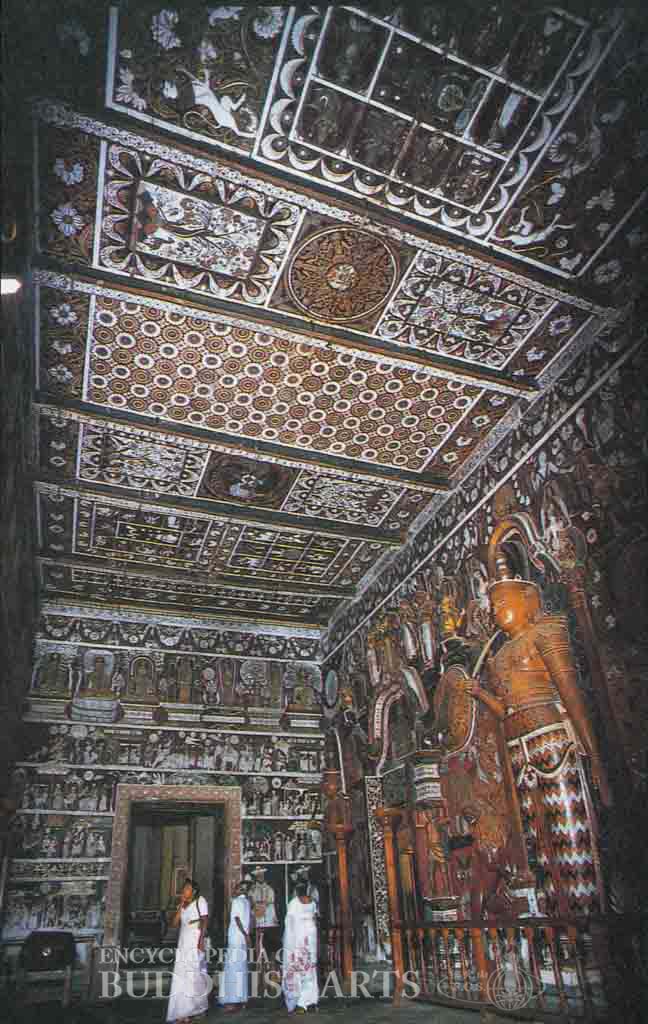
The walls and ceilings of the temple building are richly decorated. The paintings and sculptures are from the 18th, 19th and 20th centuries. There are elaborate geometric patterns on the ceiling of the front hall, with examples of Sri Lanka’s “industrial art,” which was based on Art Nouveau. There are many Buddha statues, including a reclining Buddha and a seated Buddha with snowy mountains in the background. There are numerous modern murals depicting the Life of the Buddha and scenes from the history of Buddhism in Sri Lanka, such as monks inscribing the Tripitaka and the arrival of the Buddha’s tooth relic. These modern murals were painted by Soliu Mendis between 1927 and 1946.
For more details, go to the Encyclopedia of Buddhist Arts: Architecture G-L, page 598.
Cite this article:
author = Hsingyun and Youheng and Johnson, Peter and Mankuang and Lancaster, Lewis,
booktitle = {Encyclopedia of Buddhist Arts: Architecture G-L},
pages = 598,
title = {{Kelaniya Temple}},
volume = 2,
year = {2016}}