
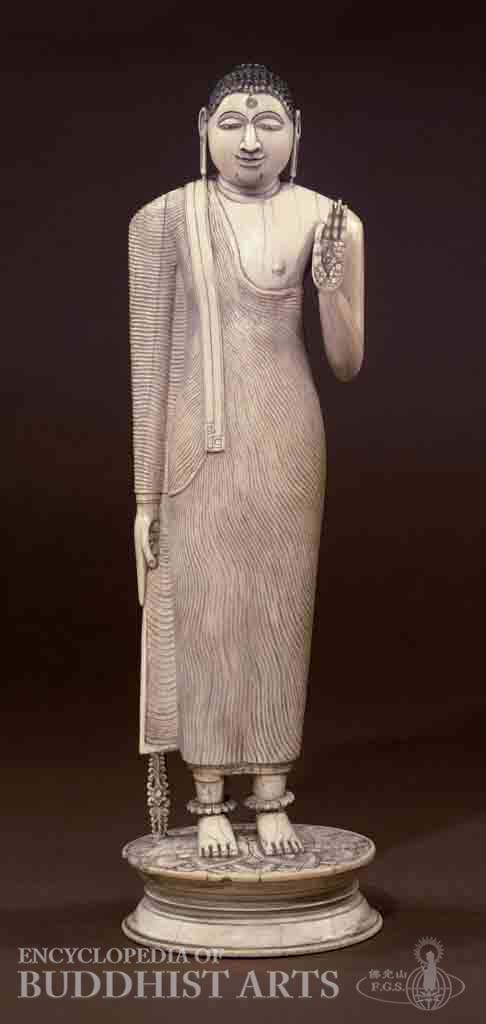
Standing Buddha
Ivory
Standing Buddha
SRI LANKA
This statuette was carved during the Kandy Kingdom (1590–1815) when the sophisticated and pains-taking medium of ivory sculpture was prevalent. The round-headed Buddha displays several characteristics of his status, including an urna in mid-forehead, elongated earlobes, three lines on the neck, and long slender fingers. The right hand is lifted in abhaya (fearlessness) mudra and displays a Dharma wheel on the palm. The monastic robe leaves the right shoulder bare and falls in a pattern of small wave-like folds. The material falls free to the right of the body and is steadied by the right hand. The figure stands on a Sumeru pedestal. Lotus prints are on his foot bracelets and the pedestal’s surface, representing the wheel pattern that tradition places on the soles of the Buddha’s feet.
For more details, go to the Encyclopedia of Buddhist Arts: Sculpture St-Z, page 1152.
Cite this article:
author = Hsingyun and Youheng and Lovelock, Yann and Chou, Yuan and Huntington, Susan and Edson, Gary and Neather, Robert,
booktitle = {Encyclopedia of Buddhist Arts: Sculpture St-Z},
pages = 1152,
title = {{Standing Buddha}},
volume = 13,
year = {2016}}