
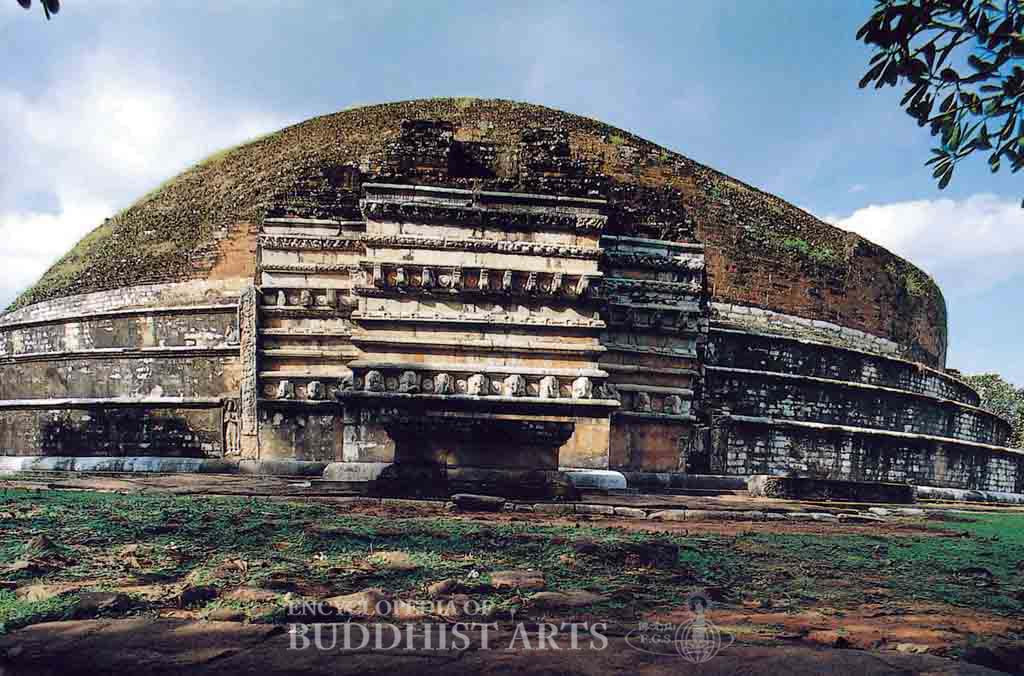
Mihintale: Kantaka Stupa
Mihintale
SRI LANKA, North Central Province
Located 11 km east of Anuradhapura, Mihintale was originally named Missaka Pabbata; it is also known as Cetiya Pabbata. It is the cradle of Buddhism in Sri Lanka and the island’s most important holy mountain. About 200 years after the parinirvana of the Buddha, King Asoka (reigned circa 269–232 BCE) sent his son Mahinda to the island to propagate Buddhism. King Devanampiyatissa (reigned 250–210 BCE) of Anuradhapura was hunting when he met Mahinda. Touched by Mahinda’s teachings, King Devanampiyatissa took refuge in the Triple Gem and thus Buddhism was established in Sri Lanka. Mahinda lived in seclusion on this mountain during his later years, and following his death his disciples renamed the mountain Mihintale in his memory.
The sacred area of Mihintale covers 182 ha. It consists of many Buddhist monuments, including three fully restored stupas: Ambatthala Stupa, Kantaka Stupa, and Indikatu Stupa. Ambatthala Stupa marks the meeting place of King Devanampiya Tissa and Mahinda. It is an inverted bowl stupa built of stone and encircled by stone pillars. Kantaka Stupa, excavated in 1934, has a height of 12 m and a base circumference of 130 m. It is an example of early Buddhist architecture during the Anuradhapura period (circa 4th century BCE–10th century CE). There are frontispieces at the four cardinal points with exquisite stone carvings, including a rare sculpture of the Hindu deity Ganesa. Indikatu Stupa has Sanskrit inscriptions from Mahayana sutras, which provides evidence that the mountain was once a center for Mahayana Buddhism. Additionally, records of the kind deeds of various kings are engraved on the rocks around the mountain.
For more details, go to the Encyclopedia of Buddhist Arts: Architecture M-S, page 736.
Cite this article:
author = Hsingyun and Youheng and Johnson, Peter and Mankuang and Lancaster, Lewis,
booktitle = {Encyclopedia of Buddhist Arts: Architecture M-S},
pages = 736,
title = {{Mihintale}},
volume = 3,
year = {2016}}