
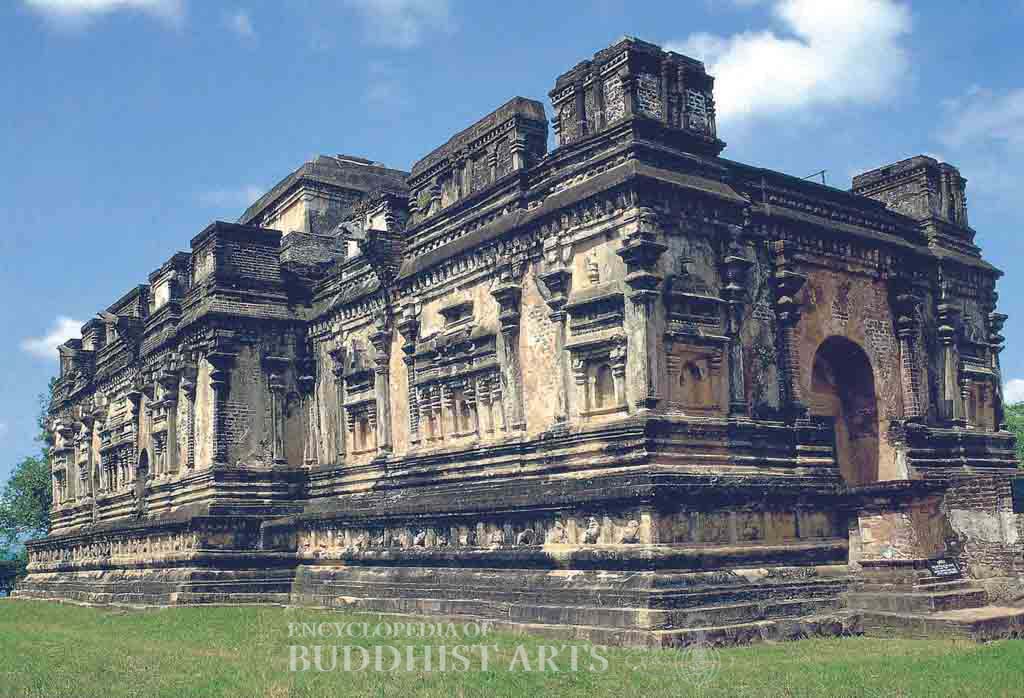
Thuparama Image House
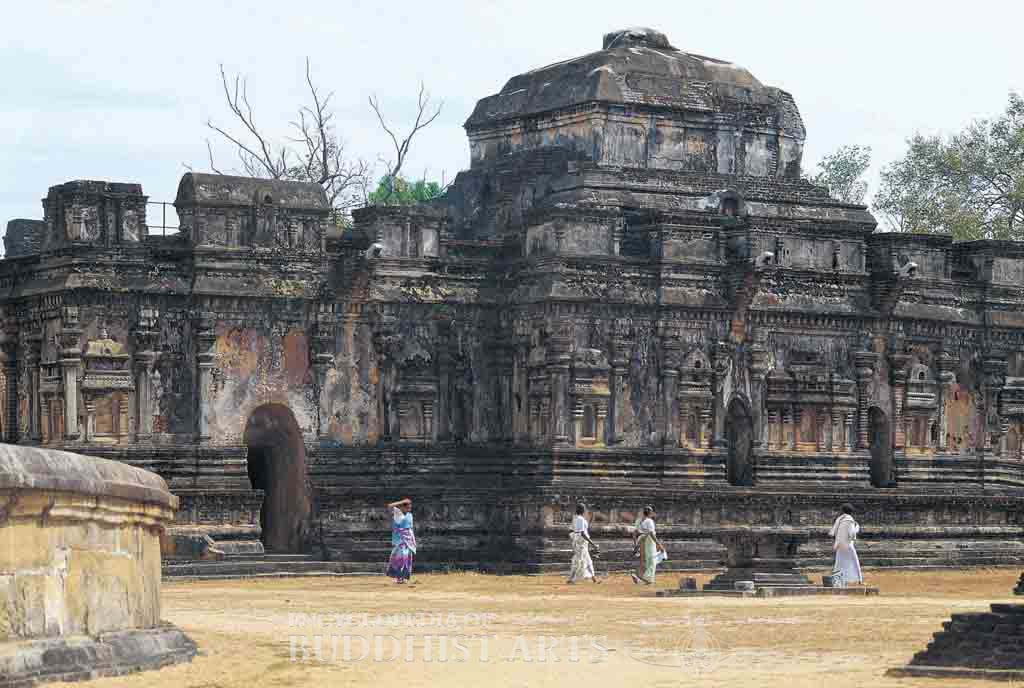
Thuparama Image House
Thuparama Image House
SRI LANKA, North Central Province, Polonnaruwa
Thuparama is derived from two Pali words: Thupa meaning Stupa and Arama meaning House. The Image House lies to the north of the old palace sites in Polonnaruwa and is one of the earliest Buddhist structures in the Sacred Quadrangle. It is said to have been built either by King Vijayabahu I (reigned 1055–1110) or by King Parakramabahu I (reigned 1153–1186). It is considered to be the best preserved vaulted roof structure in Sri Lanka and shows that vaulted architecture already existed there in the 12th century. As part of the Ancient City of Polonnaruwa, it was listed as a UNESCO World Heritage Site in 1982.
The Image House is constructed in brick and has 1.3 m thick walls covered in stucco reliefs. There are also brickwork balustrades, columns, and window frames. The arched vault with its tightly arranged bricks is typical of the prevalent Gedige style and reflects the mathematical precision of the construction technology of the time. There is a huge seated Buddha statue made of brick and stucco and several limestone statues dating from the 7th century inside the Image House.
For more details, go to the Encyclopedia of Buddhist Arts: Architecture T-Z, page 1117.
Cite this article:
author = Hsingyun and Youheng and Johnson, Peter and Mankuang and Lancaster, Lewis,
booktitle = {Encyclopedia of Buddhist Arts: Architecture T-Z},
pages = 1117,
title = {{Thuparama Image House}},
volume = 4,
year = {2016}}