
Amaravati Sculptures
Limestone
Amaravati Sculptures
INDIA, Andhra Pradesh, Amaravati; Satavahana period
A stupa was originally built on the site of Amaravati during the rule of King Asoka (reigned circa 269–232 BCE). It was expanded during the Satavahana period (circa 200 BCE–250 CE) and the following Ikshvaku period (circa 3rd–4th century). The sculptural style associated with the stupa, known as the Amaravati school, is regarded as one of the three major schools of ancient Indian art, pioneering some of the earliest physical depictions of the Buddha and a sequential manner of relating incidents that was possibly borrowed from Greco-Roman sculpture.
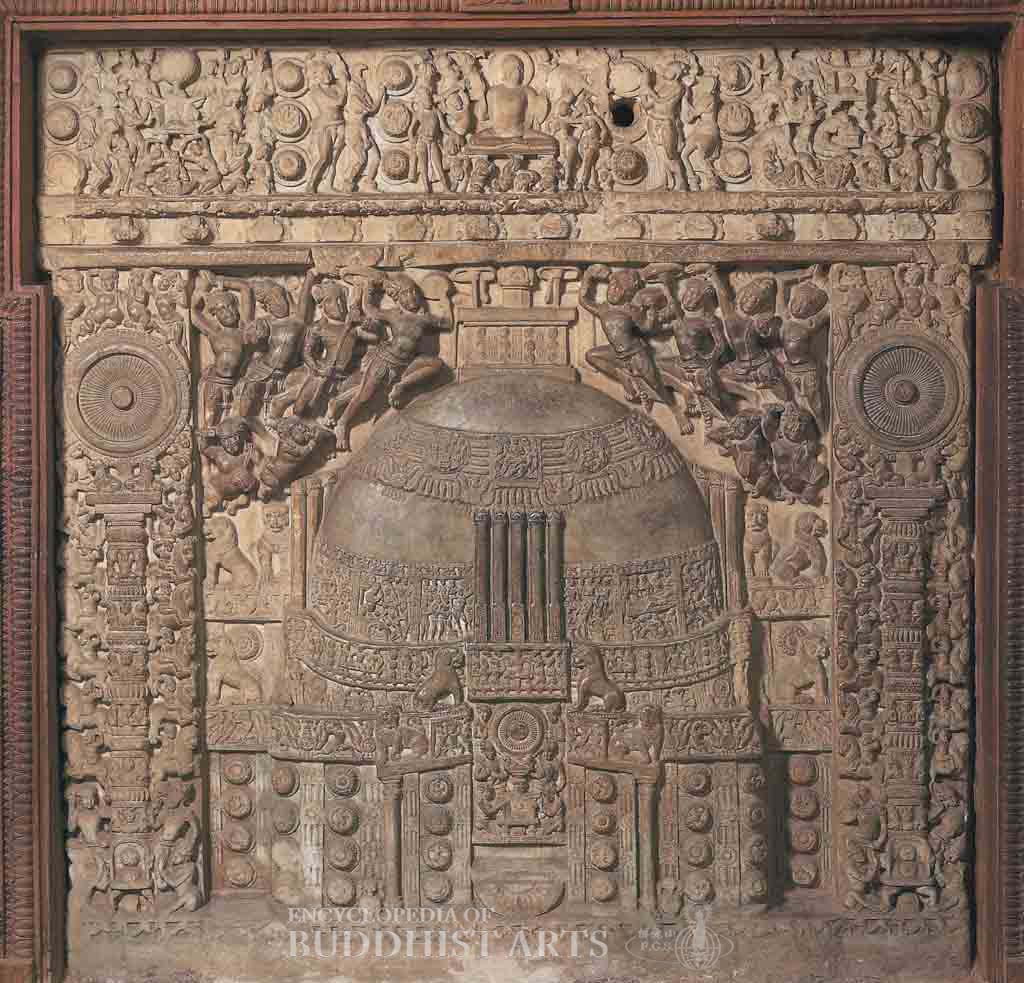
The railings were added around 150 CE and introduced a new way of treating spatial perspective. The figures of the first plane are carved in deep relief, and the depth of cutting gradually diminishes with the successive planes. The casing slabs of the following century grew richer and more elaborate in detail. The Buddha was appearing in narratives and standing sculptures by this time. Both approaches to his representation are employed in the carving illustrated. The Great Stupa at Amaravati is shown on a relief that once decorated the railing or the surface of the stupa. Worshippers in the center foreground are clustered round a thousand-spoke Dharma wheel that represents the Buddha’s teachings. Mara’s daughters, who are trying to distract him from his quest, surround Prince Siddhartha in the frieze at the top. More Dharma wheels are depicted on pillars on either side of the composition. Apsaras paying homage to the Buddha fill the remaining space.
For more details, go to the Encyclopedia of Buddhist Arts: Sculpture A-F, page 14.
Cite this article:
author = Hsingyun and Youheng and Lovelock, Yann and Chou, Yuan and Huntington, Susan and Edson, Gary and Neather, Robert,
booktitle = {Encyclopedia of Buddhist Arts: Sculpture A-F},
pages = 14,
title = {{Amaravati Sculptures}},
volume = 10,
year = {2016}}