
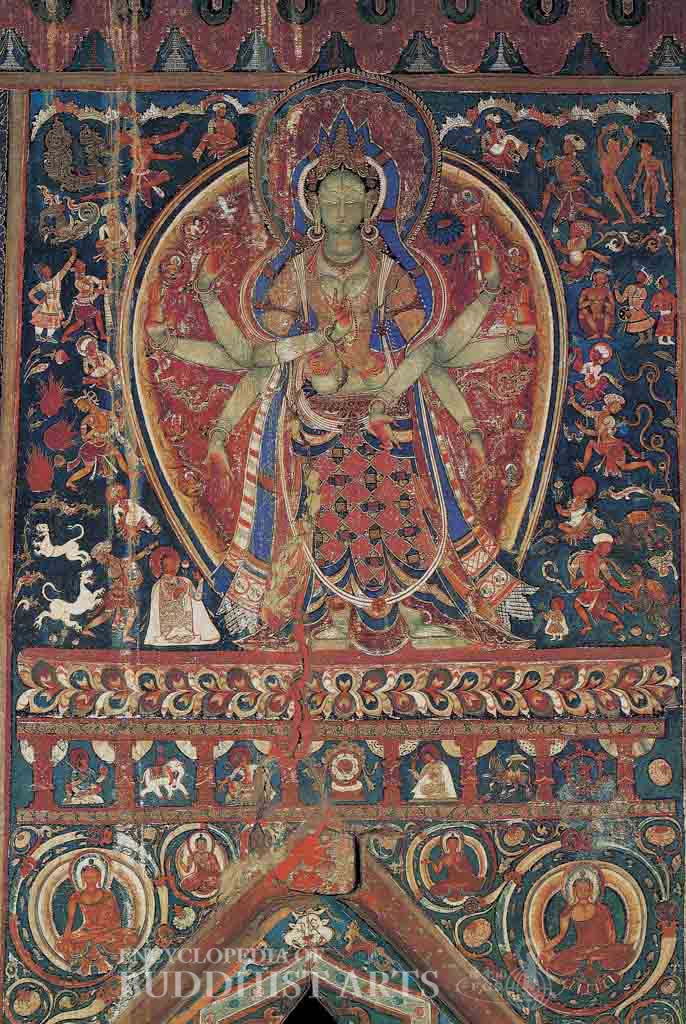
Alchi Monastery Three Story Hall: Green Tara
Alchi Monastery Three Story Hall: Green Tara
INDIA, Jammu and Kashmir, Ladakh
This mural, 217 cm high and 161 cm wide, is painted above the niche that enshrines the statue of Manjusri Bodhisattva on the east wall on the second story of the Three Story Hall. The central figure is the Eight-Armed Green Tara, a manifestation of Avalokitesvara who protects sentient beings from the eight fears. Images of Green Tara were often painted in temples in Orissa, India between the 8th and 9th centuries, as well as in western Tibet and Himachal Pradesh during the 11th century.
Green Tara is surrounded by a nimbus and a mandorla. She wears a Kashmiri headdress whose splendid bands, together with the stole wrapped around the shoulders and the stringed beads wound around the arms and hang down to the feet. Tara has a slender waist and wears a tight-fitting upper garment tied with a sash. The dhoti is decorated with geometric motifs and rich colors. Two of the hands form mudras in front of the body; the right hand also holds beads. The remaining hands hold objects including a sutra and a vase, or form mudras.
The red mandorla is outlined with colorful lines. Eight female deities seated within small circles are painted within the inner perimeter of the mandorla. There is a blue lotus suspended above Tara’s left shoulder. The pairs of illustrations drawn outside the mandorla display the encounter with and the overcoming of each of the eight fears. The illustrations on the left show the fears of water, thieves, fire, and lions; those on the right portray the fears of ghosts, imprisonment, snakes, and elephants. The images are separated by decorative flowers and plants. The vividly painted figures wear the traditional clothing of the Kashmiri people.
For more details, go to the Encyclopedia of Buddhist Arts: Painting A-H, page 16.
Cite this article:
author = Hsingyun and Youheng and Youlu and Wilson, Graham and Manho and Mankuang and Huntington, Susan,
booktitle = {Encyclopedia of Buddhist Arts: Painting A-H},
pages = 16,
title = {{Alchi Monastery Three Story Hall: Green Tara}},
volume = 14,
year = {2016}}