
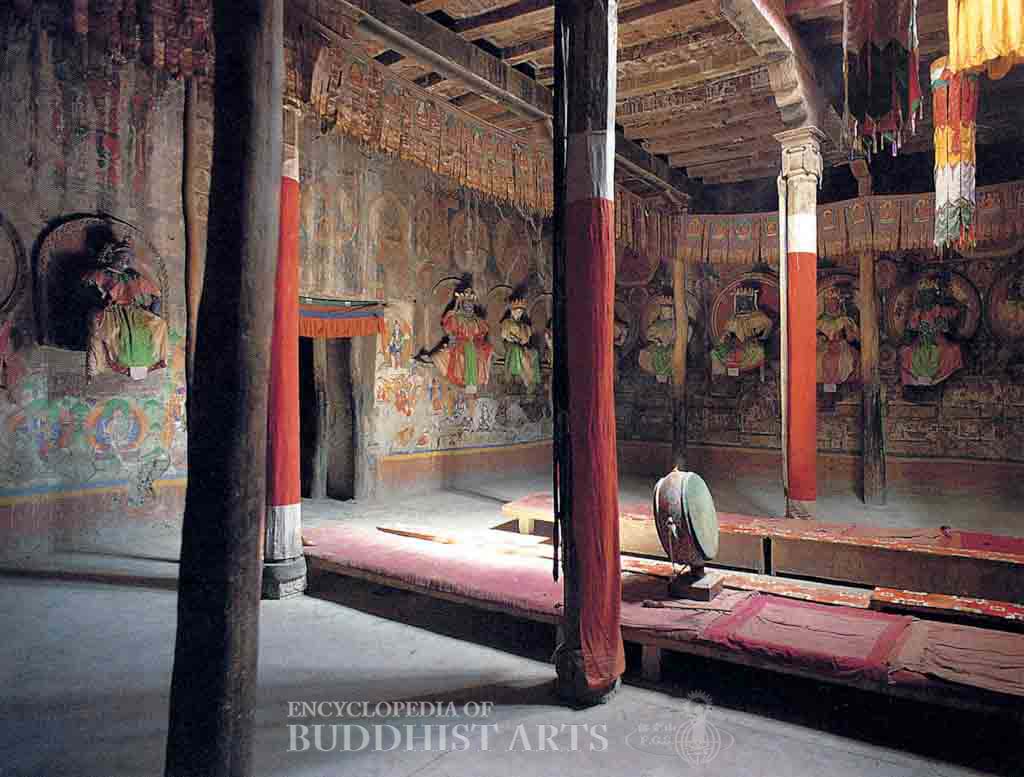
Tabo Monastery: Assembly Hall
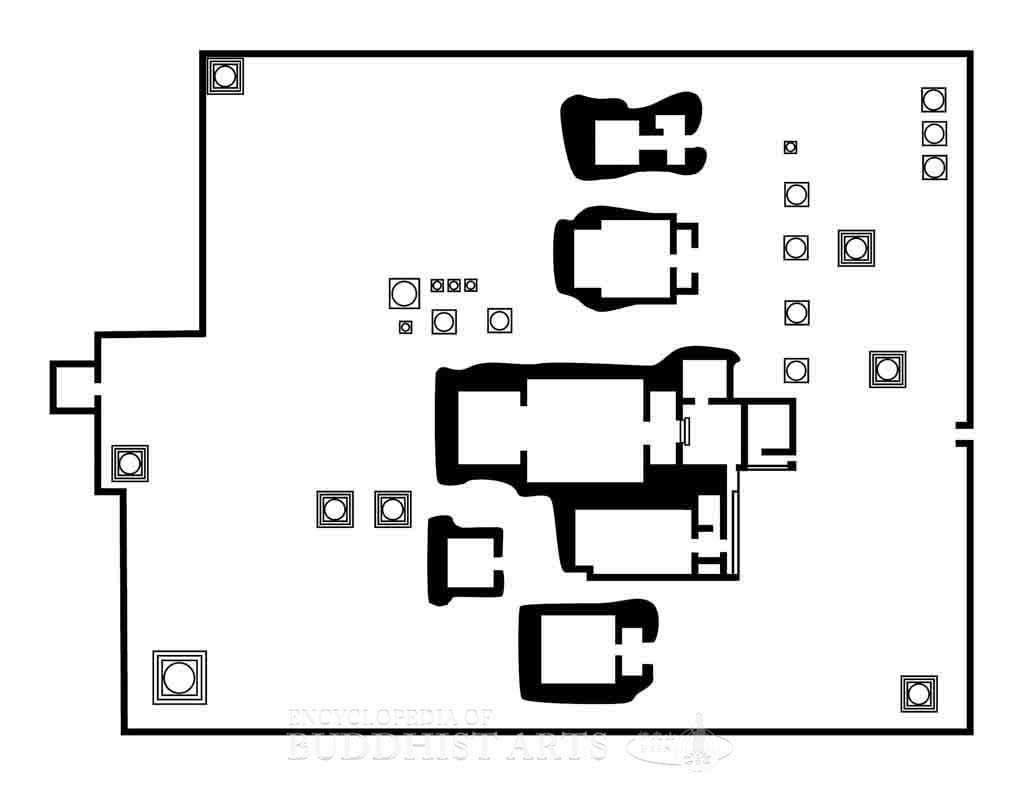
Tabo Monastery (site layout)
Tabo Monastery
INDIA, Himachal Pradesh, Lahaul-Spiti
The monastery is situated in Spiti Valley at approximately 3,000 m above sea level. Construction of the monastery was initiated in 996 by Yeshe O, a king and royal lama of the Guge Kingdom, and developed by Rinchen Zangpo. In 1042, Yeshe O’s grandnephew Jangchub O, also a royal monk, renovated the monastery and repainted the murals of the halls. The central hall was renovated in 1983.
The area of the monastery is 6,300 sq m. It lies on a north-south axis and is surrounded by high walls made of mud bricks. The central hall is situated at the center, while to the north there are the Maitreya Hall and the Small Dromton Hall, and to the south there are the Large Dromton Hall, Mandala Hall, and the Golden Hall. There are 23 Tibetan stupas scattered within the complex, but most of them are located on either side of the Maitreya Hall. There are also many meditation caves along the cliff.
The two-story central hall faces east. Starting from the entrance, it is composed of the new entrance hall, the old entrance hall, the assembly hall, and an inner shrine with an ambulatory. The assembly hall is the largest chamber and it enshrines four seated statues of Vairocana Buddha. To the north of the new entrance hall there is the Protector Shrine, and to the south there is a corridor connecting to the Large Dromton Hall.
The monastery has preserved a large quantity of precious sutras, thangkas, sculptures, murals, and other works of art. It is reputed as the “Ajanta in the Himalayas.” It is possible to detect many influences on the painting style from the art of adjacent regions. It is an exceedingly valuable resource for research into Buddhist history and the art of the western Himalayan region.
For more details, go to the Encyclopedia of Buddhist Arts: Architecture T-Z, page 1075.
Cite this article:
author = Hsingyun and Youheng and Johnson, Peter and Mankuang and Lancaster, Lewis,
booktitle = {Encyclopedia of Buddhist Arts: Architecture T-Z},
pages = 1075,
title = {{Tabo Monastery}},
volume = 4,
year = {2016}}