
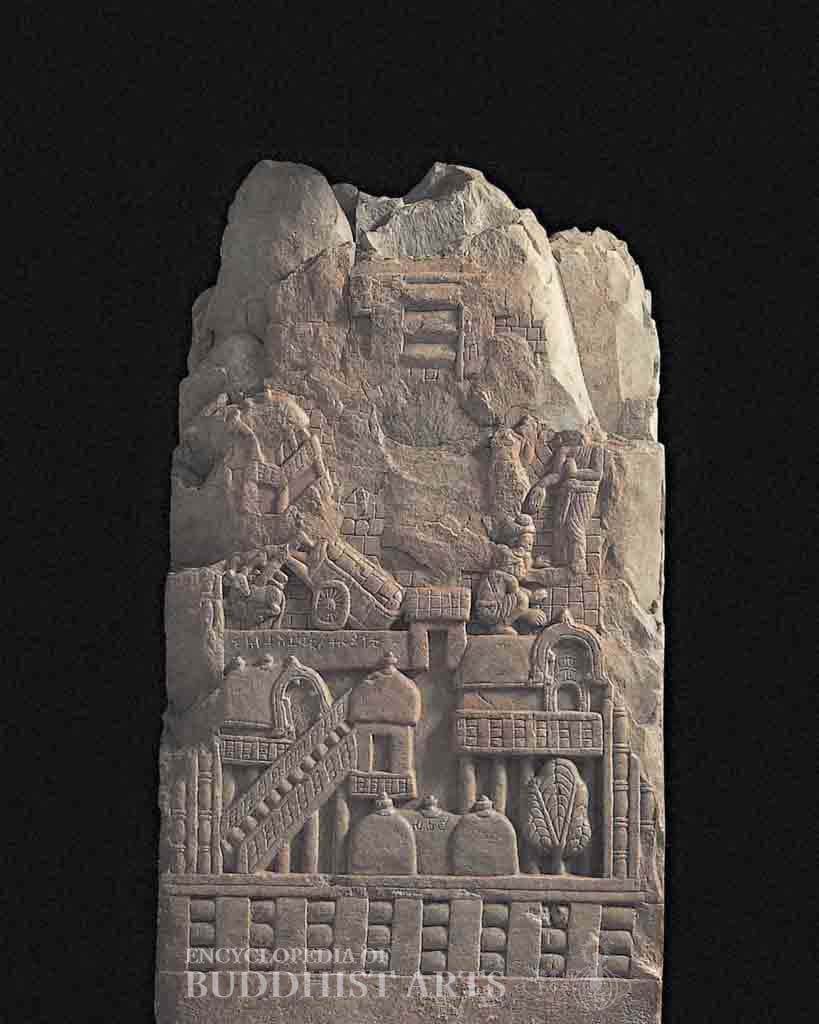
Amaravati: Donation of the Jetavana Monastery
Limestone
Amaravati: Donation of the Jetavana Monastery
INDIA, Andhra Pradesh, Amaravati; Satavahana period
This relief was originally part of a square pillar at Amaravati. It depicts the story of Anathapindada, who purchased land for a monastery by covering it in gold pieces. The linear perspective is absent in this relief, with no foreshortening as the background is extended upwards. The style is similar to the relief found at Bharhut showing the same subject. Comparison with Bharhut relief suggests this piece may date from the second half of the 1st century BCE. Workers in the upper half of the relief are busily loading and transporting gold while the newly built monastery with its monastic quarters and three stupas are located at the bottom. A horizontal wall separates the two times. A damaged figure on the upper left is robed with one hand in the varada (wish-granting) mudra and the other in reverence.
For more details, go to the Encyclopedia of Buddhist Arts: Sculpture A-F, page 15.
Cite this article:
author = Hsingyun and Youheng and Lovelock, Yann and Chou, Yuan and Huntington, Susan and Edson, Gary and Neather, Robert,
booktitle = {Encyclopedia of Buddhist Arts: Sculpture A-F},
pages = 15,
title = {{Amaravati: Donation of the Jetavana Monastery}},
volume = 10,
year = {2016}}