
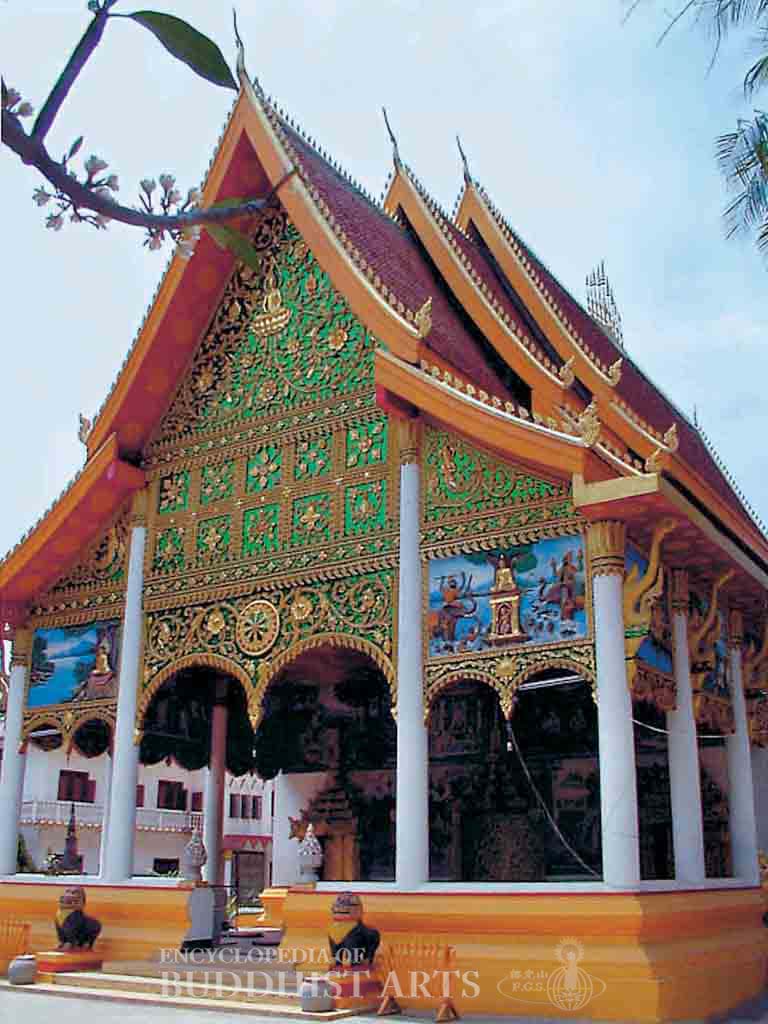
Wat Inpeng: Ordination Hall
Wat Inpeng
LAOS, Vientiane
The Lao word In is derived from Pra-in, which means God, while Peng comes from the term Penghang, meaning Transform. The exact construction date of the temple is unknown but there is a legend that it was built with the help of the King of Gods, who appeared in the form of a wise man. It has a similar layout to other nearby temples built in the 16th century by King Setthathirath (reigned 1547–1571). The first renovation started in 1911 and it was reconstructed in the 1970s.
The ordination hall is the main building at the temple. The single-story hall is supported by round columns at the front, forming a portico. A special feature of the hall is the painted relief on the gable walls and around the portico. The pediment is decorated with images of the Buddha, lotus, and vine patterns, embellished in gold with a green background. Under the eaves around the portico, there are colorful illustrations depicting the Life of the Buddha. The steep gable roof with multiple tiers and eaves, together with the highly decorated pediment is commonly seen in Central and Southern Laos, as well as in the northeastern region of Thailand. A large golden seated Buddha statue is enshrined within the hall.
For more details, go to the Encyclopedia of Buddhist Arts: Architecture T-Z, page 1198.
Cite this article:
author = Hsingyun and Youheng and Johnson, Peter and Mankuang and Lancaster, Lewis,
booktitle = {Encyclopedia of Buddhist Arts: Architecture T-Z},
pages = 1198,
title = {{Wat Inpeng}},
volume = 4,
year = {2016}}