
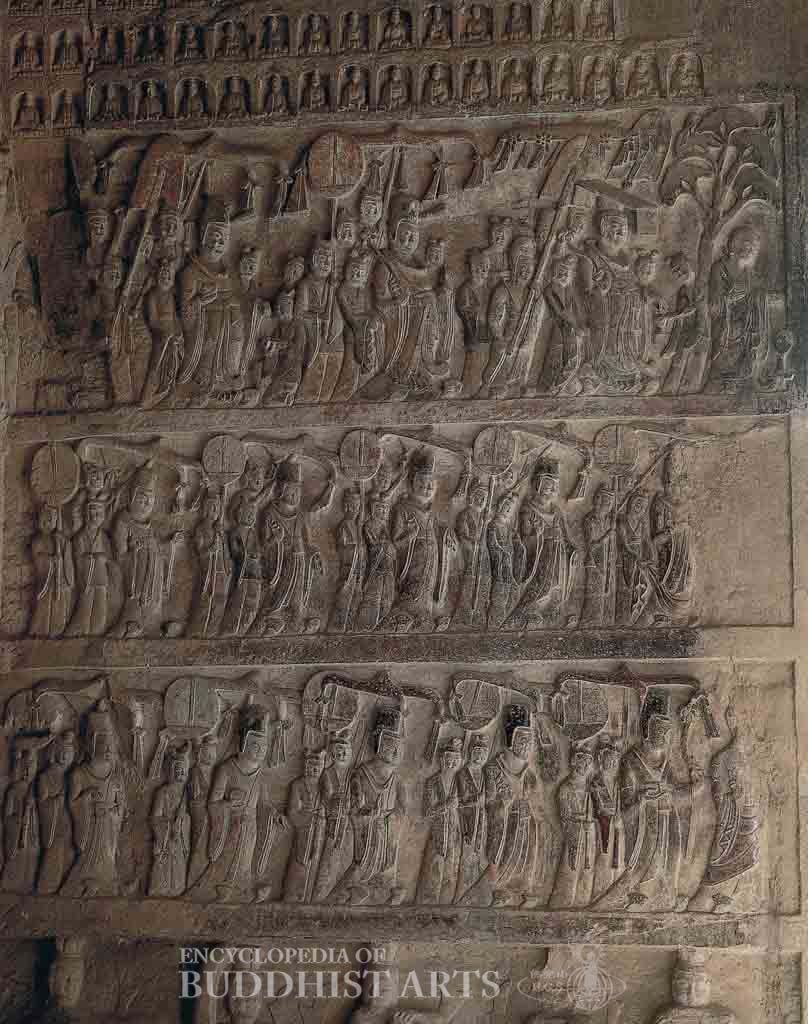
Gongxian Cave 1: Emperor Paying Respect to the Buddha (right side)
Stone

Gongxian Cave 1: Empress Paying Respect to the Buddha (detail) (left side)
Gongxian Cave 1: Emperor and Empress Paying Respect to the Buddha
CHINA, Henan, Zhengzhou; Northern Wei dynasty
These three rows of bas-relief carvings are located on the front (south) wall on both sides of the entrance. The left carving depicts the emperor and his retinue paying respect to the Buddha. The first figure on the right side of the upper row is a monk standing beside a Bodhi tree. The emperor, following behind, is depicted wearing a tasseled crown, and a lotus held in one hand. An attendant holds a parasol over his head, while other attendants and noble devotees follow behind. The lower two rows are both somewhat damaged, but it can be seen that each row features a monk leading five noble devotees who either hold a lotus or censer, or have joined palms. The number of attendants accompanying each figure is indicative of their status; notably, the emperor has the most attendants, with the number of attendants decreasing for subsequent nobles.
An almost identical carving depicting the empress paying respect to the Buddha is found on the right side of the doorway; however, the middle and lower sections are damaged. In the upper row, six attendants accompany the empress. The noble ladies following the empress are joined by attendants in varying numbers.
The front walls of Gongxian Caves 3 and 4 contain similar images. These caves were all constructed after Longmen Grotto 140 (Central Binyang Grotto), which is decorated with similar scenes. It is therefore presumed that these carvings were based on those at Longmen Grottoes. They differ only in the greater number of figures in the arrangement and their slightly more complex composition.
For more details, go to the Encyclopedia of Buddhist Arts: Caves R-L, page 385.
Cite this article:
author = Hsingyun and Youheng and Johnson, Peter and Mankuang and Huntington, Susan and Edson, Gary and Neather, Robert,
booktitle = {Encyclopedia of Buddhist Arts: Caves R-L},
pages = 385,
title = {{Gongxian Cave 1: Emperor and Empress Paying Respect to the Buddha}},
volume = 6,
year = {2016}}