
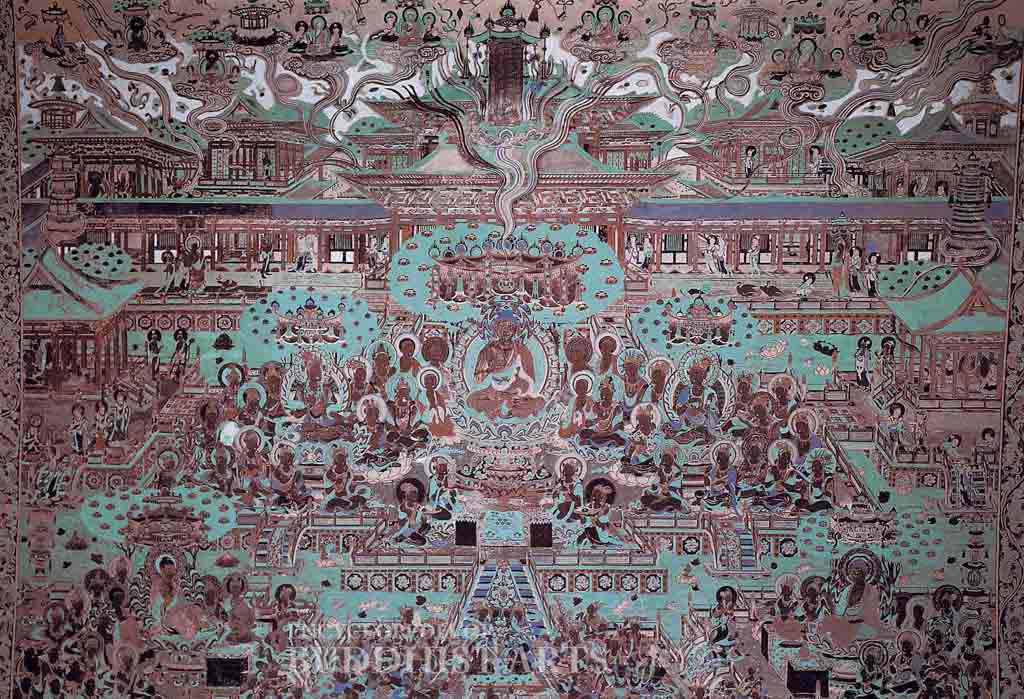
Mogao Cave 148: Illustration of the Medicine Buddha Sutra
Mogao Cave 148: Illustration of the Medicine Buddha Sutra
CHINA, Gansu, Dunhuang; Tang dynasty
This mural is located to the left of the entrance on the front (east) wall of the main chamber. According to the Medicine Buddha Sutra, the magnificence of the Medicine Buddha’s Eastern Pure Land is equivalent to that of Amitabha Buddha’s Western Pure Land. Indeed, the composition of this mural is similar to the depiction of Amitabha’s Pure Land in the illustration of the Amitayurdhyana Sutra to the right of the entrance. Both murals were painted during the High Tang period (712–756).
The Pure Land is filled with magnificent palaces and pavilions constructed above a lotus pond. The Medicine Buddha sits in full lotus position on a lotus throne in the center of a large central platform. His right hand forms a mudra, and he is flanked by Suryaprabha and Candraprabha Bodhisattvas. Three elaborate canopies hang above the figures, and they are surrounded by other Bodhisattvas and disciples of the Buddha who listen attentively to the Dharma.
On either side of the central platform are halls with groups of Bodhisattvas in the corridors. The Bodhisattvas are engaged in discourse and hold flowers or food in their hands. Above the Medicine Buddha are sutra pillars, pavilions, and more Buddhas and Bodhisattvas descending upon clouds from all directions. In the lower portion of the mural, heavenly beings dance and play music at the center, while on either side a Buddha is shown seated on a platform surrounded by Bodhisattvas. Ducks and children play in the lotus ponds. Beside this mural, just to the left of the doorway, the Twelve Great Vows of the Medicine Buddha are inscribed in a cartouche, and on the right side is another cartouche that lists the nine kinds of untimely death.
For more details, go to the Encyclopedia of Buddhist Arts: Caves M-Mo, page 964.
Cite this article:
author = Hsingyun and Youheng and Johnson, Peter and Mankuang and Huntington, Susan and Edson, Gary and Neather, Robert,
booktitle = {Encyclopedia of Buddhist Arts: Caves M-Mo},
pages = 964,
title = {{Mogao Cave 148: Illustration of the Medicine Buddha Sutra}},
volume = 7,
year = {2016}}