
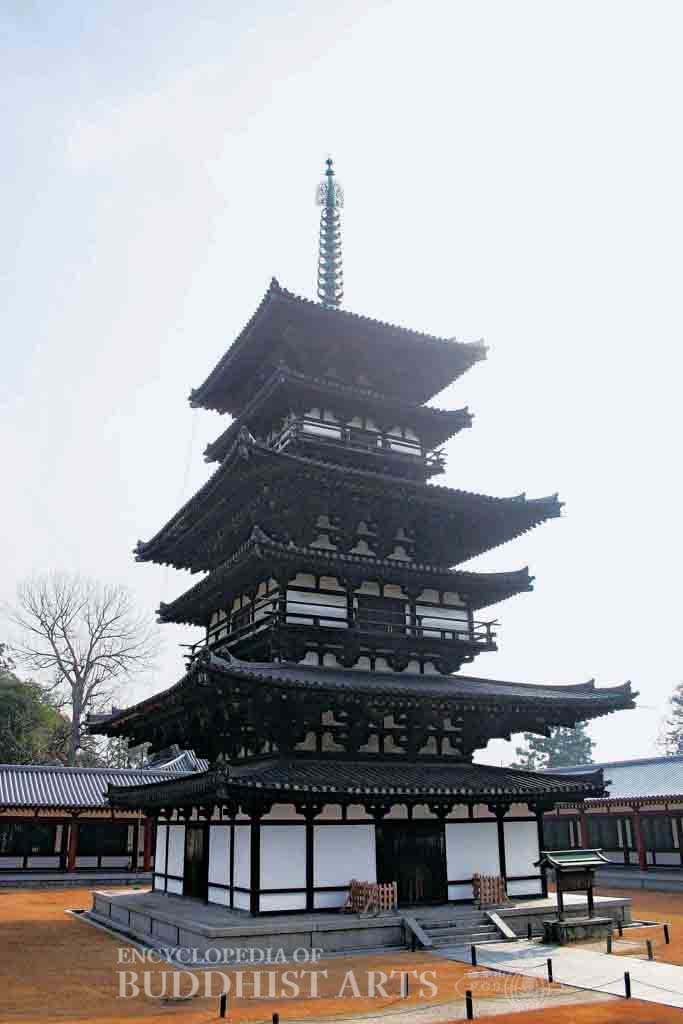
Yakushiji Temple East Pagoda
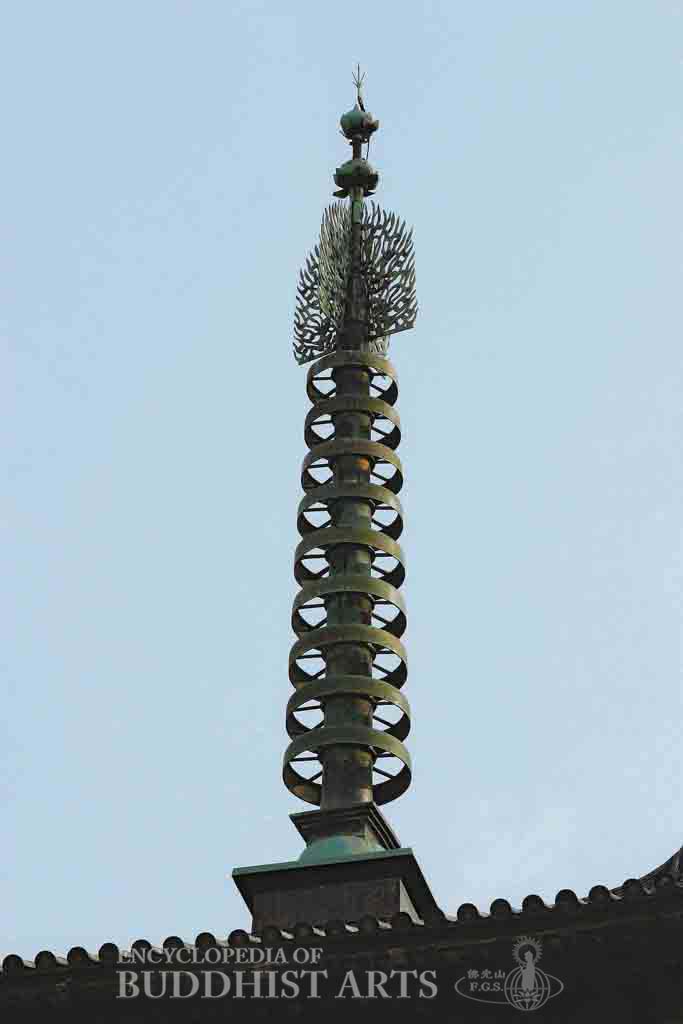
Yakushiji Temple East Pagoda: Spire
Yakushiji Temple East Pagoda
JAPAN, Nara
The East Pagoda is located within Yakushiji (Medicine Buddha Temple) and is the only structure in the temple that has remained unchanged since it was built in 730 during the Nara period. It was listed as a National Treasure in 1951.
The three-story three-by-three bay wooden pagoda stands on a stone base platform and is 34.1 m high. The eaves are covered with cylindrical tiles. It has architectural features typical of the Hakuho period (645–710), such as three-tier bracket sets and rafters. The tall spire consists of a harmika, an inverted bowl, upturned lotus, stacked rings, a flame, and a jewel. The flame has images of 24 apsaras playing flutes and scattering flowers. The columns within the first story are carved with inscriptions recording its construction. A statue of the Ascetic Sakyamuni is enshrined within. Each story has double eaves with the lower eave being smaller than the upper eave. The roofs are covered with cylindrical tiles. This pagoda’s beauty has often been compared to “frozen music,” and it is regarded as one of the finest pagodas in Japan.
For more details, go to the Encyclopedia of Buddhist Arts: Architecture T-Z, page 1340.
Cite this article:
author = Hsingyun and Youheng and Johnson, Peter and Mankuang and Lancaster, Lewis,
booktitle = {Encyclopedia of Buddhist Arts: Architecture T-Z},
pages = 1340,
title = {{Yakushiji Temple East Pagoda}},
volume = 4,
year = {2016}}