
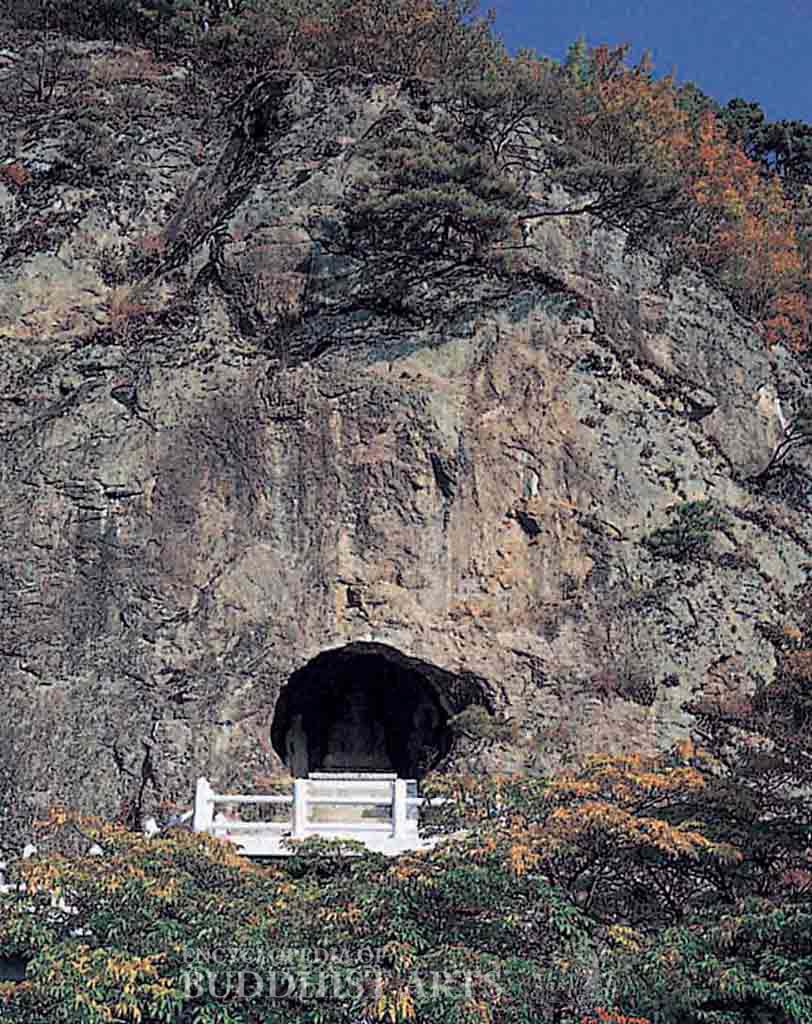
Gunwi Samjon Cave

Gunwi Samjon Cave
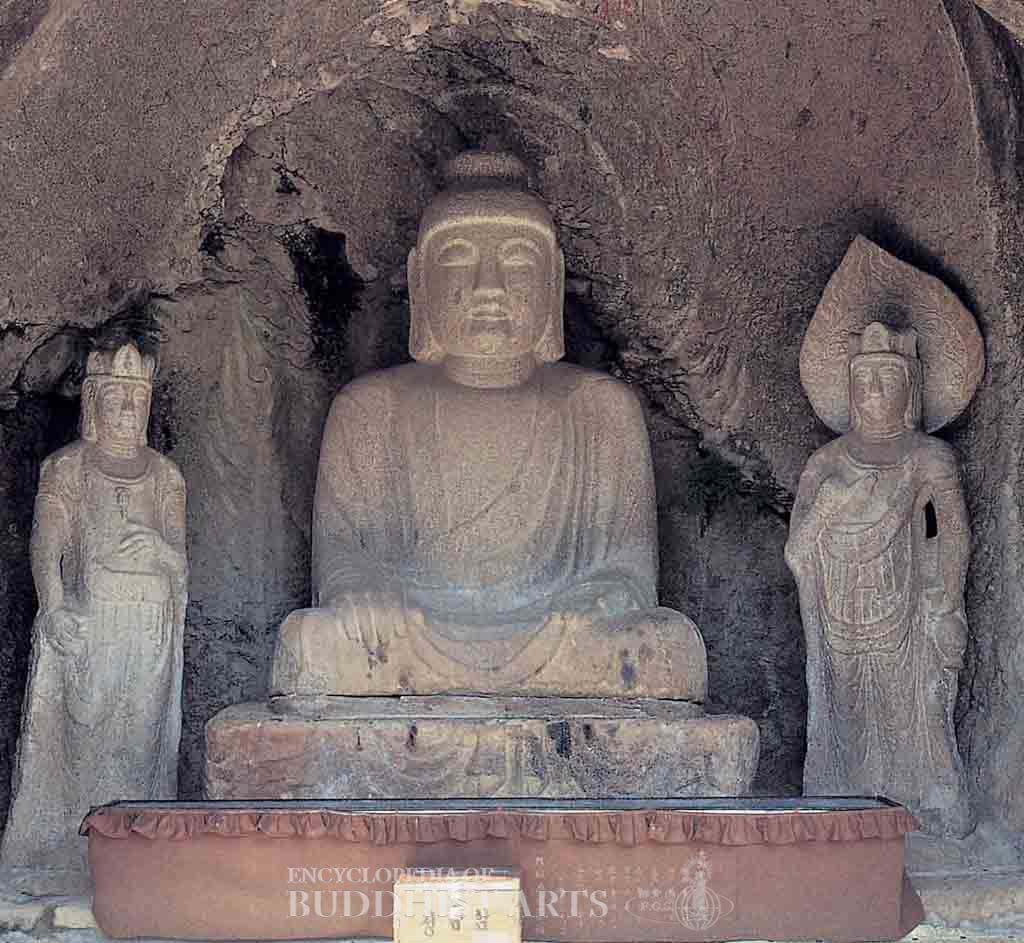
Gunwi Samjon Cave: Amitabha Buddha Triad
Gunwi Samjon Cave
SOUTH KOREA, North Gyeongsang, Gunwi
Located on a cliff north of Haksoam Valley on Palgongsan Mountain, this cave was excavated during the Unified Silla dynasty (668–935), making use of the natural structure of the cliffside. It is rectangular in shape, faces southeast, and measures 4.25 m high. The cave was listed as National Treasure No. 109 in 1962.
Enshrined within the cave is a 2.88 m high statue of Amitabha Buddha, flanked by a 1.8 m high Avalokitesvara and a 1.92 m high Mahasthamaprapta. The statues were carved outside the cave and then placed within it upon completion. Amitabha Buddha became a popular subject of devotion during the Unified Silla dynasty, and this is one of the first carvings of the Amitabha Buddha Triad in Korea. Amitabha sits in full lotus position on a square platform. The Buddha has a square face and a solemn expression. The monastic robe is carved with smooth, flowing folds. A nimbus and aureole are painted on the cave wall behind the statue. The hands rest on the legs, one placed palm down and the other with the palm facing up. The two Bodhisattvas have round faces and are adorned with necklaces and armlets. They wear stoles and flowing dhotis.
The appearance of the figures is reminiscent of the style of the Silla dynasty (57 BCE–935 CE). However, the carving techniques employed are more advanced than those of previous periods. This can be seen in the delicate lines on the Buddha’s robe, and the flame-patterned nimbus behind the head of one of the Bodhisattvas.
For more details, go to the Encyclopedia of Buddhist Arts: Caves R-L, page 418.
Cite this article:
author = Hsingyun and Youheng and Johnson, Peter and Mankuang and Huntington, Susan and Edson, Gary and Neather, Robert,
booktitle = {Encyclopedia of Buddhist Arts: Caves R-L},
pages = 418,
title = {{Gunwi Samjon Cave}},
volume = 6,
year = {2016}}