
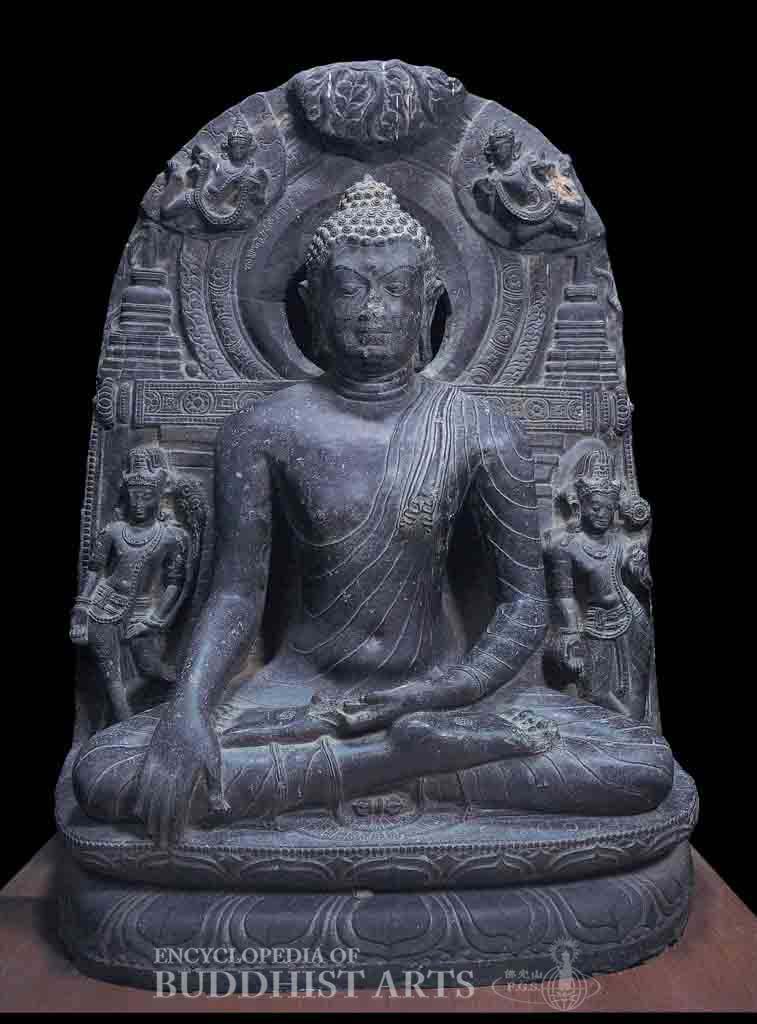
Bodhgaya: Buddha and Attendants
Stone
Bodhgaya: Buddha and Attendants
INDIA, Bihar, Bodhgaya
This sculpture believed created in the late 9th century, during the Pala period (circa 8th–12th century) was unearthed in Bodhgaya. It includes features such as a broad and muscular body. The decorative style of the robe and nimbus are characteristics prevalent during the Pala period.
The Buddha sits in full lotus position while making the bhumisparsa (earth-touching) mudra. The figure has tightly curled hair and an urna. The robe covers the left shoulder with folds that are concentrated at the top and gradually disperse over the body. The hem of the robe falls over the lotus throne and forms a fan shape. Dharma wheels are visible on the soles of the feet. A vajra is visible between the crossed ankles. A clump of Bodhi leaves hang above the Buddha’s head with apsaras on either side of the foliage. Beneath the apsaras are reliefs of stupas.
The two attendant Bodhisattvas standing in the tribhanga posture are Avalokitesvara and Maitreya. Both Bodhisattvas wear elaborate headdresses and ornaments. Avalokitesvara, standing on the right, is identified by the Amitabha Buddha image on the headdress while Maitreya’s headdress is decorated with an image of a stupa.
For more details, go to the Encyclopedia of Buddhist Arts: Sculpture A-F, page 160.
Cite this article:
author = Hsingyun and Youheng and Lovelock, Yann and Chou, Yuan and Huntington, Susan and Edson, Gary and Neather, Robert,
booktitle = {Encyclopedia of Buddhist Arts: Sculpture A-F},
pages = 160,
title = {{Bodhgaya: Buddha and Attendants}},
volume = 10,
year = {2016}}