
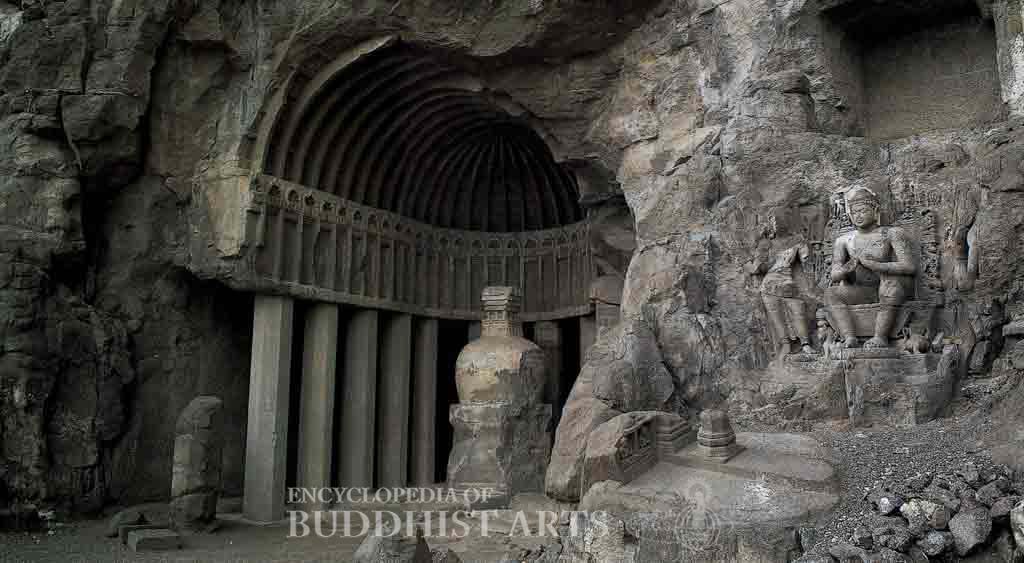
Aurangabad Caves: Cave 4

Aurangabad Caves: Cave 9
Aurangabad Caves
INDIA, Maharashtra, Aurangabad
These caves are located 4 km north of Aurangabad. The 12 caves are cut into a hill in an east–west direction and are divided into three groups. Caves 1 to 5, the west group, are separated from the central group, Caves 6 to 9, by a 500 m distance. Caves 10 to 12, the east group, is 1 km from the central group. All of the caves were created between the 3rd and 7th centuries. Cave 4 is the only caitya hall and is the oldest of the caves, built in the 3rd century. The rest of the caves are vihara caves, most of them built in the late 5th century.
Cave 4 has a rectangular layout and a vaulted ceiling. Seventeen plain octagonal columns form a corridor around the hall, and a stupa is located at the rear. The original columns have long been destroyed, though some remnants of the imitation wood beams remain on the ceiling, displaying simple embellishments. Most of the columns have been restored.
The largest vihara cave of the west group is Cave 3. It is composed of a portico, main hall, antechamber, and shrine. There are cells on both ends of the portico and within the main hall. The main Buddha is housed in the shrine. In contrast, in some of the other vihara caves, the Buddha figure is not found within the shrine but on an altar surrounded by a circumambulatory path inside the main hall. This type of layout can be seen in Caves 6 and 7.
The most significant caves of the east group are Caves 6, 7, and 9. Among these, the sculptural works of Cave 7 are the most famous. On each side of the exterior wall of the entrance is a standing Bodhisattva in high relief. On the left is Avalokitesvara Bodhisattva Rescuing People from the Eight Dangers. Relief images of Tara flank the entrance to the shrine and a relief depicting a group of musicians is found on the left wall within the shrine. In Cave 6, the Buddha altar is centered within the hall and an ambulatory path is formed around it. Both ends of the portico and the left, right, and back walls of the hall contain cells. The two cells on the back wall each enshrines a Buddha statue. Cave 9 houses a massive reclining Buddha and a Four-Armed Avalokitesvara.
For more details, go to the Encyclopedia of Buddhist Arts: Caves A-E, page 88.
Cite this article:
author = Hsingyun and Youheng and Johnson, Peter and Mankuang and Huntington, Susan and Edson, Gary and Neather, Robert,
booktitle = {Encyclopedia of Buddhist Arts: Caves A-E},
pages = 88,
title = {{Aurangabad Caves}},
volume = 5,
year = {2016}}