
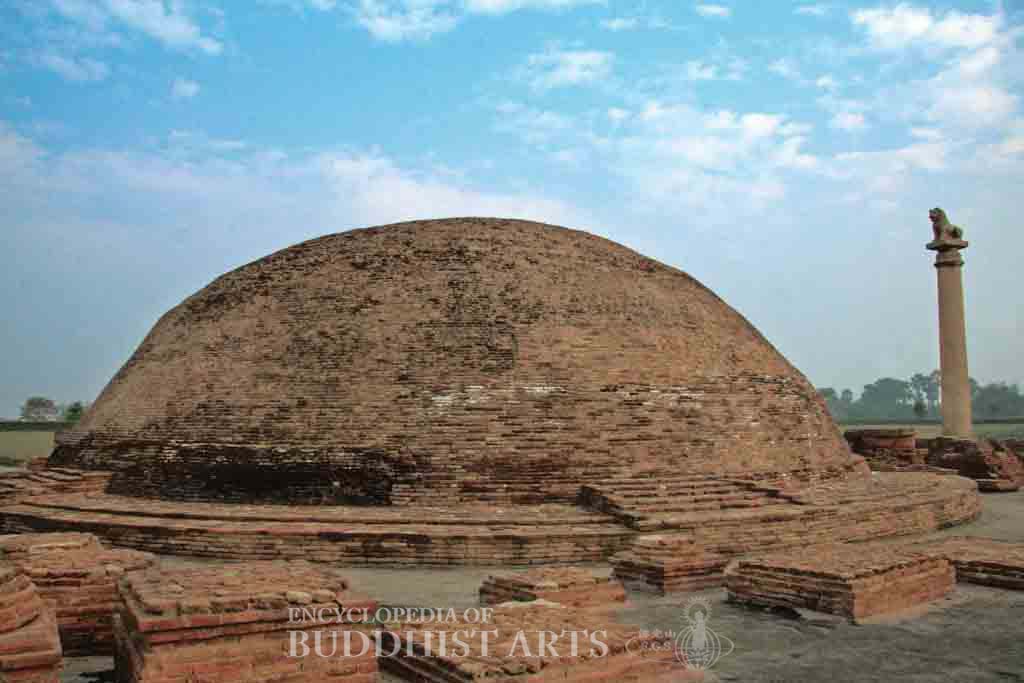
Vaishali: Ananda Stupa and Asoka Pillar
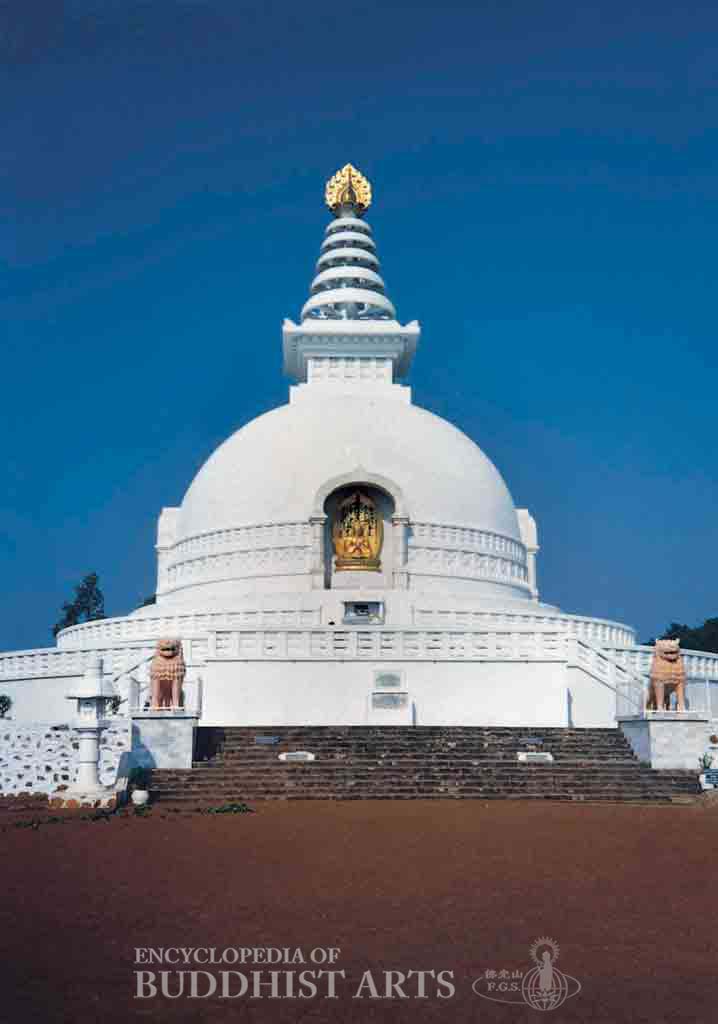
Vaishali: Vishwa Shanti Stupa

Vaishali: Asoka Pillar
Vaishali
INDIA, Bihar
Vaishali is situated in the present village of Basrah in the Vaishali District of Bihar. It was one of the six major cities in ancient India and was the capital of the Licchavi republic. According to the Dirgha Agama, it was a large and prosperous city during the time of the Buddha, who visited here on many occasions to teach the Dharma. The Buddha frequently stayed at the Kutagarasala Vihara here. After the Buddha’s parinirvana, his relics were distributed among eight kingdoms and the Licchavis erected a large stupa to house their share. King Asoka (reigned circa 269–232 BCE) erected a pillar and a stupa here in the 3rd century BCE. When Chinese Master Faxian visited Vaishali in the 5th century, he recorded seeing stupas in memory of the Buddha and Ananda. In the 7th century, when Chinese Master Xuanzang visited, the area was in ruins. He saw the stupa built by the Licchavis, the Asoka stupa and stone pillar, and a tank dug by monkeys for the Buddha. Hardly anything is known of the history of Vaishali after the 7th century until the site was identified by British archaeologist Alexander Cunningham in 1861.
A historical park known as Kolhua Complex encompasses the ruins of the Buddhist sites at Vaishali. The complex covers a large area and includes the Relic Stupa, Ananda Stupa, Asoka Pillar, Monkey’s Tank, and Kutagarasala Vihara. It can be inferred from the remains of the base platform of the Relic Stupa that the diameter of the original rammed earth stupa was 7.6 m. It was enlarged four times with bricks and had a final diameter of around 12.2 m. In the 1950s the remains of the Relic Stupa were excavated by Indian archaeologist Anant Sadashiv Altekar. He found a stone casket containing relics of the Buddha now kept in the Patna Museum.
The Ananda Stupa is an inverted alms bowl shaped stupa built by King Asoka. The Asoka Pillar located next to the stupa was built around 242 BCE by King Asoka to mark the last place where the Buddha taught in public. It is one of the best preserved Asoka Pillars discovered to date. The part of the pillar above ground level is over 12 m high and tapers significantly from the base to the top. It weighs 50 t and is carved from sandstone. The body of the pillar is perfectly round and highly polished. The capital of the pillar is a beautifully shaped inverted lotus with a crouching lion at the top. The lion faces northwest, towards Kushinagar, where the Buddha entered parinirvana.
The Monkey’s Tank is located next to the Asoka Pillar. When Buddha traveled to Vaishali to teach the Dharma, a monkey took his alms bowl up a tree to collect honey to offer to the Buddha. The monkeys even dug a tank for the Buddha, hence its name. The ruins of Kutagarasala Vihara can be seen here. Besides the archaeological remains, there is also the modern Vishwa Shanti Stupa and the Archaeological Museum in Vaishali.
For more details, go to the Encyclopedia of Buddhist Arts: Architecture T-Z, page 1164.
Cite this article:
author = Hsingyun and Youheng and Johnson, Peter and Mankuang and Lancaster, Lewis,
booktitle = {Encyclopedia of Buddhist Arts: Architecture T-Z},
pages = 1164,
title = {{Vaishali}},
volume = 4,
year = {2016}}