
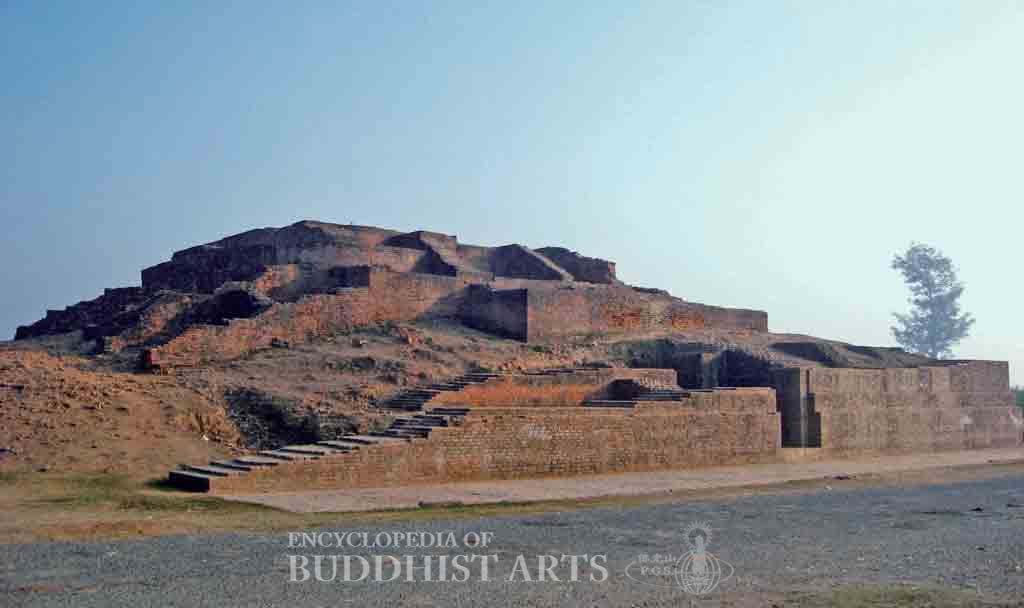
Pakki Kuti
Pakki Kuti
INDIA, Uttar Pradesh, Sravasti
Pakki Kuti is also known as Angulimalya Stupa, and was built to mark the site where Angulimalya met the Buddha, attained enlightenment, entered nirvana, and was cremated. It was identified as the stupa of Angulimalya by Chinese pilgrims Master Faxian and Master Xuanzang when they traveled to India in the 5th and 7th centuries. It is said to have been built by King Prasenajit of Kosala during the time of the Buddha. The stupa was renovated and enlarged a number of times during different periods, the earliest of which may be the Kushan period (circa 1st–3rd century). It was excavated in 1863 along with other Sarvasti ruins.
The stupa consists of a large mound covered with red bricks. It appears to be a terraced stupa built on a rectangular plan with raised platforms accessible by flights of steps. There is a hole that goes all the way from the top to the bottom of the stupa, and an iron railing has been installed so that people can view the inner parts of the stupa.
Angulimalya, the son of an official of the Kosala Kingdom, was a devoted student of Manibhadra. After his wife accused Angulimalya of being disrespectful, Manibhadra ordered him to kill 1,000 people and to cut off a finger from each person. Manibhadra said that on completion of the task Angulimalya would learn the way to enlightenment. Since Angulimalya trusted his teacher completely, he went on a killing spree and made a necklace from the fingers. After he had killed 999 people, he set off to kill his mother to complete the task. When the Buddha learned about this, he went to liberate him. After listening to the Buddha’s teaching, Angulimalya repented his wrongdoings and became a disciple of the Buddha. He eventually attained enlightenment and became an Arhat. According to Buddhist sutras, after a Buddha, a Bodhisattva, a Pratyekabuddha, an Arhat, or a cakravartin has entered nirvana, a stupa should be built to commemorate them.
For more details, go to the Encyclopedia of Buddhist Arts: Architecture M-S, page 806.
Cite this article:
author = Hsingyun and Youheng and Johnson, Peter and Mankuang and Lancaster, Lewis,
booktitle = {Encyclopedia of Buddhist Arts: Architecture M-S},
pages = 806,
title = {{Pakki Kuti}},
volume = 3,
year = {2016}}