
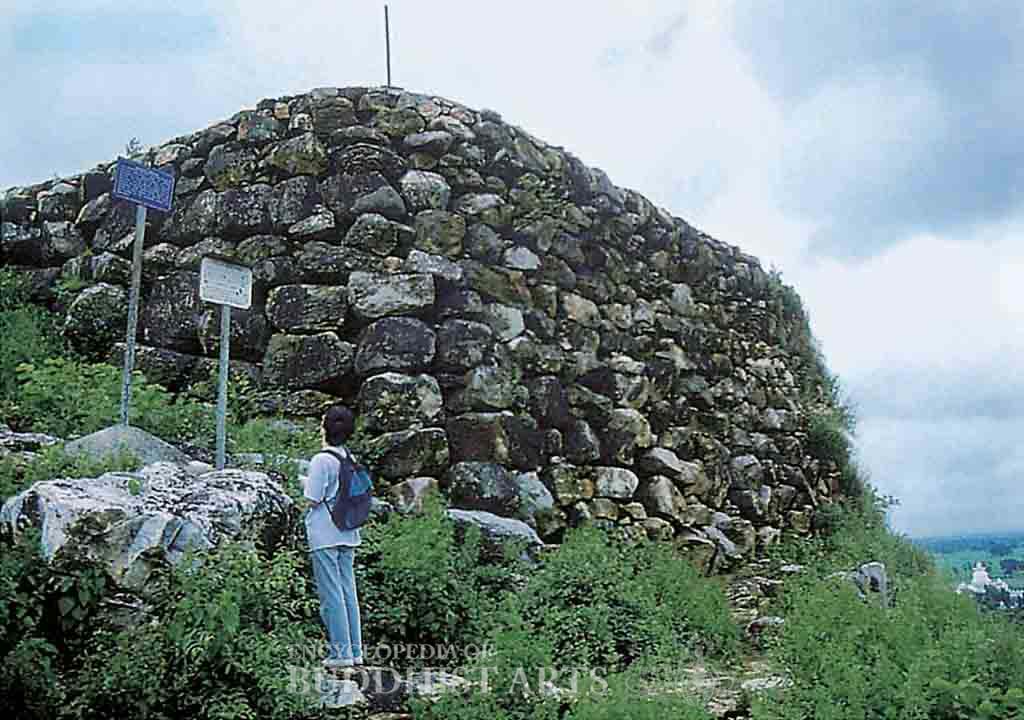
Pippala Stone House
Pippala Stone House
INDIA, Bihar, Rajgir
Pippala is the given name of Mahakasyapa, disciple of Sakyamuni Buddha. Also called Pippala Cave, it is located at the foot of Vaibhava Hill, a short distance from Venuvana Monastery. This stone-built house is believed to be the site where Mahakasyapa practiced. British archaeologist John Marshall excavated the site between 1905 and 1906 and identified the location.
The house was built by piling up stones on a rock. It is 26 m long, 25 m wide, and 7 m high. According to John Marshall, the stone house was originally used as a watchtower and later became a cell in which ascetics could meditate.
According to Samyukta Agama, the Buddha once visited Mahakasyapa when he was sick and taught him the Seven Factors of Enlightenment. After listening to the Buddha’s teaching, Mahakasyapa recovered from his illness. This stone house is believed to be the location of this event.
For more details, go to the Encyclopedia of Buddhist Arts: Architecture M-S, page 827.
Cite this article:
author = Hsingyun and Youheng and Johnson, Peter and Mankuang and Lancaster, Lewis,
booktitle = {Encyclopedia of Buddhist Arts: Architecture M-S},
pages = 827,
title = {{Pippala Stone House}},
volume = 3,
year = {2016}}