
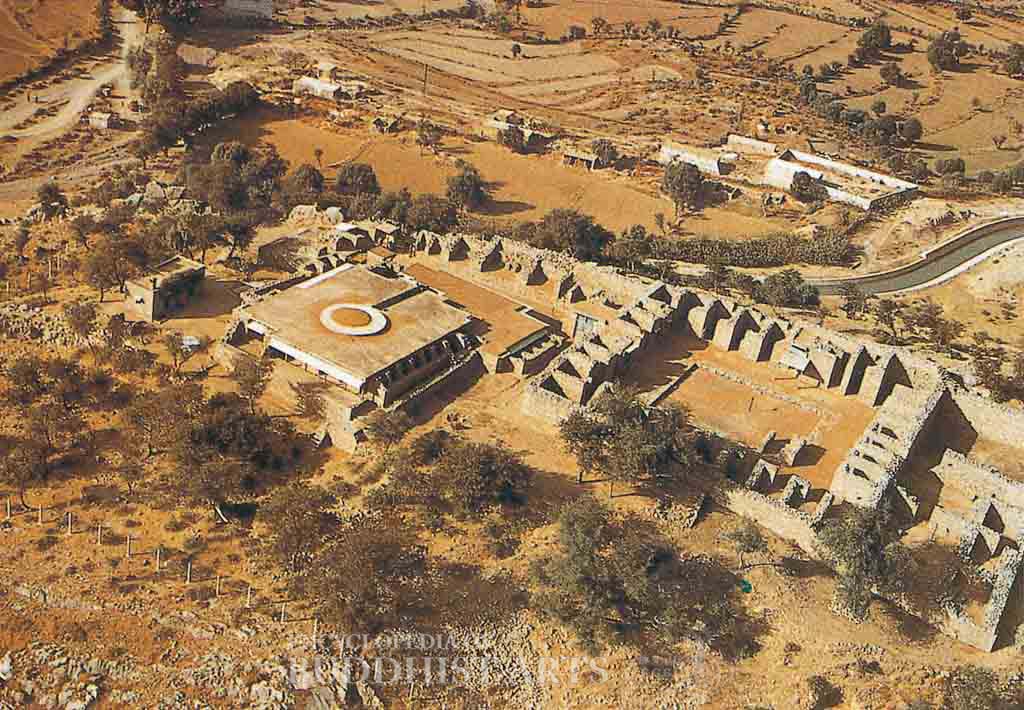
Taxila (aerial view)
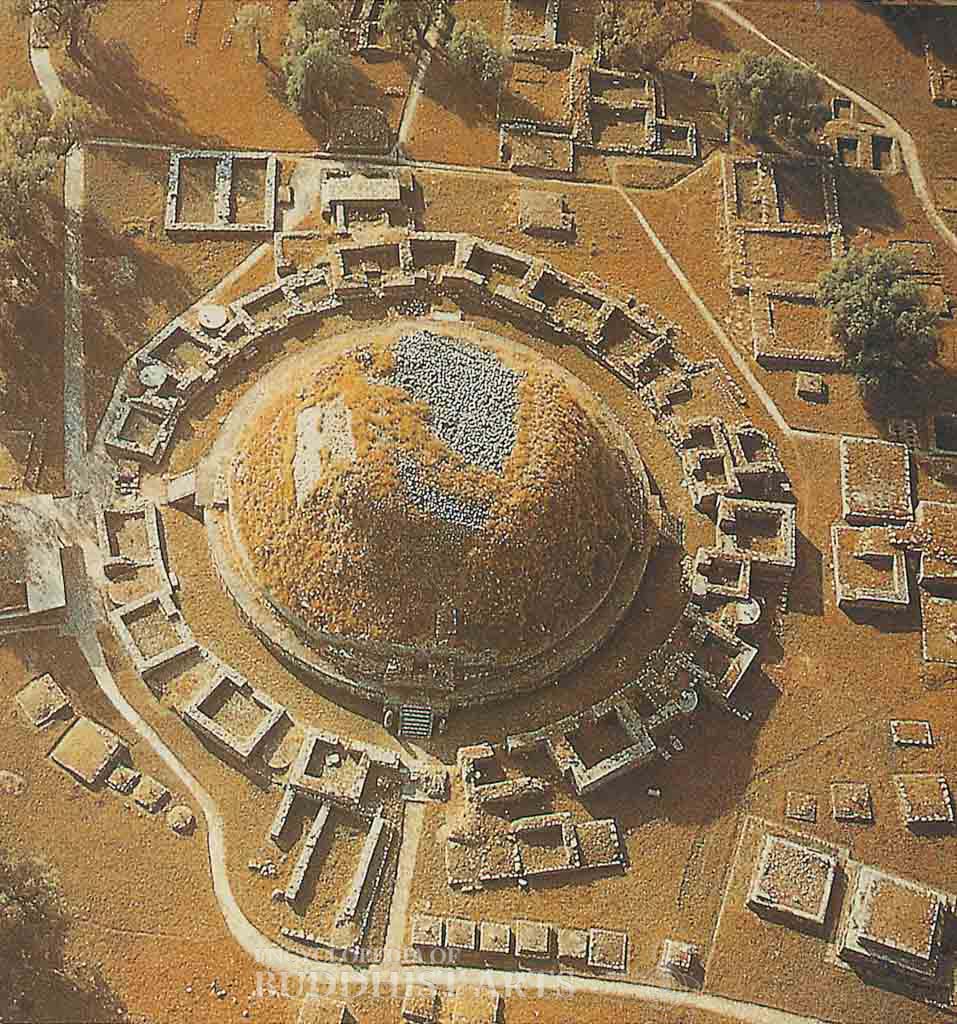
Taxila: Dharmarajika Stupa (aerial view)
Taxila
PAKISTAN, Punjab
Taxila is located about 35 km northwest of Rawalpindi. It was possibly the capital of the kingdom of Gandhara. It is thought that Buddhism may have been brought here during the Maurya period (circa 321–185 BCE). Between the 3rd and 2nd centuries BCE Buddhism flourished in Taxila under successive rulers: the Greco-Bactrians, the Scythians, the Parthians, and the Kushans. In about 230, the Persian Sassanid dynasty (circa 224–651) occupied this area and Buddhist practices were interrupted for some time. At the end of the 4th century the Kushans took over the territory and revived Buddhism. In the 5th century the Hephthalites invaded, destroying Buddhist temples. In the 7th century, when Xuanzang visited, the city was in ruins. From 1913 to 1934, British archaeologist John Marshall excavated the ruins. Taxila was listed as a UNESCO World Heritage Site in 1980.
The ruins include the sites of three ancient cities: Bhir was built between the 4th and 2nd centuries BCE and was an important city during the Maurya period; Sirkap was built by the Greco-Bactrians as a strategic city between the 2nd and 1st centuries BCE; Sirsukh was the capital of the Kushan Empire (circa 1st–3rd century). There is little remaining of Bhir. Around the cities of Sirkap and Sirsukh there are historic remains from different religions but most of them are Buddhist. In addition to these three ancient cities, there are the Dharmarajika Stupa, the Kunala Stupa, the temples at Kalawan, Mohra Moradu, Pipala, and Jaulian, as well as temples and stupas at Giri and Bhamala. There are also many ruins of temples and stupas which have not yet been excavated.
The buildings and artifacts resulting from these excavations show the interaction and development of various cultures from the Indus River basin, Central Asia, Persia, and Greece. The onsite Taxila Museum has a large number of Buddhist sculptures and artifacts, which represent a valuable resource for research into these cultural exchanges.
For more details, go to the Encyclopedia of Buddhist Arts: Architecture T-Z, page 1096.
Cite this article:
author = Hsingyun and Youheng and Johnson, Peter and Mankuang and Lancaster, Lewis,
booktitle = {Encyclopedia of Buddhist Arts: Architecture T-Z},
pages = 1096,
title = {{Taxila}},
volume = 4,
year = {2016}}