
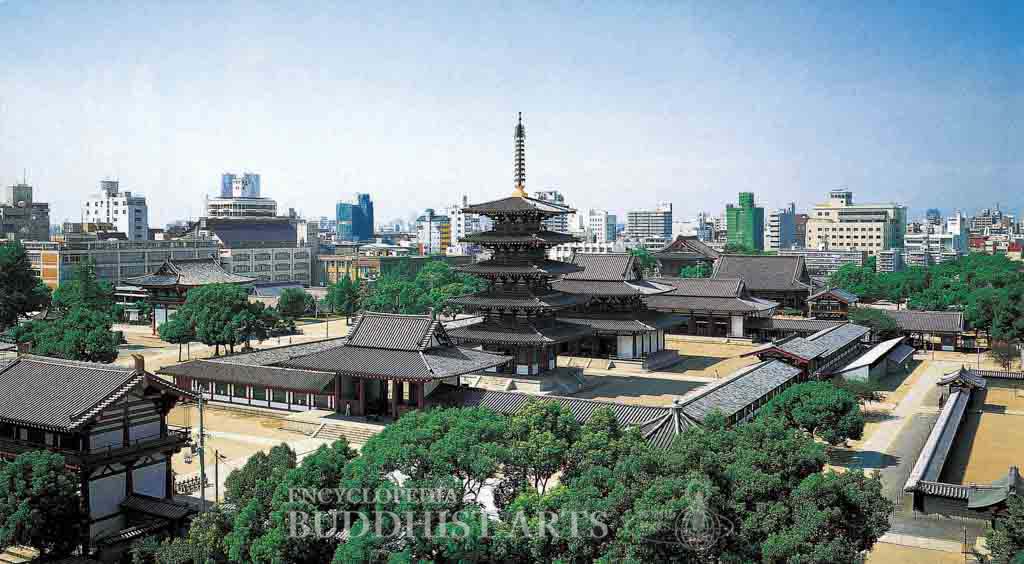
Shitennoji Temple
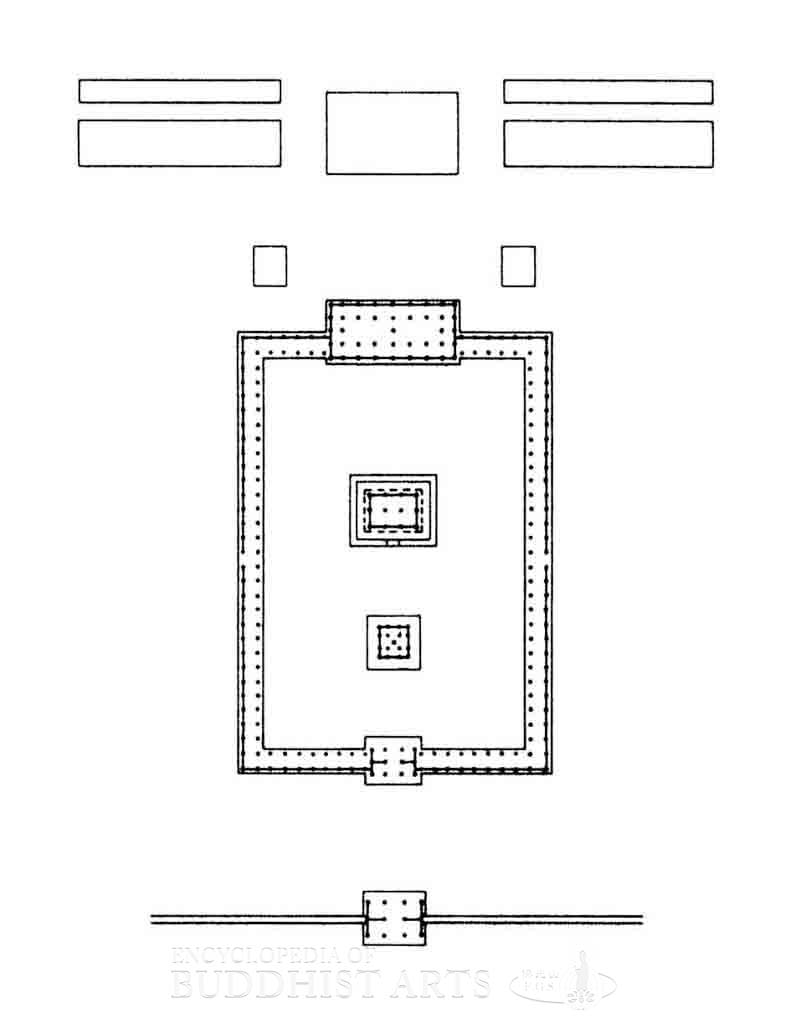
Shitennoji Temple (site layout)
Shitennoji Temple
JAPAN, Osaka
Also known as Arahakaji Temple, Nanbaji temple, or Mitsuji Temple, Shitennoji, which means Temple of the Four Heavenly Kings, is the oldest governmental Buddhist temple in Japan. It was founded by Prince Shotoku to pray for victory in warfare. Construction started in 593 during the Asuka period, and was completed in the middle of the 7th century. The temple was destroyed by lightning in 836 during the Heian period, and has since undergone numerous reconstructions. The current buildings, built in 1963 during the Showa period, retains the grandeur of the original temple.
The temple faces south and along the central axis, the principal buildings are the middle gate, five-story pagoda, Golden Hall, and lecture hall, surrounded by a covered walkway. Other buildings within the temple include the Six Period Hall, Ganzandaishido Hall, abbot’s quarters, and Five Lights of Wisdom Hall, all of which were constructed during the Edo period (1615–1868) and listed as Important Cultural Properties in 1954.
The Golden Hall was built in 1963 in reinforced concrete. It has a hip-and-gable roof, red columns, and vermilion bracket sets, which provide a contrast with the white walls. The hall was originally built to enshrine the Four Heavenly Kings. However, Avalokitesvara Bodhisattva was later enshrined as the main statue and the statues of the Four Heavenly Kings were placed in the four corners. The seven-by-five bay Six Period Hall is named after the idea of praising during the six periods. It houses a statue of the Medicine Buddha. The temple is a major pilgrimage site for Pure Land Buddhists. The temple houses National Treasures such as the Origins of Shitennoji Temple and the Fan-Shaped Booklets of the Lotus Sutra.
For more details, go to the Encyclopedia of Buddhist Arts: Architecture M-S, page 1001.
Cite this article:
author = Hsingyun and Youheng and Johnson, Peter and Mankuang and Lancaster, Lewis,
booktitle = {Encyclopedia of Buddhist Arts: Architecture M-S},
pages = 1001,
title = {{Shitennoji Temple}},
volume = 3,
year = {2016}}