
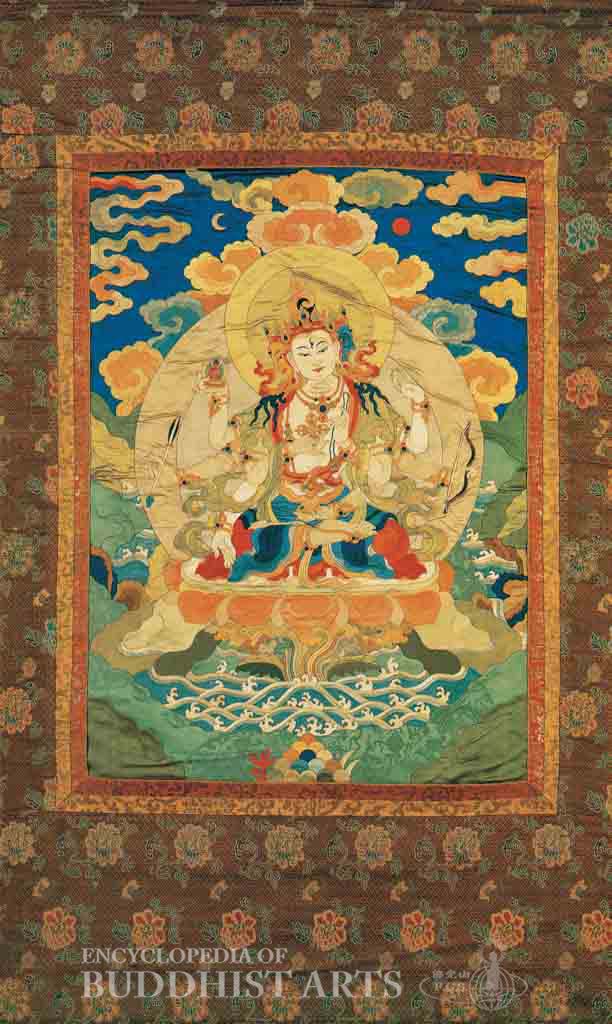
Embroidery of Usnisavijaya
Silk
Embroidery of Usnisavijaya
CHINA; Qing dynasty
This embroidery was created during the Qing dynasty and is kept in the collection of the Palace Museum in Beijing.
Usnisavijaya is one of the three Longevity Buddhas in Tibetan Buddhism. The dignified and compassionate expression signifies the end of all calamities. The image has three faces, each with three eyes and eight arms. The yellow face on the right of the main head radiates joy in the blessings and benefits of life. The blue face on the left exemplifies wrath and the subjugation of evil. In three of the four right hands, there is an image of Amitabha Buddha, an arrow, and a double vajra. The lowest right hand performs the abhaya (fearlessness) mudra, and the upper left hand performs the varada (wish-granting) mudra; the remaining hands on the left hold a bow, a vajra lasso, and a vase. Usnisavijaya sits on a lotus throne in a lake with rippling waves. Auspicious clouds float in the blue sky with the sun on one side and the moon on the other. Multiple pieces of silk were sewn together using different techniques to form the image. More than 30 colors were used throughout the entire piece.
For more details, go to the Encyclopedia of Buddhist Arts: Artifacts, page 83.
Cite this article:
author = Hsingyun and Youheng and Youji and Pokorski, Stefanie and Mankuang and Fan, Wen,
booktitle = {Encyclopedia of Buddhist Arts: Artifacts },
pages = 83,
title = {{Embroidery of Usnisavijaya}},
volume = 18,
year = {2016}}