
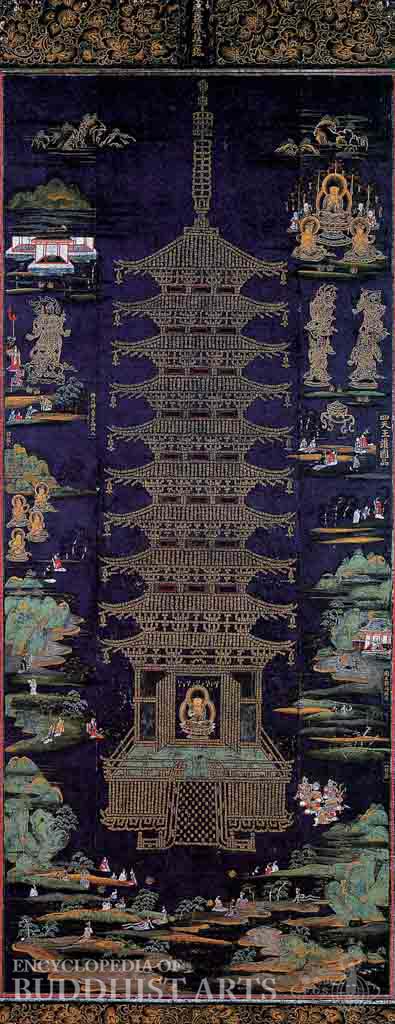
Chusonji Temple: Golden Light Sutra Pagodas - Section 6
Gold and color on indigo paper
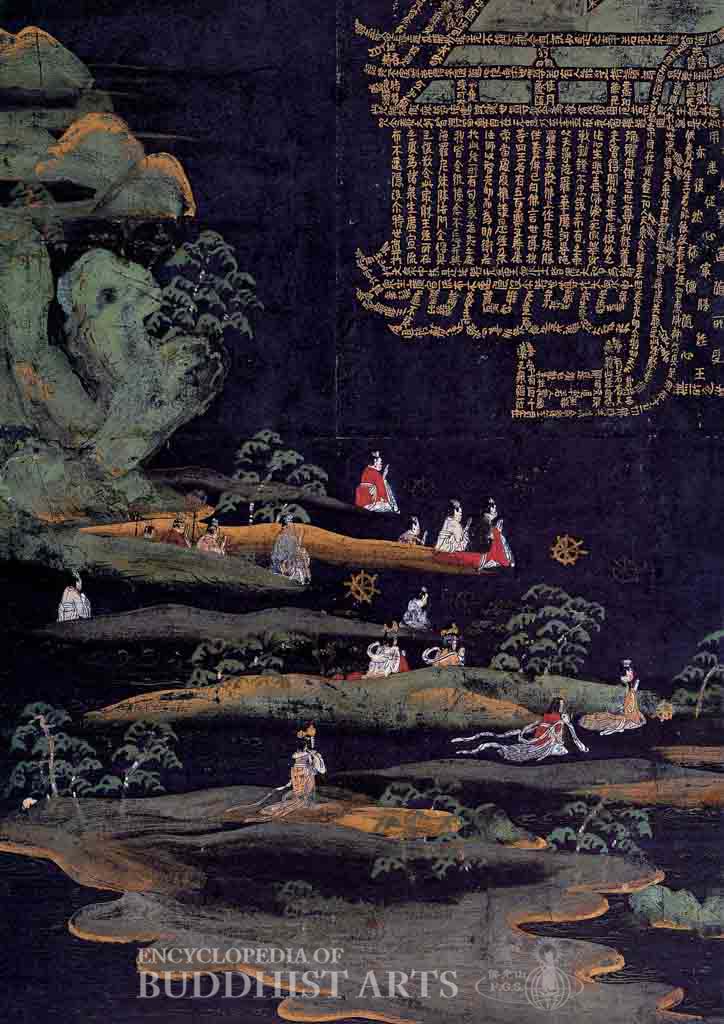
Chusonji Temple: Golden Light Sutra Pagodas - Section 6 (detail)
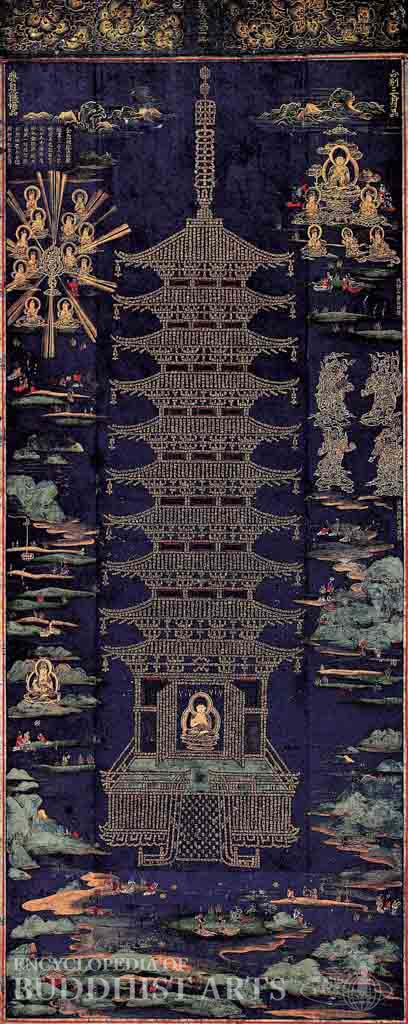
Chusonji Temple: Golden Light Sutra Pagodas - Section 2
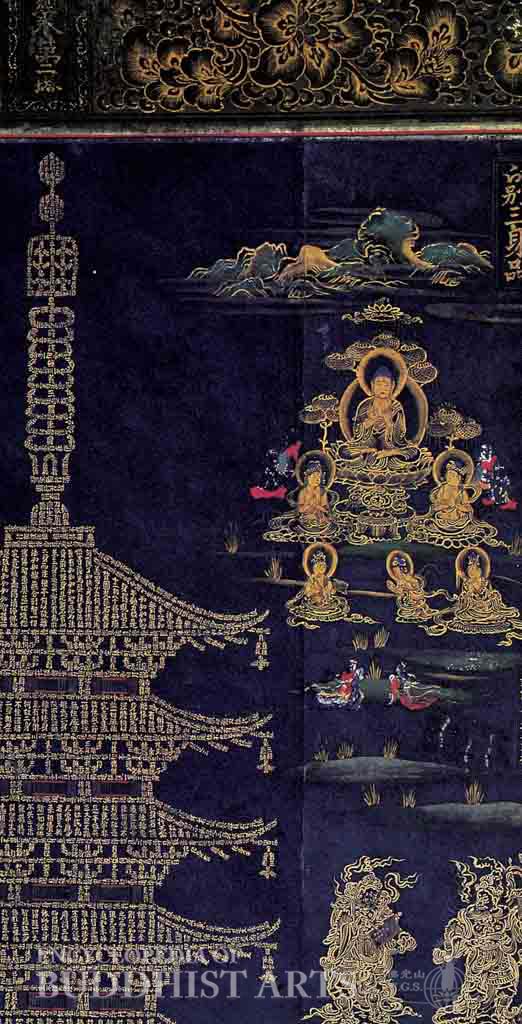
Chusonji Temple: Golden Light Sutra Pagodas - Section 2 (detail)
Chusonji Temple: Golden Light Sutra Pagodas
JAPAN, Iwate, Nishiiwai; Heian period
In this set of ten paintings, each of the ten sections of the Golden Light Sutra are transcribed in tiny gold Chinese characters carefully arranged into the shape of a pagoda. The paintings were produced during the 12th century, and were framed into panels during the Edo period (1615–1868). The Golden Light Sutra, together with the Lotus Sutra and the Benevolent King Sutra, are known as the Three Guardian Sutras of the Nation. It is said that when these three sutras are recited, a country is protected by the Four Heavenly Kings and its residents will enjoy peace and prosperity. The paintings are currently divided between the Daichojuin Hall at Chusonji Temple, the Tokyo National Museum, Nara National Museum, and Sendai City Museum. In 2001, the set was listed as a National Treasure.
Each section of the sutra begins from the stacked rings of the spire at the ninth level of the pagodas and runs downward through each level to the base. The characters are meticulously arranged to depict detailed architectural structures such as the roof, bracket sets, wind chimes, balustrades, and stairways. At the base of the pagodas, there is a gold image of seated Sakyamuni Buddha forming the vitarka (teaching) mudra.
On the left and right at the top of the paintings, there are depictions of Vulture Peak. Below on the right, Sakyamuni Buddha is shown seated in full lotus position on a lotus throne, accompanied by Bodhisattvas and disciples. Surrounding the pagoda are images of Bodhisattvas, the Four Heavenly Kings, and devotees, differing in each painting according to the content of that section of the sutra. Landscapes, clouds, and small figures are painted in the lower register. The border at the top and bottom of each painting is decorated with floral patterns. The title and the section number of the sutra is inscribed in the center of the upper border.
Green, blue, and white are used to color the landscapes. The gold paint used for the characters stands out against the indigo-dyed background. Empty spaces add depth to the paintings and emphasize the importance of the central pagoda. The scenery is painted in typical late Heian period style. These unique paintings represent a creative, symbolic, and aesthetically pleasing way of depicting a Buddhist sutra.
For more details, go to the Encyclopedia of Buddhist Arts: Painting A-H, page 157.
Cite this article:
author = Hsingyun and Youheng and Youlu and Wilson, Graham and Manho and Mankuang and Huntington, Susan,
booktitle = {Encyclopedia of Buddhist Arts: Painting A-H},
pages = 157,
title = {{Chusonji Temple: Golden Light Sutra Pagodas}},
volume = 14,
year = {2016}}