
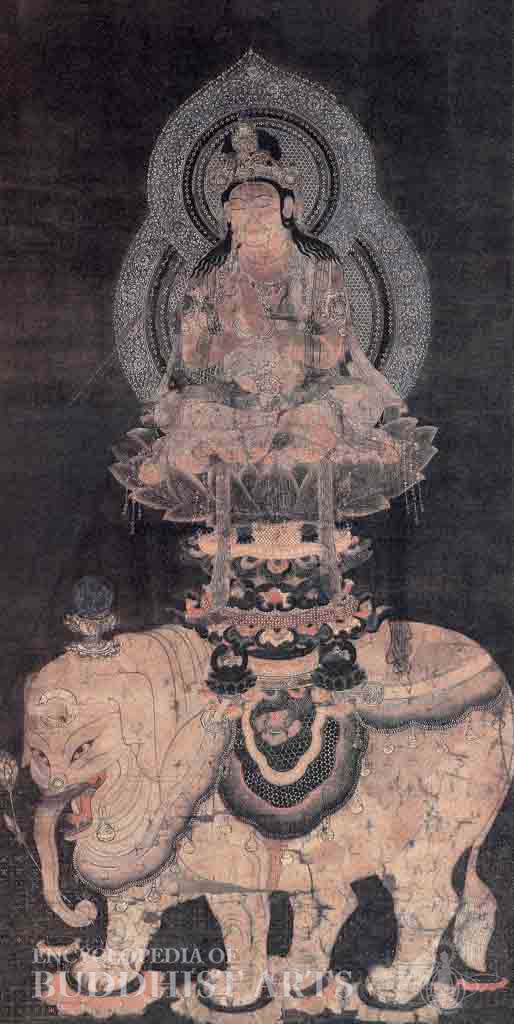
Bujoji Temple: Samantabhadra Bodhisattva
Ink and color on silk
Bujoji Temple: Samantabhadra Bodhisattva
JAPAN, Tottori, Yazu; Heian period
This 12th century painting, listed as a National Treasure in 1952, is deemed to be one of the two outstanding Buddhist artworks of late Heian period. The other painting is Samantabhadra Bodhisattva kept in the Tokyo National Museum. Samantabhadra is depicted with joined palms, sitting in full lotus position on a lotus throne carried by a white elephant. The Bodhisattva is adorned with jewelry and has dark hair tresses that hang down to the shoulders. The exquisite nimbus and aureole are decorated with multiple layers of tortoiseshell, diamond, chrysanthemum flower, and scroll leaf patterns. The elephant appears to walk on lotuses and a bejeweled pearl rests on its head.
For more details, go to the Encyclopedia of Buddhist Arts: Painting A-H, page 133.
Cite this article:
author = Hsingyun and Youheng and Youlu and Wilson, Graham and Manho and Mankuang and Huntington, Susan,
booktitle = {Encyclopedia of Buddhist Arts: Painting A-H},
pages = 133,
title = {{Bujoji Temple: Samantabhadra Bodhisattva}},
volume = 14,
year = {2016}}