
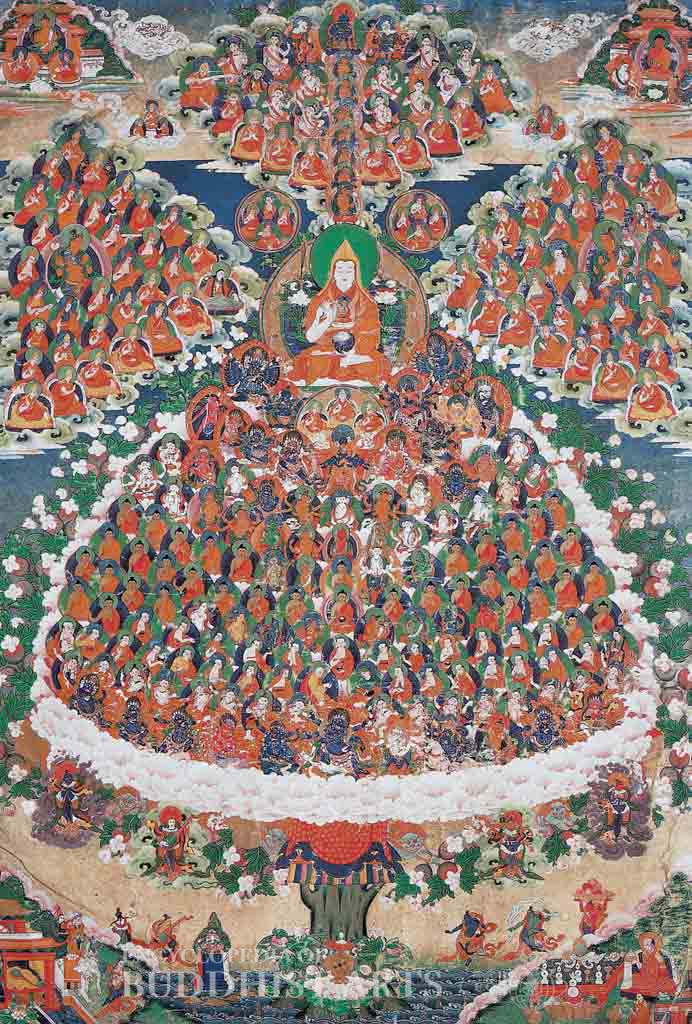
Gelug Lineage Tree
Ink and color on cotton
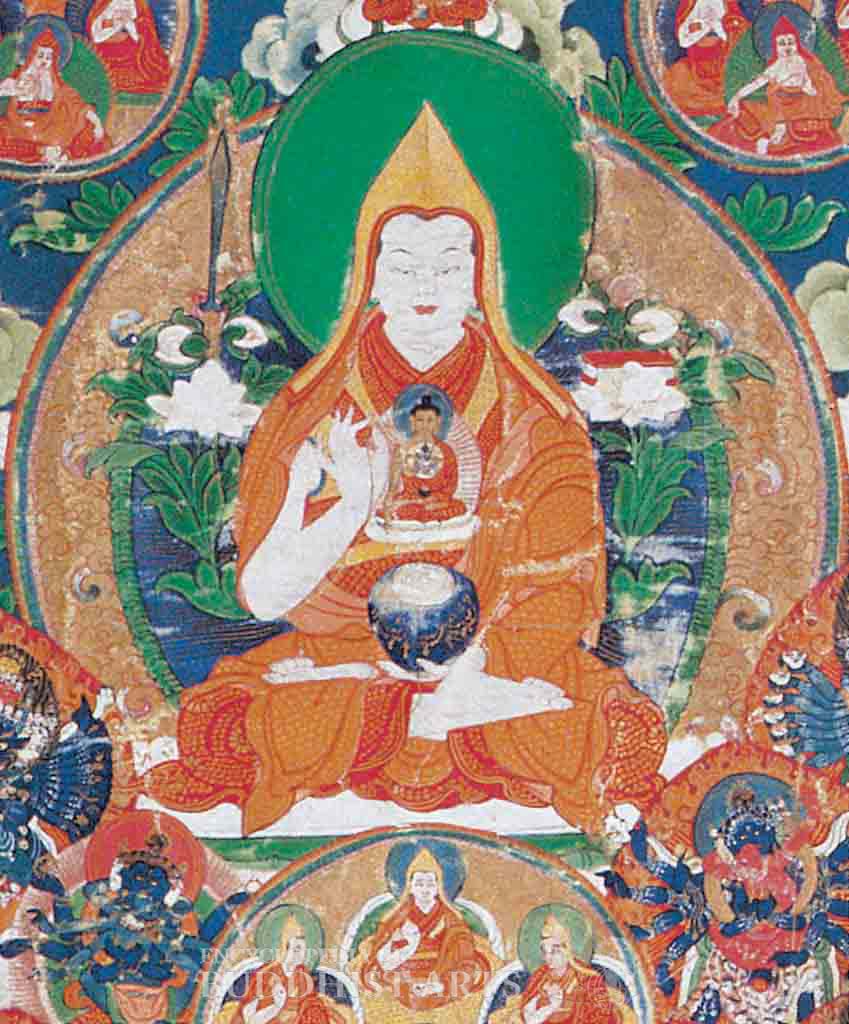
Gelug Lineage Tree - Tsongkhapa
Gelug Lineage Tree
CHINA; Qing dynasty
A lineage tree, also known as a “refuge tree” or “field of accumulation” (“tsok shing” in Tibetan) is a genealogical chart of lineage masters, Buddhas, Bodhisattvas, yidams, and a root guru used in visualization practices in Tibetan Buddhism since the 18th century. The root guru is usually featured in the center of such illustrations.
This thangka from 18th to 19th century features Tsongkhapa, the root guru of the Gelug school. Wearing an orange robe and hood, and seated in full lotus position at the top of the lineage tree, Tsongkhapa has an image of Sakyamuni Buddha on his chest, within which is an even smaller Buddha. Tsongkhapa’s right hand is raised in the vitarka (teaching) mudra. With his left hand on his lap, he holds an alms bowl containing nectar. At both of his sides are lotuses supporting the sword of wisdom and a sutra; these are attributes of Manjusri Bodhisattva, of whom Tsongkhapa is considered a manifestation.
Above Tsongkhapa are lineage masters headed by Vajradhara. In the upper corners of the thangka, there are two Buddhas within heavenly palaces. Beside Tsongkhapa, there are images of the Madhyamaka masters, headed by Manjusri Bodhisattva and Nagarjuna, as well as the Yogacara masters, headed by Maitreya Bodhisattva and Asanga.
Beneath the central image of Tsongkhapa, he is depicted again, accompanied by two disciples, at the top of an assembly of Buddhas, Bodhisattvas, Wisdom Kings, yidams, Dharma protectors, dakinis, and Arhats that rest within a healthy, blossoming tree growing from the sea of the universe. The Four Heavenly Kings guard the trunk of the tree, and beside them there are monks, apsaras, and donors.
For more details, go to the Encyclopedia of Buddhist Arts: Painting A-H, page 278.
Cite this article:
author = Hsingyun and Youheng and Youlu and Wilson, Graham and Manho and Mankuang and Huntington, Susan,
booktitle = {Encyclopedia of Buddhist Arts: Painting A-H},
pages = 278,
title = {{Gelug Lineage Tree}},
volume = 14,
year = {2016}}