
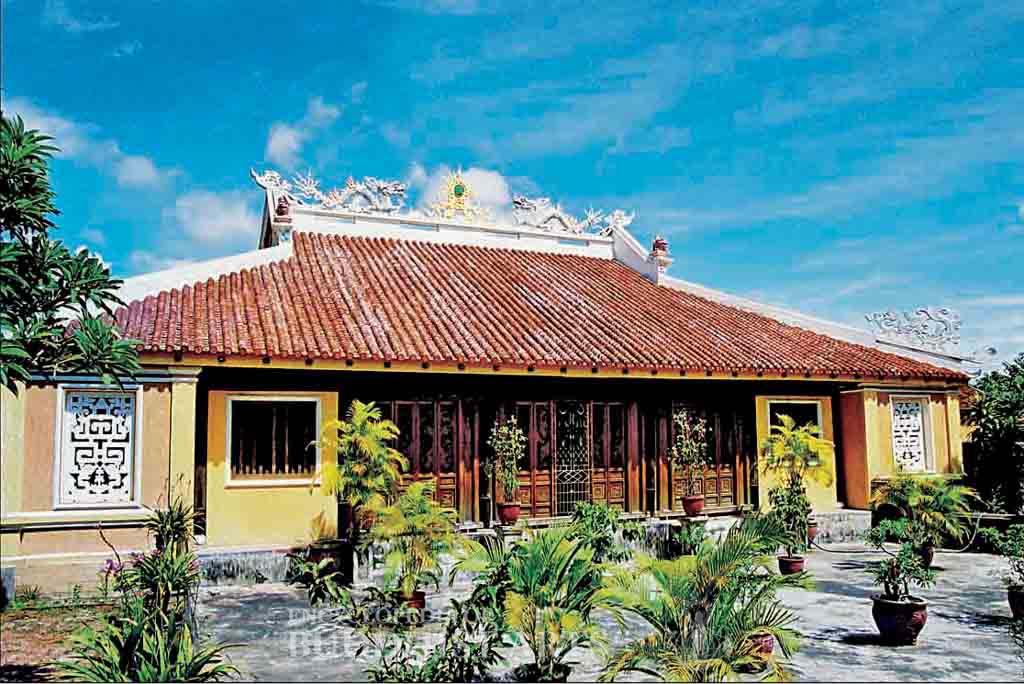
Thap Thap Di Da Temple
Thap Thap Di Da Temple
VIETNAM, Binh Dinh, An Nhon
Thap Thap Di Da means Ten Stupas and Amitabha Buddha. It was given this name because it was built near ten Champa stupas. The temple was founded by a Chinese monk Nguyen Thieu in 1665 during the Later Le dynasty and was rebuilt in 1749. It is listed as a National Cultural Heritage Site.
The principal buildings include the main hall, the eastern and western halls, the abbot’s quarters, and the funerary stupas of patriarchs. The layout of the temple is rectangular with a central courtyard. The main hall has a width of 30 m and a depth of 20 m. The roof ridge is decorated with a pair of dragons and a gem. A statue of Sakyamuni Buddha is enshrined within the hall, along with the Eighteen Arhats on one side and the Ten Kings of Hell on the other. It also contains a stele bestowed by Emperor Duc Tong (reigned 1847–1883) of the Nguyen dynasty in 1876.
For more details, go to the Encyclopedia of Buddhist Arts: Architecture T-Z, page 1108.
Cite this article:
author = Hsingyun and Youheng and Johnson, Peter and Mankuang and Lancaster, Lewis,
booktitle = {Encyclopedia of Buddhist Arts: Architecture T-Z},
pages = 1108,
title = {{Thap Thap Di Da Temple}},
volume = 4,
year = {2016}}