
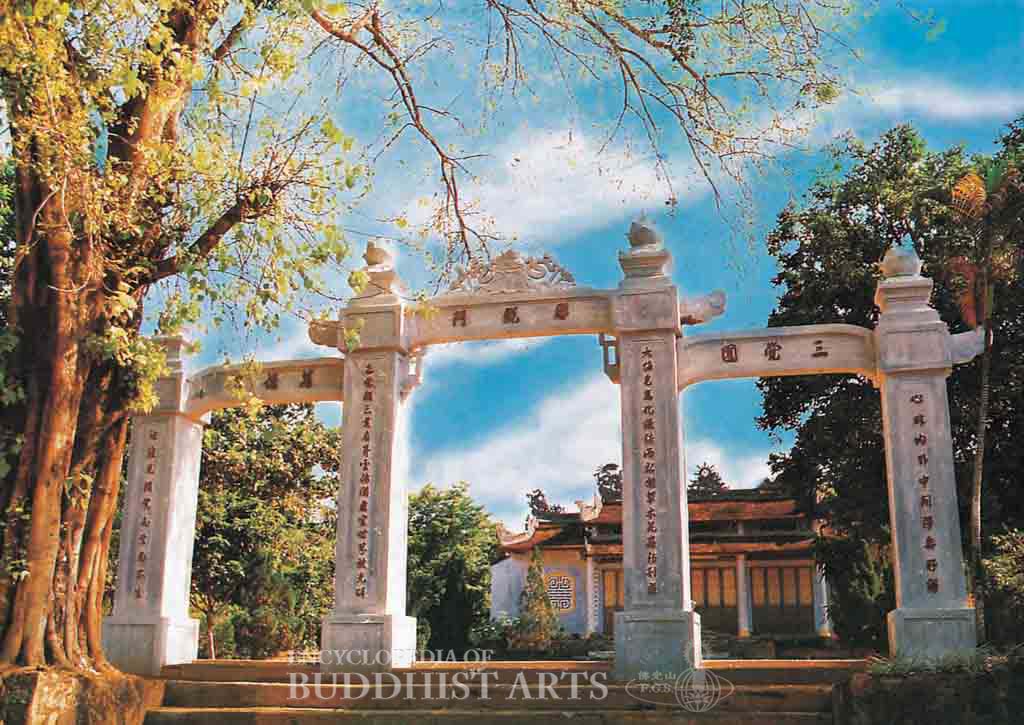
Thien Tong Temple: Main Gate
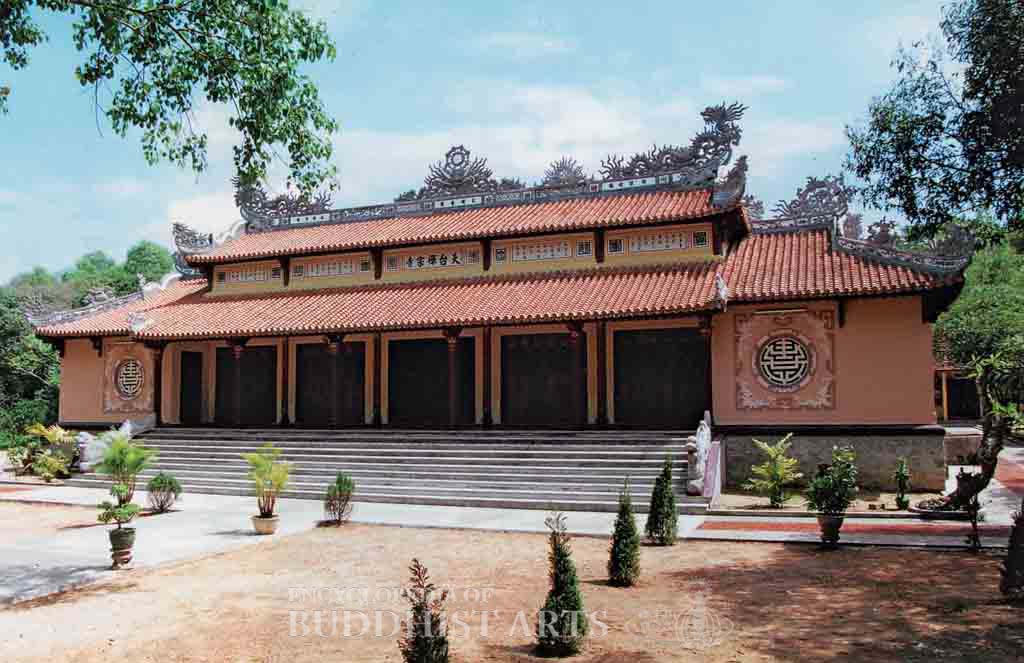
Thien Tong Temple: Main Hall
Thien Tong Temple
VIETNAM, Thua Thien-Hue, Hue
Thien Tong means the Chan School. Located on the slope of Thien Thai Mountain, it is Hue’s largest Chan Buddhist temple and is the ancestral temple of the Lieu Quan lineage of the Vietnamese Chan school. The temple was established during the 18th century by the monk Lieu Quan. It was restored in 1746 by the abbot Te Hiep and has been rebuilt several times since then. It was severely damaged in 1937 but was restored to its original appearance by monk Thich Giac Nhien in 1940.
The main structures include the main gate, the main hall, the Lieu Quan Patriarch Stupa, and the Giac Nhien Funerary Stupa. The temple gate has four columns inscribed with couplets and adorned with carvings of lotus flowers on the capitals. The architrave of the middle section has the words “Gate of Liberation” in Chinese characters. The main hall has a double-eave hip-and-gable roof with a Dharma wheel and dragons on the main ridge. Within the hall there are numerous Buddha statues and the columns are inscribed with couplets. The Giac Nhien funerary stupa is in typical Hue architectural style.
For more details, go to the Encyclopedia of Buddhist Arts: Architecture T-Z, page 1111.
Cite this article:
author = Hsingyun and Youheng and Johnson, Peter and Mankuang and Lancaster, Lewis,
booktitle = {Encyclopedia of Buddhist Arts: Architecture T-Z},
pages = 1111,
title = {{Thien Tong Temple}},
volume = 4,
year = {2016}}