
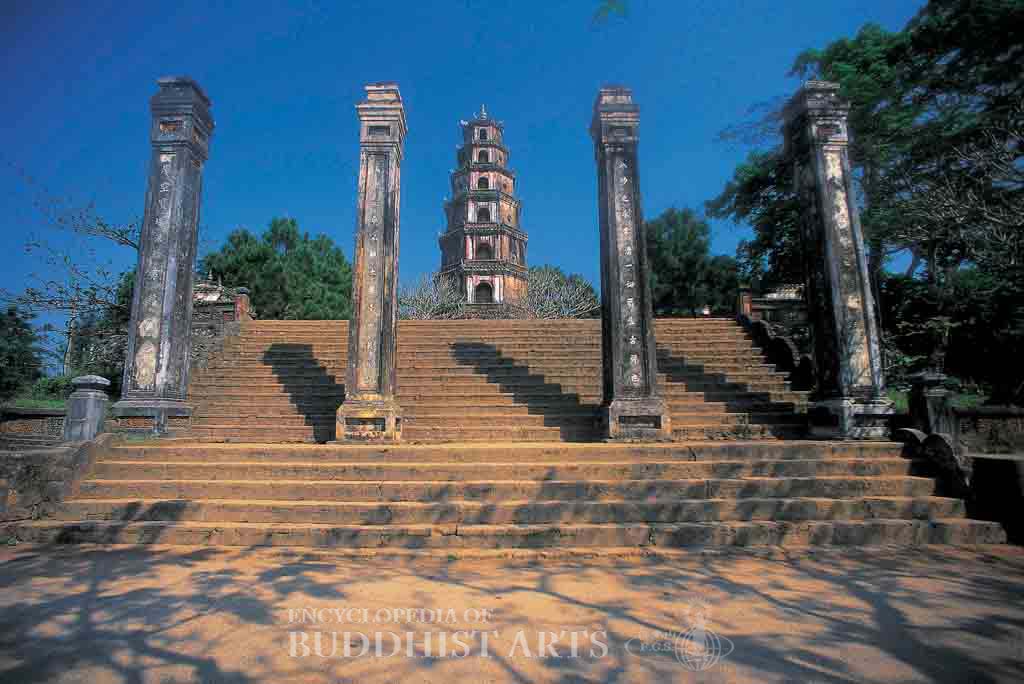
Thien Mu Temple
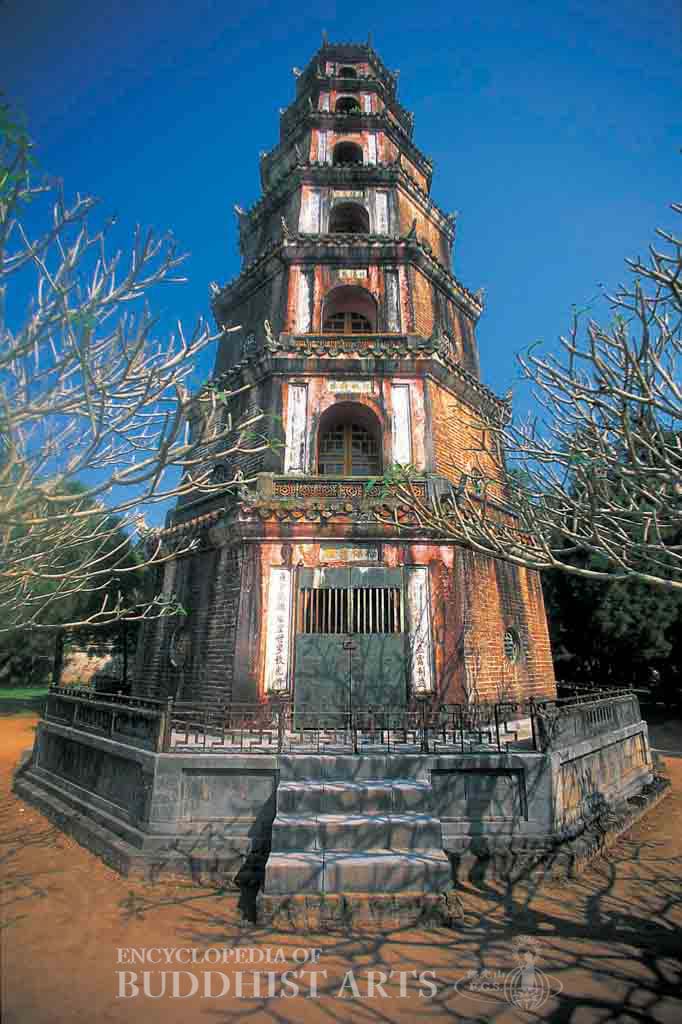
Thien Mu Temple: Phuoc Duyen Pagoda
Thien Mu Temple
VIETNAM, Thua Thien-Hue, Hue
Thien Mu means Heavenly Lady. It was named after an elderly lady who prophesized that the building of a Buddhist temple in that area would bring prosperity to the country. Built in 1601, the temple has been repaired many times. It is the National Temple of Vietnam, with its abbots appointed by the court. In 1844 the Phuoc Duyen Pagoda was built with royal patronage. As part of the Complex of Hue Monuments, it was listed as a UNESCO World Heritage Site in 1993.
The buildings in the temple are laid out along a central axis: the main hall, Ksitigarbha Hall, and Avalokitesvara Hall. In addition, there are the stupa of Thich Don Hau, the bell tower, and a stele room, as well as the Phuoc Duyen Pagoda in front of the temple.
The seven-story octagonal brick Phuoc Duyen Pagoda is 21 m high. On every level there is an arched door. There are Buddha statues on each story. The octagonal bell tower contains a bell cast in 1710 that weighs 2 t. The temple houses other Buddhist artifacts, such as colored molded statues of Dharma protectors and an old bronze gong.
For more details, go to the Encyclopedia of Buddhist Arts: Architecture T-Z, page 1110.
Cite this article:
author = Hsingyun and Youheng and Johnson, Peter and Mankuang and Lancaster, Lewis,
booktitle = {Encyclopedia of Buddhist Arts: Architecture T-Z},
pages = 1110,
title = {{Thien Mu Temple}},
volume = 4,
year = {2016}}