
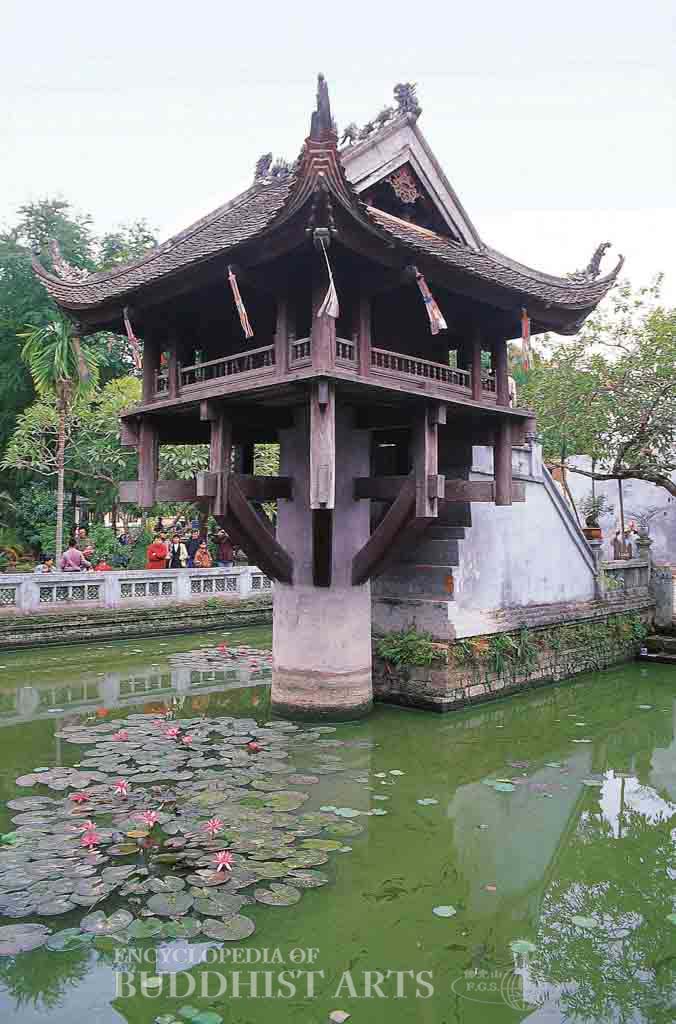
Dien Huu Temple
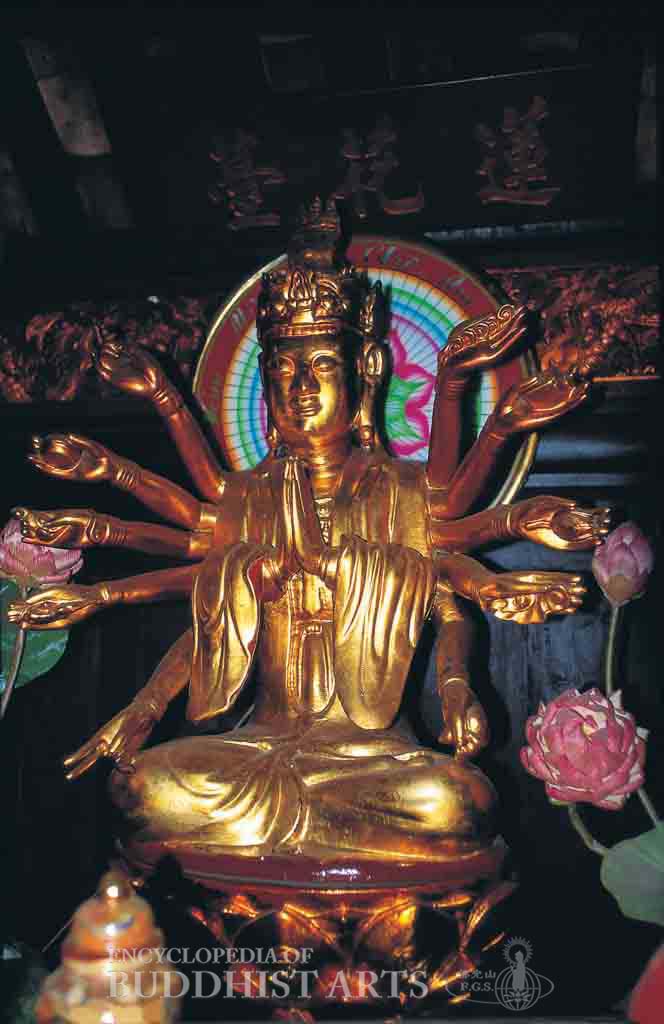
Dien Huu Temple: Eight-Armed Avalokitesvara
Dien Huu Temple
VIETNAM, Hanoi
It is also known as Mot Cot (One Pillar) Temple. It was built in 1049 and is one of the oldest wooden structures in Vietnam. According to historical records, King Li Thai Tong (reigned 1028–1053) dreamed of Avalokitesvara Bodhisattva sitting on a lotus throne, guiding him to ascend his own lotus throne. At the suggestion of the monk Thien Tue, the king erected a single stone pillar surmounted by a lotus throne at the center of a lotus pond, representing the one he saw in his dream. The temple is recognized as a National Cultural Heritage Site.
The temple contains a blossoming lotus flower sitting on top of a circular stone pillar that is 4 m high and 1.3 m in diameter. The single-story temple’s hip-and-gable roof, with upturned corners, is decorated with dragon carvings. The heavy columns and beams in the temple are connected by wooden bracket sets. It houses an Eight-Armed Avalokitesvara statue cast in bronze. This statue is popular among devotees who wish to have children, as it is said that such wishes are often granted.
For more details, go to the Encyclopedia of Buddhist Arts: Architecture A-F, page 239.
Cite this article:
author = Hsingyun and Youheng and Johnson, Peter and Mankuang and Lancaster, Lewis,
booktitle = {Encyclopedia of Buddhist Arts: Architecture A-F},
pages = 239,
title = {{Dien Huu Temple}},
volume = 1,
year = {2016}}