
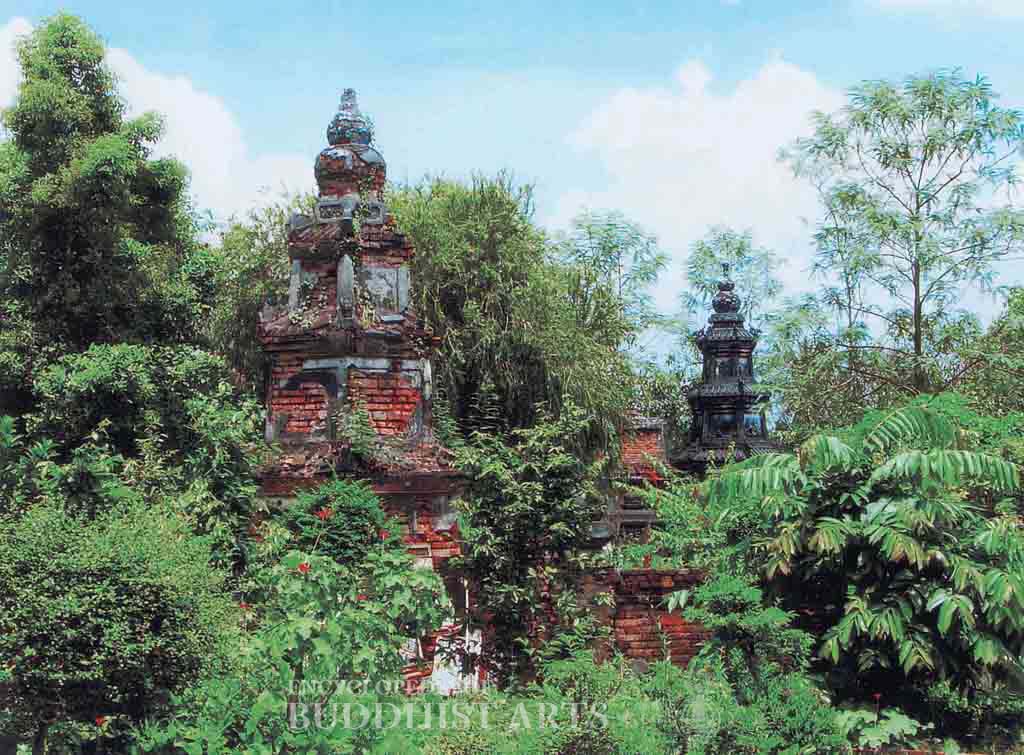
Hoi Tho Temple Patriarch Stupas
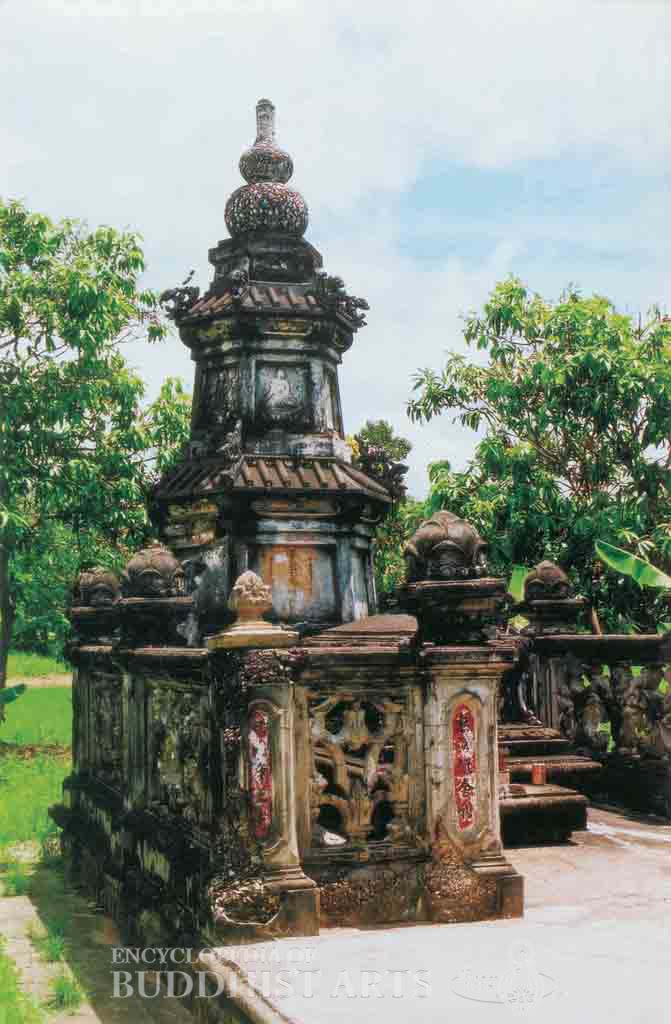
Hoi Tho Temple Patriarch Stupas: Stupa of Patriarch Thieu Long
Hoi Tho Temple Patriarch Stupas
VIETNAM, Tien Giang, Cai Be
Hoi Tho Temple houses the stupas of patriarchs Minh Giac and Thieu Long. In 1859, when the French attacked and conquered Gia Dinh (present day Ho Chi Minh City), the monk Minh Giac and his disciple Thieu Long followed a group of plantation workers and arrived at this temple. They rebuilt the temple and renamed it Hoi Tho. In 1945, when the French army invaded Vietnam again, the monastics and devotees burned down the temple for fear that it would be occupied and used for military purposes by the enemy. The present day temple is the result of reconstruction in 1982. These two Patriarch Stupas, as well as some Buddhist statues and Dharma instruments, remain from the original temple.
The hexagonal brick Thieu Long Stupa stands on a multi-corner base and has three stories. There are ridge decorations on each level. There is an inscription and reliefs in shallow niches on the body of the stupa. The base of the spire is hexagonal and the spire itself is in the shape of gourd. The stupa is surrounded on four sides by a balustrade with an opening at the front. The newel posts are in the shape of lotuses. The Minh Giac Stupa is not in such good condition and the external decorations and eaves are deteriorating.
For more details, go to the Encyclopedia of Buddhist Arts: Architecture G-L, page 444.
Cite this article:
author = Hsingyun and Youheng and Johnson, Peter and Mankuang and Lancaster, Lewis,
booktitle = {Encyclopedia of Buddhist Arts: Architecture G-L},
pages = 444,
title = {{Hoi Tho Temple Patriarch Stupas}},
volume = 2,
year = {2016}}